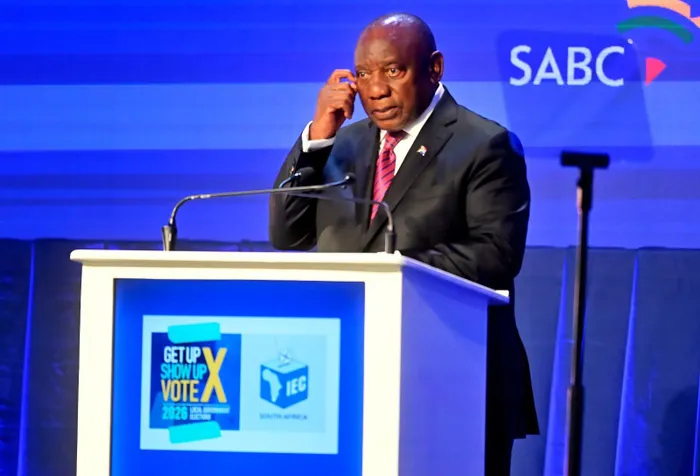
President Cyril Ramaphosa speaks at the announcement of the final results of the 2026 Local Government Elections at the National Results Operations Centre, Gallagher Convention Centre in Midrand.
President Cyril Ramaphosa has told the soon-to-be-appointed councillors to put service delivery ahead of political power struggles, warning that voters expect results, not political infighting, and communities cannot afford to have essential services sacrificed for the sake of power struggles.
Addressing the election results announcement at the Electoral Commission’s operations centre in Midrand on Sunday, Ramaphosa said the elections had demonstrated the strength of South Africa's multi-party democracy, with more than 540 political parties and nearly 137,000 candidates participating.
But beyond the political competition, he said, the real test of the elections would be whether those elected could improve the daily lives of ordinary South Africans.
Ramaphosa acknowledged that the country was facing serious social and economic pressures, with households battling the rising cost of living, unemployment continuing to affect millions, particularly young people, and municipal services falling short of what communities should expect.
He said residents wanted functioning municipalities where water flowed from taps, electricity supplies remained reliable, refuse was collected, public infrastructure was maintained and neighbourhoods were safe.
“These are not unreasonable expectations. They are the basic requirements of a life of dignity,” he said.
Expectations high, frustrations deep
Ramaphosa stressed that voters had made their political choices freely, placing their confidence in established parties, newer political formations and independent candidates.
However, he said every elected representative would ultimately be judged by the same measure: their ability to deliver on their commitments.
He also warned that the responsibility facing incoming councillors extended far beyond securing positions in council chambers.
They would become the public face of government in communities where expectations were high and frustrations often deep, making it essential that they listened to residents, addressed their concerns and acted with honesty and integrity.
The President's message comes as municipalities face the prospect of coalition arrangements where no single political party has secured an outright majority.
He urged political parties to approach negotiations with maturity and humility, insisting that discussions about forming municipal governments must focus on serving communities rather than distributing positions, privileges and political power.
“This is not a weakness of democracy. It is an expression of the choices that the people have made,” he said.
Ramaphosa warned that municipal stability must not be undermined by narrow political interests and that essential service delivery should never become a bargaining tool in political negotiations.
He said voters had not gone to the polls to give elected representatives another five years of fighting among themselves.
Instead, they expected functioning councils, capable administrations and leadership that could rise above political differences.
He called on political leaders to ensure that councils were constituted without unnecessary delays, office-bearers were elected through good-faith negotiations and municipal budgets were passed on time.
The President also reminded councillors that winning an election did not guarantee continued public confidence.
Being sworn into office, he said, was only the beginning.
Representatives would have to earn residents' trust throughout their terms by demonstrating that public office was a responsibility rather than an opportunity for personal advancement.
With the elections concluded, Ramaphosa said the focus must now shift from political competition to the work of governing.