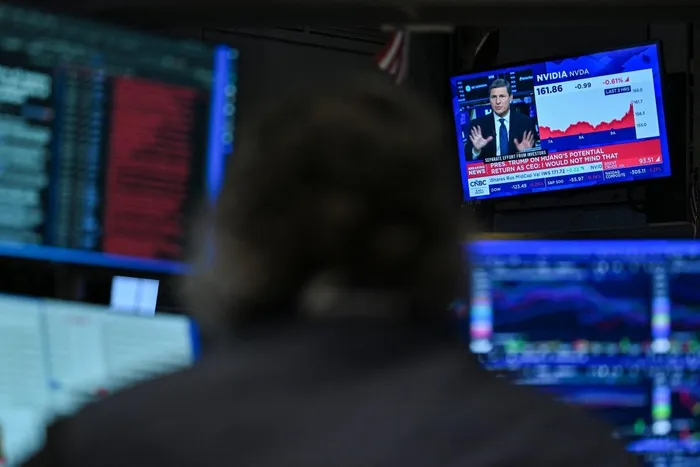
Following Jensen Huang's resignation and stricter U.S. export bans, Nvidia projects a record $130 billion quarter without Chinese data centre sales, signalling durable global AI infrastructure demand for investors. Picture: ANGELA WEISS / AFP
Nvidia has forecast a staggering $130 billion quarter without counting on a single dollar of Chinese data centre revenue, even as its chair closes the door on any return for co-founder Jensen Huang.
Nvidia Chair Harvey Jones confirmed the board does not intend to reinstate Huang as CEO, ending speculation about a comeback less than a week after his abrupt resignation amid reports of an affair with a businesswoman alleged to be a Chinese spy.
According to Nigel Green, CEO of deVere Group, one of the world’s largest independent financial advisory organisations, the results should give AI investors renewed confidence following one of the most turbulent weeks in the chipmaker's history.
“Nvidia has just been through one of the worst weeks in its history,” says Green. “It lost its founder in dramatic fashion, the board has now made clear he isn’t coming back, and it got hit with new US restrictions on China. Its answer is a forecast that beats everyone’s expectations, with China left out entirely.

Nvidia’s Fiscal Third Quarter Surge: AI Spending Drives Growth Amid Market Concentration and China Risks
“This is huge for investors. It shows AI spending is being driven by companies and governments that view the technology as essential, and they’re likely to keep spending big.”
Nvidia shares rose roughly 3% in extended trading on Tuesday after the company beat both revenue and profit estimates for its fiscal third quarter. Revenue reached $115.84 billion—surpassing the $109.10 billion consensus and more than doubling the $57 billion reported a year prior—while adjusted earnings per share hit $2.68 against forecasts of $2.48. For the current quarter, Nvidia is guiding to approximately $130 billion, representing roughly 90% growth and topping the $125.1 billion analyst consensus, while assuming zero data centre compute revenue from China.
The guidance comes days after the US Commerce Department moved to ban Chinese companies from renting Nvidia chips altogether.
While Nvidia dominates headlines, Green emphasises that the broader opportunity for investors lies across the entire AI supply chain.
“A chip on its own does nothing,” he notes. “It needs memory, networking equipment, massive amounts of electricity, cooling systems, the physical facilities to house it all, and the software to make it useful. Every one of those industries is riding the same surge in spending, and many are far less crowded than the major chip names.”
Green warns that the past week exposed heavy market concentration, noting that many investors hold substantial Nvidia exposure simply through index funds. He expects more investors to diversify across the wider AI ecosystem so they capture the upside without everything hinging on a single boardroom.
Still, China remains a long-term risk. Green points out that the rental ban could restrict Chinese firms accessing computing power via overseas cloud providers, while Beijing is likely to pour massive state funding into domestic chipmaking—much as it did to rapidly catch up in solar panels and electric vehicles.
“Governments now treat chips as national security, meaning policy will shape this market almost as much as demand,” Green concludes. “Nvidia is projecting rapid growth with China switched off and its founder gone for good. The AI build-out is set to run for years, and the gains will spread far beyond one chipmaker.”