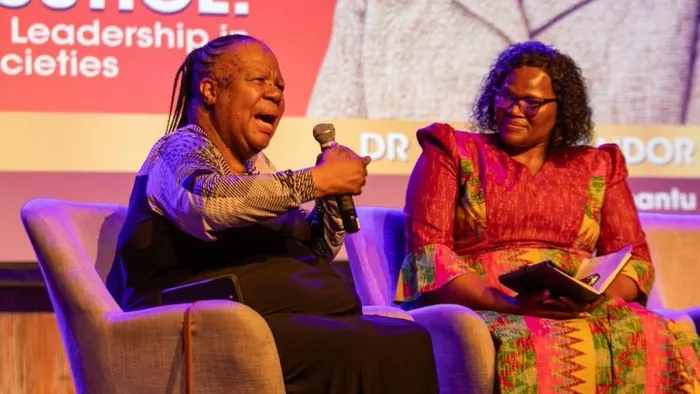
Former minister Naledi Pandor says communities cannot leave social transformation to politicians alone. At the Mandisa Monakali Annual Lecture, she called for stronger civil society and a renewed women's movement.
Former minister Dr Naledi Pandor has called for a revival of women's activism and stronger civil society organisations, warning that social transformation cannot be left to politicians and government alone.
Delivering the keynote address at the 2026 Mandisa Monakali Annual Lecture in Cape Town, Pandor urged communities to recognise their ability to influence decisions, defend their rights and shape a more inclusive society.
The lecture, hosted by Ilitha Labantu at the Homecoming Centre in District Six on Wednesday, November 25, formed part of the organisation's 2026 16 Days of Activism for No Violence Against Women and Children programme.
Held under the theme “Rethink Justice: The Role of Women's Leadership in Building Inclusive Societies”, the annual event brought together activists, civil society organisations and community members to reflect on women's leadership, social justice and collective action.
Pandor delivered the keynote address, with Dr Thozama Maduma serving as moderator.
The lecture honours the legacy of Ilitha Labantu founder, the late Dr Mandisa Monakali, whose work focused on advancing women's rights, social justice and community empowerment. It also paid tribute to the late Dr Phumzile Mlambo-Ngcuka for her contribution to gender equality and women's leadership.
Pandor reflected on the contributions of both women, highlighting how their influence extended beyond South Africa into the Southern African Development Community, the African continent and the international community.
She emphasised the importance of historical reflection in understanding present-day inequalities and the progress still needed to build a just society.
Pandor calls for stronger civil society and women's mobilisation
A key focus of Pandor's address was the need to revive and strengthen the non-governmental organisation (NGO) sector, which has historically played an important role in advancing democracy and defending human rights.
Drawing on Monakali's legacy, she highlighted the importance of organised civil society in ensuring communities have a voice in decisions affecting their lives.
“Social transformation cannot be left entirely in the hands of political leaders. Communities must recognise their own agency and understand that they have the power to influence decisions and shape the future they want,” Pandor said.
She also challenged excessive reliance on political parties and elected leaders, emphasising social agency, active citizenship and the responsibility of communities to shape their own futures.
Maduma highlighted the need to rebuild the women's movement through renewed mobilisation, solidarity and collective organisation.
“The women's movement must find its voice again. We cannot afford to take for granted the gains achieved through decades of activism. We need to organise, mobilise and ensure that women's rights remain firmly on the national agenda,” Maduma said.
Audience contributions raised concerns about declining levels of visible and organised activism compared with previous generations of women's rights advocates.
One participant questioned what had happened to the spirit of activism that characterised women such as Monakali.
“We need to ask ourselves where that level of activism has gone. We remember women who were prepared to stand up, organise communities and challenge injustice. We need to find ways of bringing that energy back, particularly among younger generations,” the participant said.
Another audience member highlighted the importance of ensuring communities receive practical support to address violence against women and children.
“We cannot simply tell communities to stand up against gender-based violence without giving them the resources and support to do so. Survivors need accessible support systems, while community organisations need the capacity to intervene and work with government to bring about meaningful change,” the participant said.
Ilitha Labantu calls for year-round action against GBV
Ilitha Labantu, established in Gugulethu in 1989, reiterated that addressing gender-based violence and femicide (GBVF) requires a 365-day approach rather than attention limited to awareness campaigns.
The organisation warned that despite South Africa's progressive legislation and policy frameworks, the country continues to experience alarmingly high levels of violence against women and children.
It also highlighted the gap between collecting evidence on GBVF and translating that information into effective interventions.
Ilitha Labantu called for stronger institutional accountability, effective implementation of existing legislation and adequately resourced community-based interventions.
The lecture concluded with a renewed call for collective responsibility, emphasising that building an inclusive society requires more than political commitments. Strong civil society organisations, active citizens and sustained community mobilisation remain essential to advancing justice and protecting the rights and dignity of women and children.