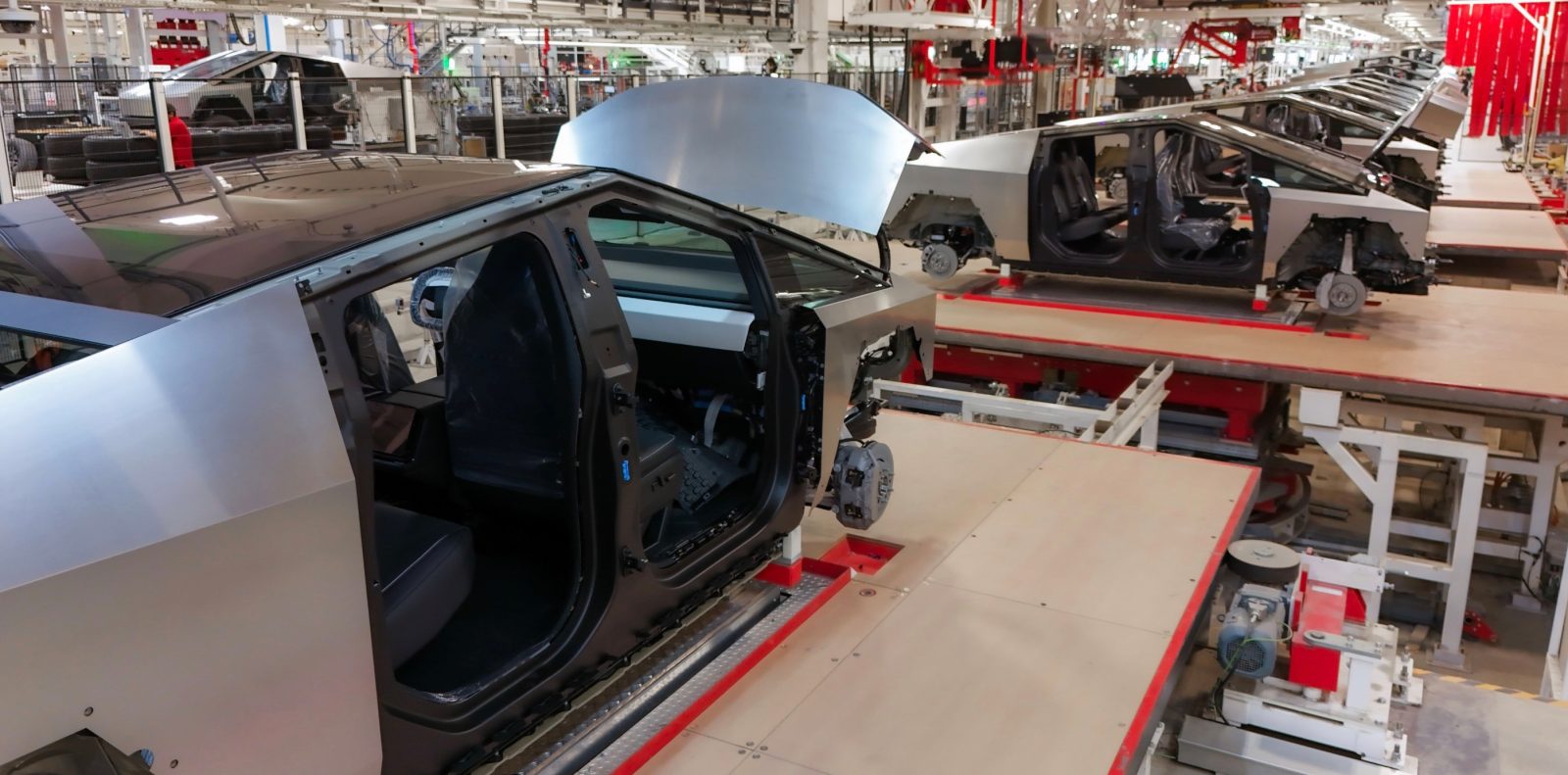
 Tesla Cybertruck production April 2024
Elon Musk now claims Cybertruck orders “far exceed” Tesla’s production rate, and that the truck isn’t being killed because it’s unprofitable. It’s his second explanation in three days for ending the pickup.
The problem is that Tesla’s own numbers say the opposite. The Cybertruck line has been running at roughly a quarter of its installed capacity, and Tesla spent all of 2026 discounting, re-trimming, and repricing the truck to find buyers.
“The Cybertruck order rate far exceeds our production rate. We will try to make as many as possible before shutting down the line in about 8 months, but will have to return deposits for a lot of people. This is not a case of Cybertruck being unprofitable, as has been misreported by legacy media, but rather that the opportunity cost of the complexity of Cybertruck is vastly outweighed by the value of incremental Cybercab production.”
The Cybertruck order rate far exceeds our production rate. We will try to make as many as possible before shutting down the line in about 8 months, but will have to return deposits for a lot of people.
— Elon Musk (@elonmusk) November 9, 2026
This is not a case of Cybertruck being unprofitable, as has been misreported… https://t.co/rGmNKV3ILs
The Cybertruck order rate far exceeds our production rate. We will try to make as many as possible before shutting down the line in about 8 months, but will have to return deposits for a lot of people.
This is not a case of Cybertruck being unprofitable, as has been misreported… https://t.co/rGmNKV3ILs
He was quote-tweeting a Tesla fan telling people to “get it while you can.” So yes, this is also a sales pitch.
On Friday, Musk announced Tesla would wind down Cybertruck production at Giga Texas around mid-2027 “to make room for increased Cybercab production.” That was the first story. Now it’s about “complexity” and “opportunity cost.” Let’s go through it.
“Order rate far exceeds our production rate”
Tesla controls its production rate. That’s the flaw in this claim.
Tesla built the Cybertruck supply chain for 250,000 units a year, and its latest shareholder letter still lists more than 125,000 units of installed capacity. In Q3 2026, it delivered 8,295 “Other Models.” With Model S and Model X out of production, we estimated 7,000 to 8,000 of those were Cybertrucks. That’s a 30,000-a-year pace, down 48% year-over-year in that category.
If orders had been outrunning production at any point this year, Tesla had about 95,000 units of idle annual capacity sitting right there. It didn’t use it.
And companies with a backlog don’t behave like Tesla did. In February, it offered a dual-motor Cybertruck at $59,990 for “only the next 10 days.” It pulled a single-motor RWD version after just 173 sales. It leaned on Musk’s own companies too: SpaceX bought 1,279 Cybertrucks in Q4 2025, about 19% of US registrations that quarter once you add his other firms.
Cox Automotive estimates US Cybertruck sales fell from 14,416 in Q3 2024 to 3,519 in Q1 2026 and 3,744 in Q2. It’s a demand problem everyone could see.
So if orders spiked this weekend, there’s an obvious reason: Musk told the world on Friday that the truck is going away. A last-call rush on a discontinued vehicle is not proof that it was selling.
“Will have to return deposits for a lot of people”
Tesla has been sitting on Cybertruck deposits it was never going to fill for years.
Musk touted more than a million reservations, and crowdsourced tallies put the list near 2 million by 2023. Its best US quarter, by Cox Automotive’s estimate, was 14,416 trucks. The reservation book was a vanity number, not an order book.
Two weeks ago, Tesla cancelled the Cybertruck for Australia and New Zealand and refunded deposits people had paid in 2019. Returning deposits is something Tesla was already doing because it couldn’t sell the truck in those markets, not because it was swamped.
“Not a case of Cybertruck being unprofitable”
This one is a straw man. Our reporting, and most of the coverage Friday, was about sales, not margins. The truck sells at about 12% of the volume Tesla planned for.
Tesla doesn’t disclose Cybertruck margins, so Musk can say whatever he wants here and nobody can check it. But he’s the one who said in 2023 that Tesla had “dug our own grave with Cybertruck” because of how hard it was to build profitably.
And look at what Tesla did the same day it announced the end of production: it raised Cybertruck prices by up to 10% and paused orders for the cheapest trim. The cheapest orderable Cybertruck went from $69,990 in early August to $92,490. You do that to squeeze margin out of the last trucks, not because the line was printing money.
The “opportunity cost” argument proves our point
Follow Musk’s logic to the end. If the Cybertruck were profitable and orders really outran production, killing it would mean walking away from guaranteed profit for a robotaxi that had 463 units registered in Texas as of late October and no proven business yet.
The only way that trade makes sense is if the Cybertruck’s profit at 30,000 units a year is small. Which is another way of saying it doesn’t sell enough.
Giga Texas also has more than 10 million square feet of floor space, and the Cybercab runs on its own “unboxed” line. Tesla can’t make use of the Cybertruck line and floor space was never the constraint. To further adapt his logic for shutting down Cybertruck production, Musk shifted his argument from “space” to Cybercab’s line needing some “smart people”, who he implied work on the Cybertruck.
Musk wrote on Saturday that “there are a very limited number of smart, dedicated people”, but Michael So, who led Cybercab new product introduction and was Giga Texas employee #1, left in April for nuclear startup Aalo Atomics. Last month, Tesla lost its Cybercab general assembly lead to Rivian’s R2 program just weeks after the launch. If talent is the bottleneck, it’s the Cybercab team that’s bleeding it.
Electrek’s Take
Musk doesn’t want the Cybertruck to go down in history as a flop, and we get it. It’s his truck. He approved the controversial design, hyped it for four years before it shipped, and boasted that 1 million reservations could translate to 5000,000 units a year.
But you can’t run a line at a quarter of capacity, run “10 days only” discounts, pull trims after 173 sales, and sell trucks to your own rocket company, then turn around and tell people demand was never the issue. The data is public. Tesla’s own delivery reports are public.
Our read on what happened is simple. Demand collapsed in 2025 and never came back. Tesla tried every pricing trick it had. When nothing worked, it found a future-facing reason to end it, and now it’s spinning the inevitable end-of-life rush as proof the truck was a hit all along.
Musk loves a big TAM. SpaceX’s IPO filing put its total addressable market at $28.5 trillion, and last month he went further, writing that he sees “a path to SpaceX being worth orders of magnitude more than the current Earth economy.”
So apply the same lens to Tesla. Pickups are one of the biggest and most profitable vehicle markets on the planet. Ford sold 801,525 F-Series trucks in the US last year, GM sold 925,656 Silverados and Sierras combined, and Ram moved 374,059. That’s more than 2.1 million trucks from three automakers, easily north of $100 billion a year at today’s transaction prices.
Top comment by Bobb Bobb
Its funny that such a "free speech absolutist" won't disclose something as simple as auto only OpMargins...proving my point that Tesla post-Musk buyout simply existed to make products that were eligible for EV and green tax credits.
Robotaxis? Waymo, by far the leader, is doing about 500,000 paid rides a week, and analysts estimated its revenue run rate at roughly $355 million earlier this year. Tesla doesn’t even break out robotaxi revenue and we expect it to be a fraction of Waymo’s.
Maybe that flips one day. But that’s the bet here: Tesla is walking away from a giant market it can sell into today for one that only gets big if autonomy is solved in the next couple of years. Musk has made that exact bet before. He promised a million robotaxis on the road by 2020 and has said unsupervised self-driving was a year away almost every year since 2016. He’s lost every time.
And that rush is real, for what it’s worth. Some people want the last of a weird, genuinely impressive truck. That doesn’t make it a business.
If you’re buying an EV, powering it with home solar can cut your fuel costs to nearly zero. With electricity rates up almost 10% last year and expected to keep climbing, going solar is one of the best ways to protect yourself against rising costs. And with lease and PPA options, you can do it with zero upfront cost and start saving immediately. If you want to find the best deal, check out EnergySage. It’s a free service with hundreds of pre-vetted installers competing for your business, so you save 20 to 30% compared to going it alone. No sales calls until you pick an installer. Get your free quotes here.
FTC: We use income earning auto affiliate links. More.
Subscribe to Electrek on YouTube for exclusive videos and subscribe to the podcast.