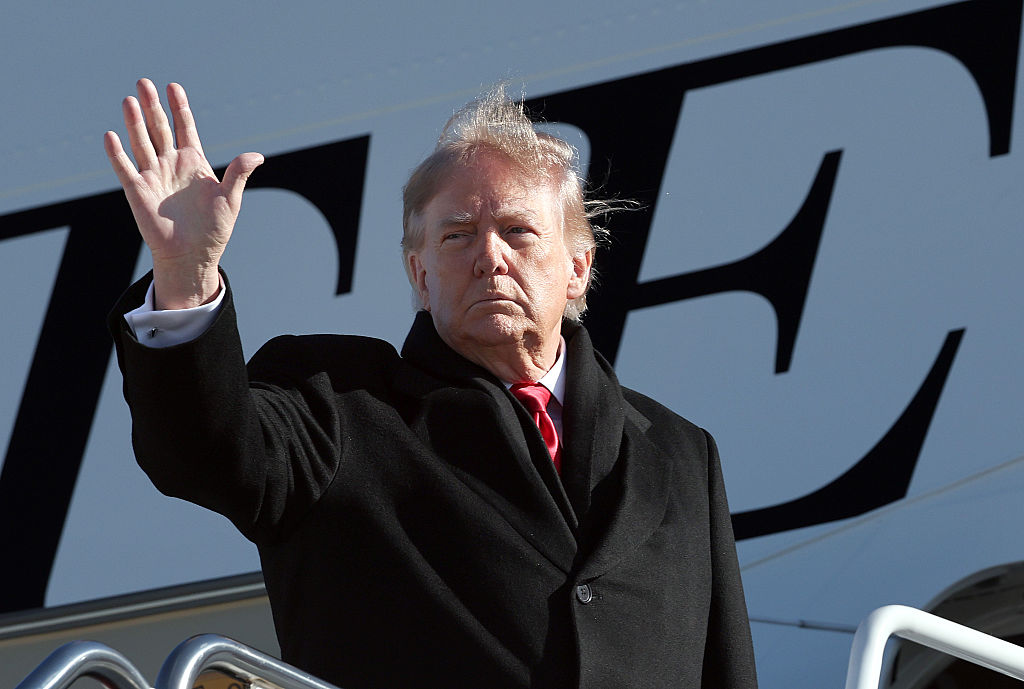
 U.S. President Donald Trump boards Air Force One at Joint Base Andrews, Md., on Nov. 16, 2026. —Win McNamee—Getty Images
President Donald Trump suggested he is putting off any major decisions on Iran until 2027, amid reports that he’s considering renewed major operations in the war that continues despite repeated promises that it’ll end soon.
Speaking to Reuters on whether new major strikes are possible—the U.S. has engaged in limited strikes on Qeshm Island in the Strait of Hormuz—Trump, who was en route to Washington following his trip to China, said, “Well, I’ll talk to you about it after the beginning of the year.” He added: “We’ve got time.”
Trump made similar comments in other interviews. “We’ll see what happens after January 1st," the U.S. President told Fox News in an interview that aired on Thursday, just before his summit with China’s Xi Jinping and Russia’s Vladimir Putin. He also told Axios in a phone call Thursday that he was “not rushing into any decision” on Iran.
The President initially promised that the war with Iran would only take weeks, but it has dragged on to nearly nine months, though major hostilities have subsided. Trump has previously said that the war would end immediately after the Nov. 3 midterm elections, but the impasse between Iran and the U.S. remained. And in the past weeks, he’s alternated between publicly threatening Tehran and holding off on authorizing new strikes at the request of American allies in the Gulf.
Israel has reportedly tried to convince Trump of a new joint strike. The New York Times reported that the U.S. President is considering a new round of extensive military strikes on Iran, after Tel Aviv warned of Tehran’s “success in rebuilding its missile and drone arsenals and advancing its chemical and biological weapons programs.” Benjamin Netanyahu, the Israeli Prime Minister whose premiership is in limbo, is reportedly pushing for a four- to seven-day airstrike campaign on Iran.
Axios reported, citing unnamed sources, that the White House sought input from the Pentagon and intelligence experts on how Iran would respond to the strike scenarios prepared by the U.S. military. Axios also reported that any U.S. campaign would involve Israel and could include strikes on Iran’s nuclear facilities such as Pickaxe Mountain, energy and other infrastructure, and Iranian military and civilian leaders.
The U.S. midterm elections, in which Democrats won control of Congress as the American public largely rebuked Trump and the Republican Party following their handling of the Iran war and the economic fallout it caused, could complicate decisionmaking. Before the Nov. 3 elections, Trump said that Iran was willing to strike a deal, but after the GOP’s stunning losses, which Iranian leaders celebrated, the Administration’s messaging pivoted to maintaining economic sanctions and the blockade on Iran.
Vice President J.D. Vance has blamed the war for the GOP’s election losses, but still appeared to defend the President’s foreign policy on Iran. The Vice President earlier said there was no difference between the President and members of his Administration on the war, but as Vance voiced his misgivings, Trump ordered the Vice President to shift his focus away from Iran diplomatic negotiations and toward domestic policies.
Trump has a small window to push through further military action against Iran before the newly elected Democrats take office in January. On Thursday, the GOP-led U.S. Senate rejected a measure aimed at curbing the war.
Trump addresses reported ‘dirty bomb’ threat
In the interview with Fox News, Trump said he thinks people should not be alarmed by reports of a planned “dirty bomb” attack on Washington, D.C. A dirty bomb combines conventional explosives like dynamite with radioactive material.
“If it does happen, we wipe them out,” Trump said.
Trump acknowledged, however, that intelligence indicated Tehran is potentially interested in biological weapons. “Iran is looking at gases, looking at bio, because we’ve shut them out with the nuclear,” he said, referring to the damage that the U.S. has claimed it dealt to Iran’s nuclear facilities.
Iran’s foreign ministry refuted Trump’s recent statements. “The allegations keep changing, but the underlying narrative remains disturbingly familiar,” spokesperson Esmaeil Baqaei said in a post on X. “Once again, the world is apparently expected to suffer a bout of collective amnesia."
Baqaei then referred to how the U.S. justified its invasion of Iraq in 2003, alleging that the government of the late Saddam Hussein was developing weapons of mass destruction, which subsequent investigations found to be untrue.
“We find ourselves facing ominous new allegations,” Baqaei said, “and a narrative that appears to be following the same fraudulent script.”