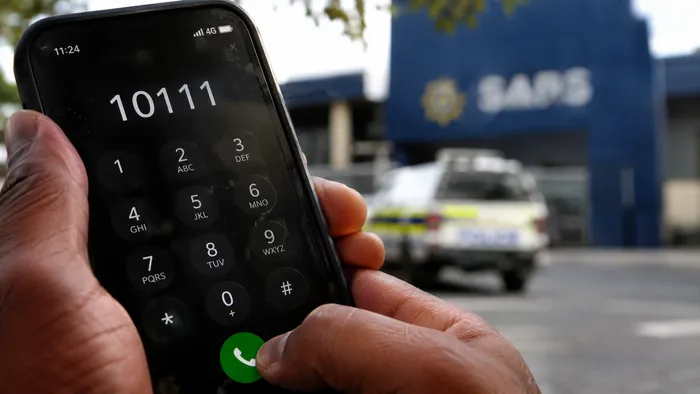
Nearly 1.8 million calls to police emergency number 10111 were abandoned in 2025/26, with Maitland recording more than 377 000 abandoned calls.
Nearly one in five calls to South Africa’s police emergency number 10111 went unanswered during the 2025/26 financial year, with almost 1.8 million calls abandoned as SAPS acknowledged severe staff shortages at its call centres.
The figures, disclosed in a parliamentary reply by Acting Police Minister Professor Firoz Cachalia, reveal the scale of the difficulties facing people trying to reach police during emergencies.
SAPS recorded approximately nine million calls to its 10111 centres during the financial year, of which 1 790 428 were abandoned. The abandonment rate was approximately 20%, meaning roughly one in every five callers failed to get through.
The figures were provided in response to a question from Ian Cameron, MP and chairperson of Parliament’s Portfolio Committee on Police.
The department said abandoned calls included instances where callers hung up after waiting in excessive queues or where calls were dropped by the system.
SAPS acknowledges severe 10111 staffing shortages
Cachalia acknowledged that the ratio of operators to incoming calls was severely inadequate to meet public demand.
“Significant numbers of emergencies go unanswered,” the parliamentary reply stated.
Operators are also required to deal with hoax calls, nuisance complaints and general enquiries, consuming limited capacity and preventing people facing life-threatening situations from connecting with available staff.
Despite acknowledging the staffing crisis, SAPS could not provide an accurate national ratio of operators to incoming calls.
The department said staffing levels fluctuated between shifts and calculating the ratio would require manually extracting the number of operators on duty and comparing it with corresponding call volumes.
It argued that doing so would divert scarce personnel from their operational responsibilities.
The pressure is particularly evident at individual centres. Maitland recorded 377 121 abandoned calls in 2025/26, while Port Shepstone recorded 103 976 abandoned calls out of 184 365 calls received, representing approximately 56.4%.
The national average call-answering time was approximately 12 seconds, based on calls answered. Maitland recorded the longest average at 26 seconds, followed by Midrand at 13 seconds.
Cameron said the crisis could not be viewed simply as a matter of call-centre statistics.
“When someone calls the police during an attack, a robbery or a threat to their life, getting through is the first step towards receiving help. An emergency number that people cannot reliably reach puts public safety at risk,” Cameron said.
He said the inability to reliably reach an emergency number put public safety at risk, particularly when people needed immediate police intervention.
“The operators who are trying to keep this service functioning need adequate support. SAPS leadership must account for the staffing, systems and management failures acknowledged in its own reply, and demonstrate when callers can expect a more reliable service.”
Cameron called on SAPS to produce a recovery plan outlining staffing shortages at individual centres, deadlines for addressing them, technical interventions to resolve dropped calls and measurable targets for reducing waiting times and abandonment rates.
The parliamentary response also exposed shortcomings in the systems used to track missed and mishandled calls.
SAPS said disciplinary procedures under its Discipline Regulations were implemented where applicable and that continuous in-service training was conducted to improve service delivery.
However, it acknowledged that statistics relating to accountability could not always be retrieved because of limitations in the systems available to track such incidents.
SAPS says contingency measures are in place
SAPS national spokesperson Brigadier Athlenda Mathe had previously said the service was monitoring the operational capacity of its 10111 centres and working to address challenges involving telephone-line capacity and infrastructure.
She said contingency measures were activated when individual centres experienced reduced capacity or technical interruptions to ensure emergency calls were managed and policing resources could still be mobilised.
Mathe said technical difficulties at a particular centre should not be interpreted as meaning that emergency policing assistance was unavailable.
“Members remain at police stations and operational points, and members of the public can approach the nearest police station in an emergency,” she said.
Responding to questions about measures to address the crisis, Police Ministry spokesperson Kamogelo Mogotsi said Cachalia had convened meetings with SAPS senior management to discuss the operation of the emergency line.
“The Minister has convened a number of meetings with the SAPS Top management, and a plan is underway to ensure the operation of the 10111 line,” Mogotsi said.
The concerns come amid heightened public attention on gender-based violence and femicide, with separate figures from the Department of Social Development showing increased demand for support services in September 2026.
The department recorded 6 782 calls to its 24-hour Gender-Based Violence Command Centre between September 1 and 16, averaging 424 a day. This was a 21% increase on the daily average of 350 recorded over the same period in August.
Between September 13 and 16, the centre received approximately 500 calls a day, while September 16 alone saw 589 calls, the highest daily figure during the period.
The department said the increase came amid heightened public attention on gender-based violence and femicide, including reports that at least 12 women had been found dead in Ekurhuleni.