The first democratic elections on 27 April 1994 changed South Africa’s political landscape, but the year also marked the beginning of a new commercial era.
The first democratic elections on 27 April 1994 changed South Africa’s political landscape, but the year also marked the beginning of a new commercial era. A new national identity took shape, mobile telecommunications arrived, and businesses began operating in a country emerging from decades of international isolation.
From the commemorative coin marking Nelson Mandela’s inauguration to the arrival of Vodacom and MTN, these are some of the moments that made 1994 a landmark year for South African business and consumers.
The Madiba coin marked a new beginning.
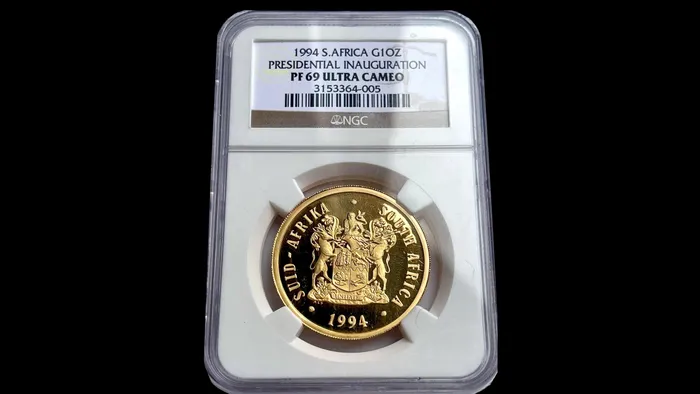
The South African Reserve Bank marked Nelson Mandela’s inauguration as the country’s first democratically elected president with a commemorative R5 coin in 1994.
The coin commemorated the inauguration on 10 May, when Mandela was sworn in at the Union Buildings in Pretoria, after the first democratic elections held from 26 to 29 April. The 1994 Presidential Inauguration issue is recorded among the Reserve Bank’s commemorative coins.
The South African Reserve Bank marked Nelson Mandela’s inauguration as the country’s first democratically elected president with a commemorative R5 coin in 1994.
A new flag for a new South Africa
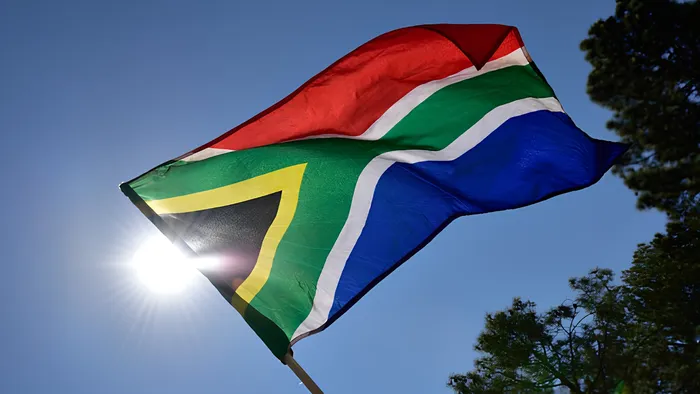
South Africa’s new national flag was first used on 27 April 1994, the day millions of people voted in the country’s first democratic elections.
Designed by former State Herald Fred Brownell, the flag replaced the one that had been in use since 1928. Its distinctive Y-shaped design brought together six colours and was intended to represent the convergence of different elements of South African society.
In February 1994, the Transitional Executive Council appointed a technical committee, with Brownell as its convenor, and gave it a week to find a suitable flag. The design was presented to the council and unveiled on 15 March.
The flag was initially intended as an interim symbol. Its first use on election day, followed by its appearance at Mandela’s inauguration on 10 May, made it one of the most visible emblems of the transition.

Switching on a new era
South Africa’s mobile telecommunications industry took its first major step in 1994, when Vodacom and MTN formally launched their networks on 1 June.
The arrival of cellular technology came in a country where access to telecommunications was uneven and fixed-line infrastructure did not reach everyone.
MTN had begun building its network in January and held a launch event at Johannesburg’s Planetarium on 28 February. Both operators were preparing for commercial services ahead of the formal switch-on.
Vodacom’s own 30th-anniversary history says it connected 10,000 customers on its first day of mobile voice services. Mobile phones were expensive and far from an everyday purchase for most South Africans.
Advertising in 1994 was operating in a country undergoing profound change, with brands competing for the attention of a diverse and changing consumer market.
One documented campaign from the year was Coca-Cola’s “Always” advert. Kantar’s Adtrack database included it in its retrospective list of South Africa’s best-liked television advertisements over 35 years, identifying it as the top advert for 1994 and naming McCann Erickson as the creative agency.

The music of a changing country
South African History Online identifies 1994 as an important year in the development of local music, noting the growing prominence of Prophets of Da City, the Cape Town hip-hop group.
The period also saw the emergence into wider prominence of kwaito, a distinctly South African sound influenced by house music and hip-hop.
Sport provided another visible marker of South Africa’s changing international position in 1994.
South Africa returned to the Commonwealth Games in August, competing in Victoria, Canada, for the first time in 36 years.
The team won 11 medals, including two gold medals, both in lawn bowls. The men’s and women’s fours teams took gold, while South African athletes also collected silver and bronze medals.