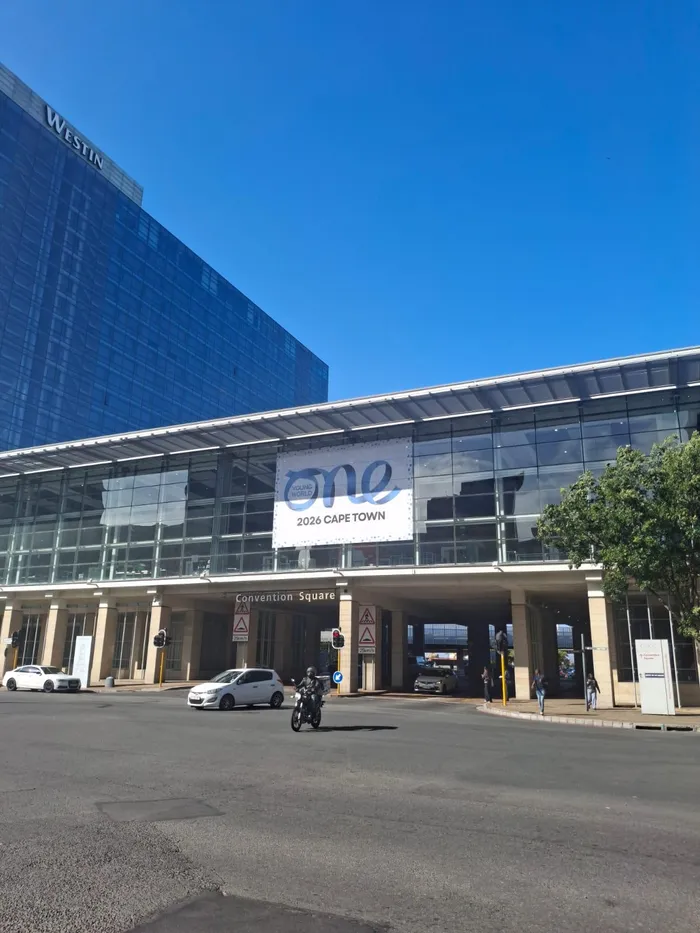
The Cape Town International Convention Centre (CTICC) hosts the 2026 One Young World Summit, bringing global delegates together to redefine inclusive youth leadership and drive systemic social change.
Discussions on the first day of the One Young World Summit focused on inclusion, service, social change, and creativity, where speakers reminded attendees that titles, status, or public recognition do not determine genuine leadership.
During the panel discussion The Leaders We Need Are Already in the Room, former UN official Michael Møller, ENS chief executive Mzi Mgudlwa, and Professor Thuli Madonsela examined the qualities of leadership required to guide communities, businesses, and institutions through challenging times.
Møller moderated the session, which asked what it takes not only to reach positions of influence but to remain credible once there — particularly when doing the right thing proves difficult.
Madonsela focused on the need for institutions to examine whether their policies, cultures, and physical spaces genuinely include the people they claim to serve.
Using the story of Alice’s Adventures in Wonderland, she argued that systems too often expect newcomers to shrink themselves to fit environments that creators did not design with them in mind.
She suggested that leaders should not ask how people can adapt to existing systems, but rather how they can adapt systems so more people can participate fully.
She noted that this challenge applies to everything from workplace policies to equipment and clothing that manufacturers historically designed for men.
Her message was simple: make sure you provide room at the table — and ensure you build the table itself to accommodate those you previously left out.
Madonsela directs Stellenbosch University’s Centre for Social Justice and founded the Thuma Foundation for Democracy, Leadership and Literacy. She also formerly served as the Public Protector of South Africa.
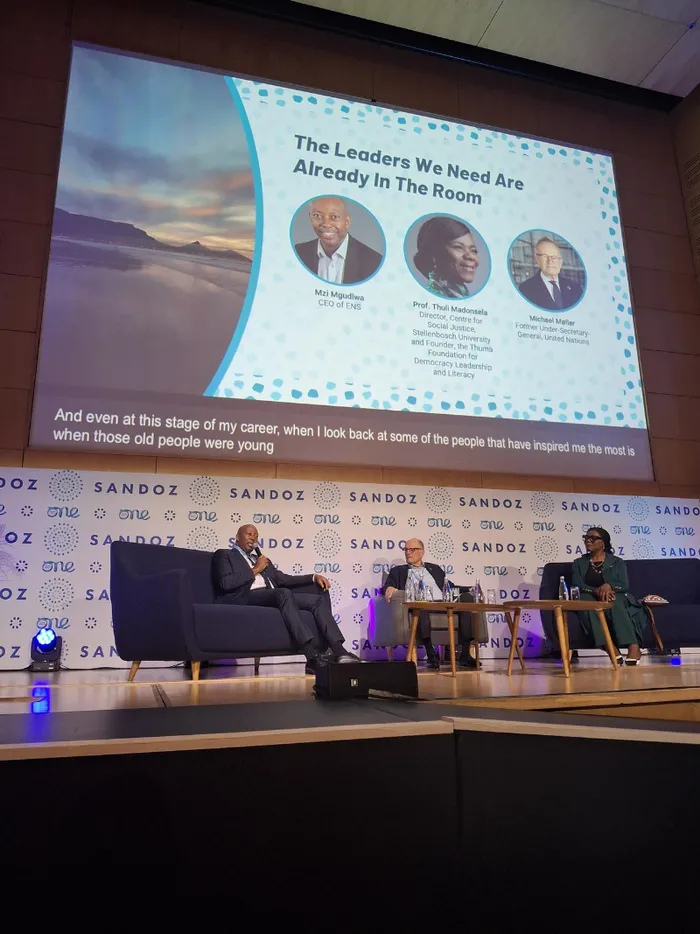
ENS chief executive Mzi Mgudlwa, Professor Thuli Madonsela, and former UN official Michael Møller on the Sandoz stage during 'The Leaders We Need Are Already in the Room' panel discussion at the 2026 One Young World Summit.
Leadership as service
Mzi Mgudlwa returned repeatedly to the idea that society should measure leadership by impact rather than recognition.
Speaking about personal achievement, he cautioned against treating leadership as a route to status. He said its true value lies in service and in the effect leaders have on the people around them.
He used the image of a chair to illustrate the point: while people may identify its legs, seat, or back as it's defining features, the screws and glue — the parts that receive the least attention — actually hold it together.
The analogy called for leaders to make a difference without demanding applause.
“Leadership has nothing to do with positions,” Mgudlwa said. “Leadership has everything to do with impact.”
Møller stated that leaders face an urgent task in rebuilding trust. In a society that has lost confidence in its institutions, he argued, leaders must earn credibility through conduct rather than claim it through titles.
Madonsela said young people give her hope because many see solutions where others see only crisis.
Young leaders, she said, "often believe they can be part of creating solutions rather than waiting for someone else to act."
The conversation also turned to ethical leadership and the personal cost of speaking out.
Madonsela urged delegates to hold the line, but to examine their motivations and their methods.
Where possible, she said, "people should handle difficult conversations directly and respectfully rather than through gossip or public humiliation."
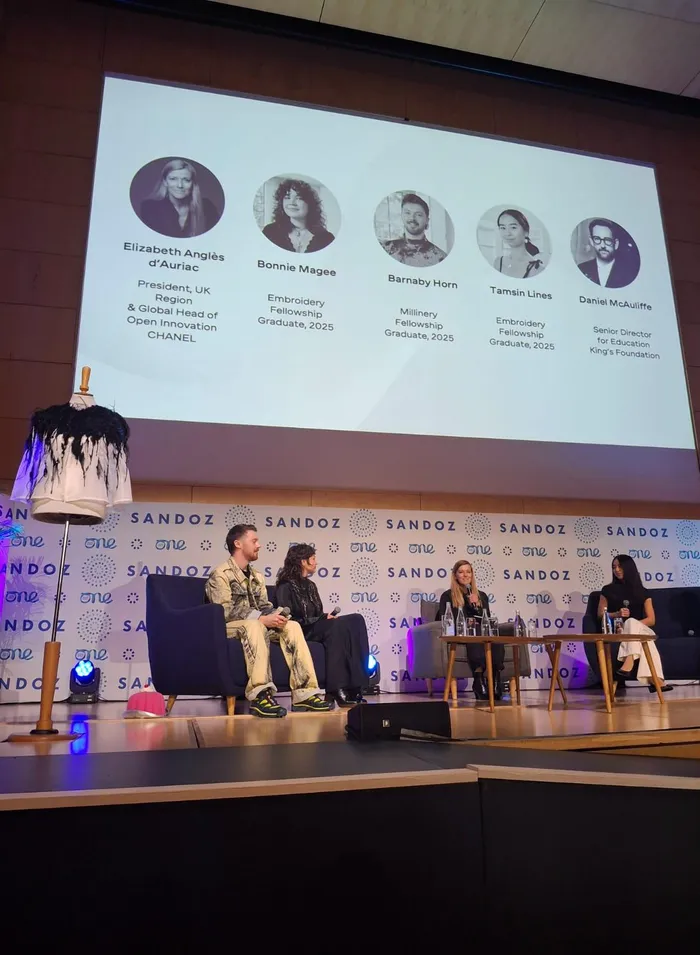
Representatives from Chanel and The King's Foundation during a panel discussion on creativity, craftsmanship, and technology on the Sandoz stage at the 2026 One Young World Summit.
Creativity, craftsmanship and technology
While earlier panels focused on challenging structural systems, later discussions examined how craftsmanship preserves humanity in changing systems.
On the Sandoz stage, conversations on creativity and craftsmanship explored the relationship between human skill, new technology, and sustainability.
A panel involving Chanel and representatives linked to The King’s Foundation considered what distinguishes work that artisans make by hand from images that AI generates.
The discussion focused on the long process behind a finished item: training, technical knowledge, mentorship, experimentation, and the practice required to develop a distinctive style.
Daniel McAuliffe, Senior Director for Education at The King’s Foundation, described the organisation’s ethos as one of harmony between people, places, and nature. He said craft education should preserve valuable skills without trapping people in nostalgia.
He suggested that good teaching and mentorship rely on passionate experts who willingly share their knowledge and make it accessible to people regardless of background.
“Talent exists everywhere,” he said. “But where is the access?”
The panel stressed that young artisans absolutely require confidence. Mentors may teach technical skills, but networks of support, repeated practice, and the chance to learn from experienced practitioners build true confidence.
Speakers encouraged young creatives to avoid narrow categories and to remain curious about materials, methods, and industries.
They noted that a finished piece represents more than an object: it carries the time, knowledge, patience, and accumulated skill of the people who made it.
The panel delivered a clear message for emerging creatives: learn from experts, develop your own voice, and keep experimenting.
Stories that make people care
A panel featuring mental-health advocate Shudufhadzo Musida, actor and playwright Danai Gurira, model Adot Gak, and Andrea Thompson explored the power of identity, representation, and telling stories that make people care.
Musida spoke about the need for society to stop separating mental health from physical health. She argued that the world often treats anxiety, burnout, and self-doubt as individual weaknesses when the systems people live and work in actually shape these challenges.
She urged young people not to equate exhaustion with success, or to believe their worth depends on a job title, an invitation, or external approval.
“Your value is defined before you walk in,” Musida said.
Gurira reflected on growing up in Zimbabwe and on the importance of seeing media represent African women as complex, fully realised people. She described how art and storytelling possess the power to challenge stereotypes and shift how audiences see communities, countries, and women.
For her, authenticity was not simply a personal virtue; it functioned as a means of resisting pressure to become what others expect.
“The world is always telling you to be something else,” she said. “Your authenticity is your superpower.”
Gak said that young women should “make choices guided by their values and by the kind of life they want to have years from now, rather than by the approval of an industry, audience, or social media culture.”
Thompson spoke about the role family and community play in helping people remain grounded while working on a global stage.
Recalling her grandmother’s generosity despite limited means, she said connecting purpose to something larger than individual ambition makes that purpose more durable.
Uyinene's mother
The day closed with reflections on service, resilience, and the responsibility to act when injustice strikes close to home.
A contribution from Nomangwane Mrwetyana, the mother of Uyinene Mrwetyana, brought the conversation back to the human cost behind public discussions of gender-based violence.
She reminded the audience that before the public turned her daughter into a rallying cry, she lived as a deeply loved child, sister, and friend.
“I stand before you as a mother, not only as a mother, but as a mother whose daughter never had the opportunity to fulfill her dreams, but I'm here to let you know that before the media made her a headline or symbol, she was my child, she was my daughter, she was a friend to her friends and a sister to her brother, and that beyond the tragedy that took place at the post office stood a human being,” Nomangwane said.
“She possessed a full life, she loved deeply and laughed, she despised and hated any form of injustice including GBV and femicide, she studied at university and believed in the opportunities ahead of her.”
She described the devastating reality of losing that future:
“Like every mother, I imagined watching her graduate, and grow into the woman she meant to become. Someone stole that future and in 2019, her death became a rally cry, not because she was the first victim but because millions of people finally saw the devastating reality women and girls face every day, but the truth is that long before Uyinene, many died and even after, many continue to die.”
Actor Terry Crews reinforced the point, sharing a deeply personal story to highlight the urgent need for men to take accountability in ending domestic violence.
He recounted growing up in a religious household where his father struggled with alcoholism.
“My mother would always approach him about his behavior, it would always lead to him throwing things, yelling cuss words and I remember coming out of my bedroom at 5 years old and he hit my mother in the face as hard as he could and every time I talk about this it's extremely emotional for me, here I am witnessing this tremendous act of violence,” Crews recalled. By telling his story, Crews challenged men to confront toxic behavior, take accountability, and actively work to break cycles of abuse.
Their contributions underscored a central theme of the day: leaders cannot separate leadership from empathy.
Leadership begins before the title
By the end of the first day, One Young World’s message focused less on finding flawless leaders and more on recognising the responsibility that the people in the room already hold.
Speakers argued that leadership is not a destination reserved for those with the loudest voices or most impressive titles. Instead, people express leadership through service, curiosity, courage, and the willingness to ensure that others have a place at the table.
This is the test One Young World set for its audience on day one: not whether they can imagine a better future, but whether they will help build it now.