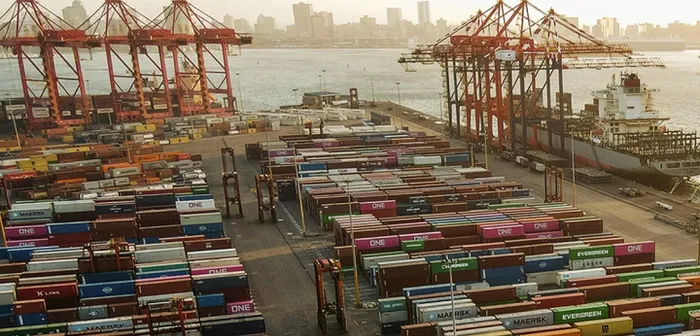
Delays at Durban Container Terminal Pier 2 could affect festive-season merchandise and essential medicines, while Transnet and Durban Gateway Terminal work to clear the backlog.
Truck drivers at the Port of Durban now face waiting times of up to 24 hours, up from about three, because of the backlog—a delay that is affecting their well-being and income.
The primary cause of the Port of Durban delays has been attributed to the recent transition to the Navis 4 operating system under the new management company, International Container Terminal Services (ICTSI), which assumed operational control earlier this year. The delays have become so severe that ships are reportedly waiting up to 20 days to berth at Durban Gateway Terminal.
Gugu Sokhela of the All Truck Drivers Forum said drivers normally spent about three hours at the port waiting to load but now spent close to 24 hours there.
Transnet has said the delays are about 20 days, while the business community warned that they could extend to three months.
“We could go into the harbour at 7pm and only come out at 7pm the following day, so this situation has become very difficult for us,” he said.
He said some drivers were paid per load, meaning they earned money only when they delivered cargo. “We are also losing a lot of money because some employers pay per load. Employers argue that if the truck is standing still, they are not making money and therefore cannot pay you,” Sokhela said.
He added that drivers who previously made 12 deliveries a month were now making only six in the same period. “This means we are not getting paid as much,” he said.
Sokhela said some areas of the port had no bathing facilities, toilets or places to buy food. “This means we could spend 24 hours without eating, drinking, washing or even having breakfast,” he said.
The business community has warned that the delays could damage the economy. Although goods such as medicines are being prioritised, products intended for the festive-season shopping period remain stuck at the port. This could prevent goods from reaching stores in time for Christmas shopping and lead to financial losses for businesses.
The challenges at the port have angered South Africans. Lindokuhle Magubane posted on social media, saying ships were waiting, cargo was delayed, manufacturers were scrambling and businesses were losing money. He questioned whether the partnership between Transnet and its private-sector partner had delivered the expected improvements.
Magubane said the issue involved “a strategic national asset, a 25-year partnership, a foreign operator, a state-owned enterprise that surrendered operational control, and a government that must now explain how its much-promoted private-sector intervention ended up creating another headache for the South African economy”.
In a statement, the ANC called for an urgent intervention team to enforce strict daily clearance targets, stabilise terminal IT systems, guarantee the uninterrupted emergency release of medical and essential cargo, and hold both Transnet and its private partner accountable for contractual performance.
The ANC said it was alarmed by warnings from the business community that port delays could persist for up to three months, leaving vessels stranded and essential goods trapped ahead of the festive-season peak. The ANC said businesses across the country faced losses running into hundreds of millions of rands, threatening jobs, stalling industrial production and choking trade for landlocked regional economies.
It said restoring operational efficiency at the Port of Durban was central to achieving this strategic objective. The ANC also called for decisive leadership to end what it described as institutional finger-pointing between Transnet and its private operating partner.
Dr Chris Hunsinger MP, the DA’s spokesperson on transport, called for a public recovery plan with weekly targets. He said progress should be published weekly until the backlog is cleared.
“The economic damage is spreading just as fast. Automotive suppliers are paying for emergency air freight to keep assembly lines running. Citrus trucks have waited up to 30 hours to deliver refrigerated containers. Shipping lines are adding congestion surcharges, and thousands of containers have been diverted to other ports. Every one of these costs ends up in the price of goods,” he said
Transnet did not respond to requests for comment.