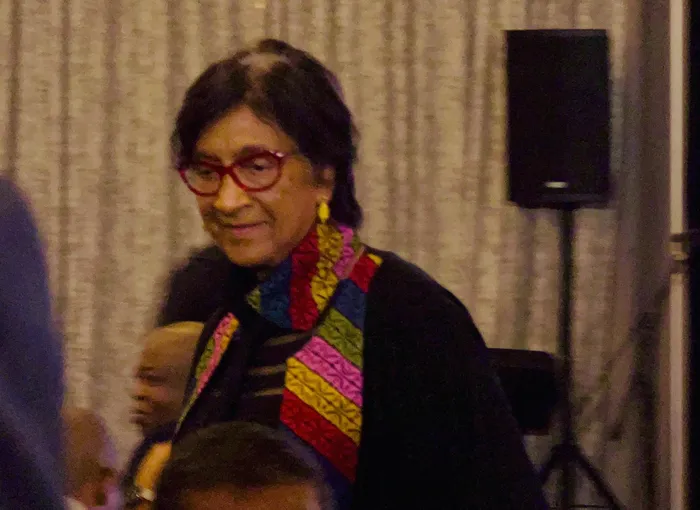
Nobel Peace Prize laureate Judge Navi Pillay.
The decision to award the 2026 Nobel Peace Prize to Navi Pillay is both exceptionally well-timed and profoundly well-chosen. At present, the global landscape is defined by deep international concern, as millions worldwide protest the ongoing violence perpetrated against the Palestinian people—including women, children, and the elderly.
Alarming acts of violence in various other parts of the world further compound this global anxiety. Pillay, who headed the UN International Commission of Inquiry on the Occupied Palestinian Territory from 2021 to 2025, concluded that these actions constitute a serious case of genocide.
If this conclusion served as a criterion for her selection, then this award is a crucial victory for the "naming and shaming" of global atrocities.
Millions of people suffering from violence in the Middle East and beyond have received this news with profound hope. It signals that prestigious bodies like the Norwegian Nobel Committee and its advisors firmly favour peaceful conflict resolution, which will hopefully exert a positive influence on those continuing to perpetrate these atrocities.
A Victory for Demilitarisation and Diplomacy
This award arrives amid a months-long surge in global mobilisation, with hundreds of thousands of people lobbying for the abolition of nuclear weapons. Activists are increasingly calling for the diversion of trillions of dollars from the manufacture of lethal weapons toward the world’s development agenda. Coming just nine years after the International Campaign to Abolish Nuclear Weapons (ICAN) won the Nobel Peace Prize in 2017, Pillay’s recognition is a significant victory for communities striving to restore peace and justice through negotiations rather than war.
Choosing this moment to honour Pillay sends a clear message: the international community must reject the spread of hatred and violent confrontation in favour of dialogue and active negotiation.
Championing Gender Equality and Human Rights
As the first South African woman to receive this prestigious honour, Pillay’s award reinforces the urgent need for gender equality, respect for basic human rights, and an end to the oppressive system of patriarchy. Her groundbreaking work exposed the systematic use of violence against women in times of war, challenging the historical treatment of women as "booty" or spoils of war for soldiers.
As a judge on the International Criminal Tribunal for Rwanda, her landmark judgment in the Akayesu case famously categorised rape and sexual violence during wartime not merely as isolated crimes, but as grave breaches of international humanitarian law.
She defined them as acts of genocide and crimes against humanity when used systematically to destroy a community. Pillay has long championed these fundamental rights on the ground, notably through her role in establishing a help desk for abused women in Durban. This Nobel Prize represents a vital recognition of her domestic and international efforts. It shines a critical spotlight on the gravity of gender-based violence and femicide, both globally and locally, following the recent devastating wave of such crimes in South Africa.
Pillay’s legacy urges us to treat these issues with the utmost seriousness.
Strengthening International Instruments of Justice
Receiving this prize at a time when the world feels on the brink of another global conflict, offers more than just a proud moment for South Africa; it offers a lifeline of hope. It provides an opportunity for leaders of warring regions to realise the futility of violent confrontation and direct their energies toward peaceful settlements.
True joy lies in seeing the highest form of global recognition given not just to an individual, but through her, to the international instruments of human rights and justice. While untold atrocities are being committed daily and bad actors actively attempt to dismantle international legal institutions, this award serves as a vital tool to help strengthen these institutions.
As a former judge of both the International Criminal Court (ICC) and the International Court of Justice (ICJ), and as the former United Nations High Commissioner for Human Rights, Pillay embodies the exact legal frameworks that the world must now strengthen. Real, just peace can only be attained through these collective instruments.
This award serves as a stark historical reminder. Following the horrific atomic bombings of Hiroshima and Nagasaki in August 1945 and the revealed cruelties of the concentration camps, humankind united to ensure such atrocities would never happen again.
This collective awakening birthed the United Nations in October 1945 and the Universal Declaration of Human Rights in December 1948. Eight decades later, presenting the Nobel Peace Prize to a figure who has led these very international bodies is a renewed call for humanity to unite against ongoing genocide and atrocities.
It is a plea to prevent the cataclysm of another world war, especially given that today's nuclear arsenals are vastly more destructive than those of the 1940s. Nearly a century ago, Mahatma Gandhi called for "world support in this battle of Right against might."
Today, amidst gross human rights violations and the indiscriminate use of lethal force, Navi Pillay’s Nobel Prize echoes that call to our shared basic humanity. It reminds the global community that we can restore peace and human rights if we stand together. Ultimately, this award demands that we restore confidence in, and enforce the findings of institutions, like the ICJ.
The evidence of gross violations documented under Pillay's leadership must now be met with decisive international action to halt ongoing atrocities and restore a just global order.
*Gandhi is a social worker, political activist, Chairperson of the Gandhi Development Trust and Phoenix Settlement Trust and co President of Religions for Peace International.