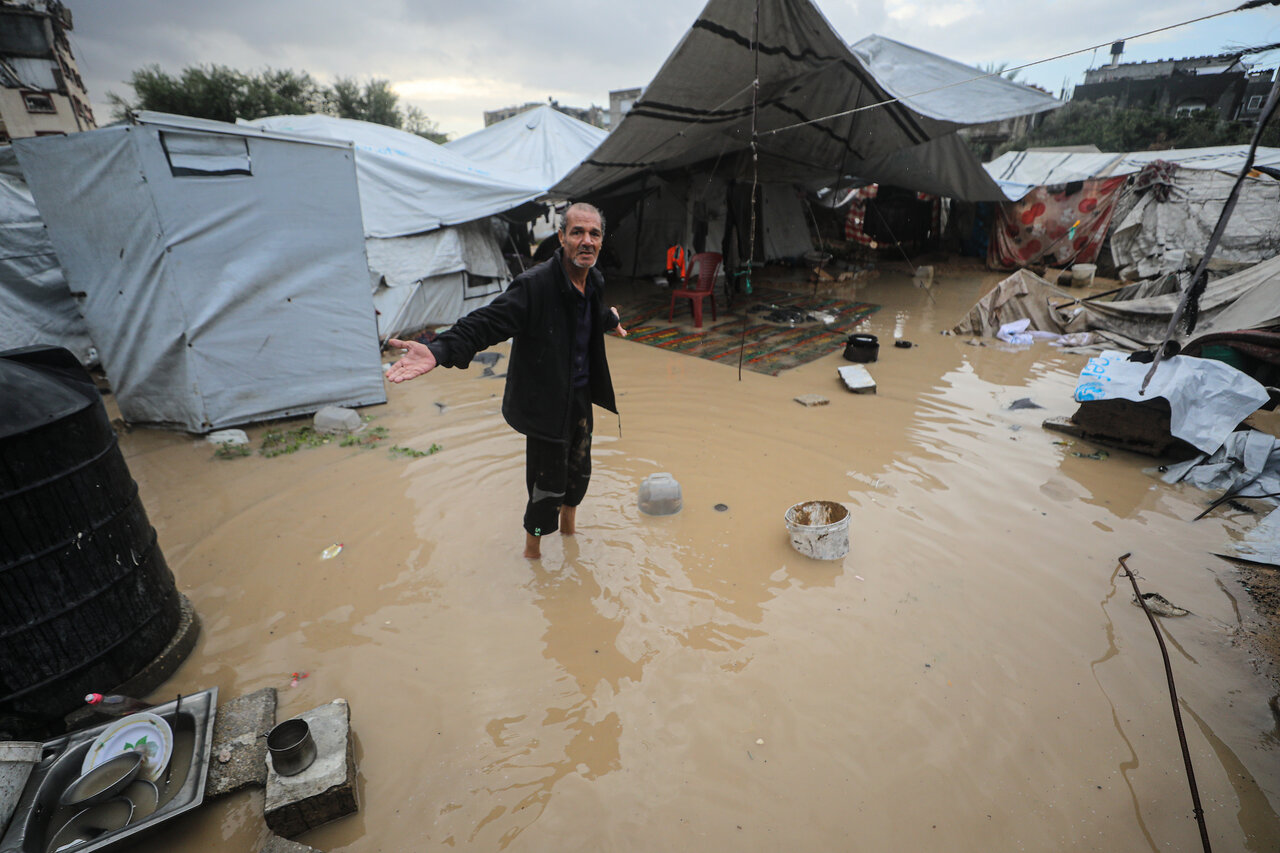
TEHRAN – Four Palestinians have been killed in Gaza after a sand embankment collapsed onto tents sheltering displaced families.
The Government Media Office announced that two more Palestinians are missing and several others injured following the incident, which occurred in the central region of Deir al-Balah.
In a press statement, the office stated that hundreds of tents had been flooded as the first winter storm arrived, adding that women and children were among those killed or missing.
It emphasized that the announcement comes amid the worsening humanitarian catastrophe across the Gaza Strip, expressing “profound anger and sorrow” and describing the tragedy in Deir al-Balah as a reflection of the scale of “complicity and abandonment” faced by the Palestinian people.
The office stressed that the flooding of displacement camps and the collapse of sand onto defenseless displaced people were “an inevitable consequence of the ongoing genocide, the suffocating blockade” and the arbitrary measures imposed by Israeli Occupation Forces (IOF).
It pointed out that the reduction of designated displacement areas and the widening of the IOF’s so-called “Yellow Line” had forced Palestinians to seek refuge in extremely hazardous geographical areas, lacking the most basic necessities for survival and safety.
More than 70,000 displacement tents have been flooded since Friday in the first storm of the winter season, with initial losses estimated at $3 million, the office said.
It warned that dozens of damaged buildings are at risk of collapse. These structures had previously sustained damage during the IOF bombardment throughout the three-year genocidal war.
Reporters on the ground reported that rainwater had flooded displacement tents and mixed with sewage, increasing the risk of disease outbreaks. Many displaced Palestinians have once again been forced to flee their tents, with families separated and nowhere to seek shelter amid the ongoing Israeli siege.
Reporters also noted that the entire population of the Strip, more than two million people, is displaced and dependent on humanitarian assistance following the U.S.-backed genocidal war and the siege.
The scale of the disaster has overwhelmed emergency response teams across the Gaza Strip. More than 1,500 emergency appeals have been received since Friday from displaced residents whose tents and shelters had been damaged.
The Civil Defense warned that all areas of the Gaza Strip are facing a new humanitarian catastrophe, with dozens of displacement camps, shelters, and entire residential neighborhoods submerged by heavy rainfall. Water levels have reached up to 1.5 meters in some areas.
The General Directorate of Civil Defense says it received 2,166 distress calls from displacement camp administrators, shelter management teams, and families whose homes had previously been damaged by IOF strikes.
However, rescue teams, working alongside municipalities and relevant authorities across the Strip, managed to respond to only 218 of those calls. In the remaining cases, they could only provide guidance to families facing flooding because of the overwhelming number of appeals and the severe shortage of resources.
Calls for urgent international intervention
Gaza’s Civil Defense appealed to countries worldwide, stressing that the harsh humanitarian conditions facing residents of the Strip cannot be ignored.
It called for effective international pressure on the Israeli regime to allow the entry of rescue equipment and machinery needed to deal with winter-related emergencies.
The directorate also demanded the immediate entry of tents, plastic tarpaulins, and prefabricated mobile homes, commonly known as caravans, to provide emergency shelter for displaced Palestinians.
Furthermore, it called for the provision of sufficient fuel to support Civil Defense operations and enable emergency teams to respond to humanitarian crises, which become increasingly severe during the winter season.
The directorate urged the countries guaranteeing the Gaza ceasefire agreement, as well as the National Committee for the Administration of Gaza, to fulfill their responsibilities and intervene immediately to save the lives of Palestinians who are facing winter without even the most basic means of protection.
Hamas has criticized the positions taken by the so-called “Board of Peace” and its executive director, Nikolay Mladenov, over IOF violations of the ceasefire agreement, emphasizing that these positions provide cover for the continuation of such violations.
The movement called on the board to assume its responsibilities, prevent further deterioration of the humanitarian situation, and take serious measures to compel the IOF to fulfill its obligations.
It also called on mediators and guarantors to play a more active role in ensuring the full implementation of the humanitarian protocol and the uninterrupted delivery of humanitarian assistance, shelter supplies, and relief materials.
Furthermore, Hamas called on mediators and guarantors to pressure the regime to stop blocking the entry of the National Committee into the Gaza Strip and allow it to immediately begin carrying out its responsibilities.
Palestinian Islamic Jihad said the devastating scenes across Gaza following the storm, including flooded displacement tents and the destruction of personal belongings and food supplies, provided further evidence of the profound humanitarian catastrophe facing Palestinians amid destroyed infrastructure and the absence of adequate shelter and drainage systems.
The movement warned that the IOF continues to open fire around displacement areas, posing an additional threat to civilians struggling to protect their families from flooding and the cold.
94% of Gaza’s population needs urgent shelter assistance
The United Nations Relief and Works Agency for Palestine Refugees (UNRWA) announced that approximately 94% of Gaza’s population, equivalent to 1.98 million people, urgently need humanitarian assistance, particularly shelter and non-food items.
The agency explained that 58% of the population faces critical or catastrophic shelter needs.
Its winter needs assessment, which covered 113 displacement sites, identified 18 emergency shelters as unsafe because of serious risks to the structural integrity of their buildings.
According to the assessment, four of these facilities face an extremely high risk of collapse, while six have been classified as high-risk and another eight as medium-risk, highlighting the severe dangers facing displaced Palestinians in their temporary places of residence.
Regarding access to essential services, UNRWA revealed that 84% of Gaza’s population experiences frequent and irregular interruptions in access to safe and clean water. Meanwhile, 89% of households reported that their available basic hygiene supplies were insufficient.
The agency stressed that these figures highlight the growing scale of humanitarian needs across the Gaza Strip amid the continued deterioration of living conditions and worsening shelter, water, and sanitation crises. These conditions pose mounting and persistent risks to the health and safety of the population.
The humanitarian crisis is unfolding amid continued IOF aggression across various parts of the Gaza Strip, including artillery shelling and airstrikes, resulting in further casualties.
Since the supposed ceasefire took effect on October 11, 2025, the death toll has reached 1,610 Palestinians, with 5,819 others injured. Meanwhile, the initial toll of the U.S.-backed genocidal war since October 7, 2023, has risen to at least 74,640 killed and 175,947 injured.