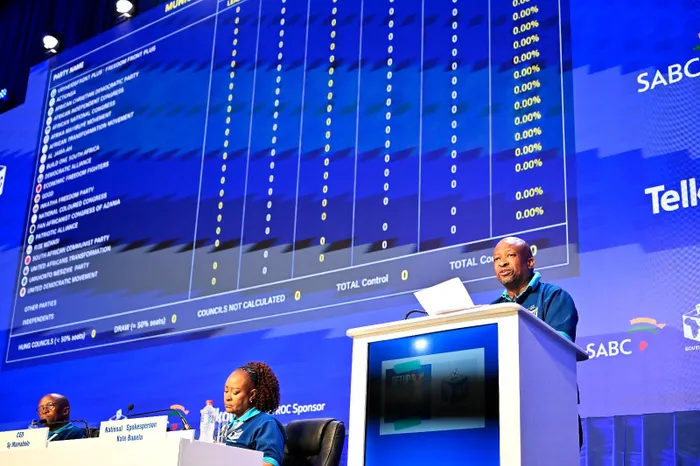
With 71% of election results captured nationally, the IEC has outlined how it is managing counting delays, objections and verification processes as political parties await the final outcome of the 2026 local government elections.
The Electoral Commission of South Africa (IEC) says it has defended the commission’s election planning and results management processes, saying resources are allocated according to the needs of individual voting stations as the national results tally reaches 71%.
The commission outlined the measures it has put in place to manage the counting, capturing and verification of results.
This, as the process continues following the conclusion of voting in the 2026 local government elections.
IEC chairperson Mosotho Moepya said the commission takes into account the number of voters, staff requirements and the complexity of each voting station when planning for an election.
Moepya was responding to questions about the practical measures in place to ensure the counting process runs smoothly, particularly where some voting stations experience challenges or delays.
“We have looked, when we plan, the complexity is part of the planning process. The number of workers, the number of voters, the amount of streams, in other words, and so we get to a number of staff that would be required at that voting station,” he said.
He explained that staffing and resources are allocated according to the needs of individual voting stations, adding that the commission also makes provision for situations where some stations complete their work earlier than others.
“At a time such as this, when complications arise, and maybe there is a challenge, someone has finished early and others are badly, that's also part of the plan,” he said.
Moepya said the IEC could deploy teams to assist where necessary, adding that the distribution of resources and workload was an important part of election planning.
He likened the process to the allocation of ballot papers, explaining that voting stations with different numbers of registered voters would not receive identical quantities.
Unique security features and challenges
Moepya also highlighted the security measures used to validate ballot papers, saying each security stamp was unique and could be identified by the commission.
“Every one of the security stamps we use to validate a ballot paper is completely unique. And we will know whether that was our stamp or not our stamp for this election or for the previous election,” he said.
He also acknowledged that adverse weather conditions in parts of the country could affect the process, particularly where movement and access were disrupted by rain.
The IEC has an issue-tracking system through which political parties and candidates can raise concerns. Moepya said the system allows issues to be monitored and escalated if they are not attended to.
He said the commission had been dealing with thousands of issues since Monday, with the system helping ensure that they were addressed within the required timeframes.
Recount requests and objections
On questions around political parties seeking recounts after signing results slips, Moepya said he was not aware of many such instances.
He explained that party agents are expected to be present when results are finalised at voting stations and that the results slips provide an indication of each party's performance at that particular station.
However, he said party agents were not legally compelled to sign the results slips.
While the law encourages the signing of results slips, parties that have legitimate concerns can raise objections through the prescribed process.
Moepya said a narrow winning margin alone did not automatically justify a recount.
“There is no automatic demand to say, because the margin is small, or I lost by a small margin at this voting station, let's recount,” he said.
Voters must cast ballots where they are registered
Moepya also addressed concerns about people who move between areas, reiterating that voters are required to register and vote in the areas where they live.
He said the IEC had communicated this requirement from the beginning of its preparations for the elections.
“The law requires that you register where you live, and in this election, you vote where you register,” he said.
He added that the election timetable, including the dates for special voting, was communicated when the elections were proclaimed and was governed by the law.
More than 60% of results captured
Moepya said that, as of 5pm on Thursday, more than 60% of the 66,073 results had been captured, with approximately 40,202 results slips scanned.
A further 2,238 results slips had undergone independent auditing as part of the commission's verification and quality assurance processes.
He was speaking during a media briefing at the National Results Operations Centre (NROC) in Midrand on Thursday evening, as the collation of results continued following the conclusion of voting.
Voting took place across the country on Wednesday, November 4, following special voting on Monday and Tuesday.
Approximately 29.2 million registered voters were eligible to cast their ballots to elect local government representatives.
As of Friday morning, the national vote-counting process had reached 71%.
The IEC continues to capture and verify results as political parties await the final outcome, with coalition negotiations expected to take centre stage in several municipalities.