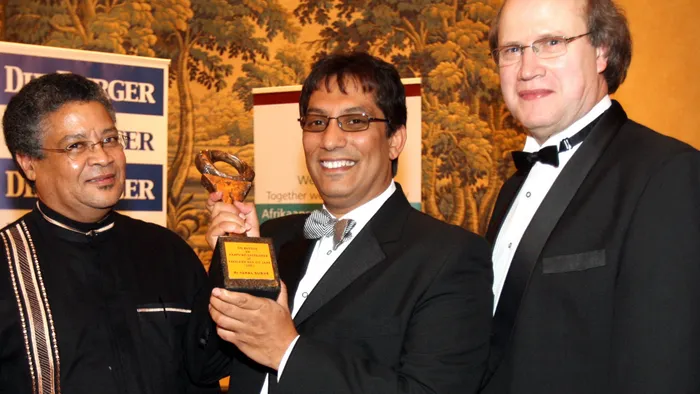
Dr Iqbal Survé honoured as the Sakeleier van die Jaar (Business Person of the Year) in 2007.
There comes a moment in journalism when the carefully manufactured image of corporate respectability begins to crack, exposing uncomfortable questions about the power operating behind the headlines.
I experienced such a moment when Jacques Dommisse, whom I had known from my years within the Naspers media establishment and who later headed a specialised investigations unit, approached me seeking information that could portray Dr Iqbal Survé as corrupt.
What disturbed me was not merely the request. It was his alleged disclosure that Koos Bekker, one of the most influential figures in the Naspers empire, had established an investigations unit with the express purpose of taking Survé out.
An individual associated with an influential media establishment allegedly approached a former colleague seeking damaging information about a businessman who would later become one of South Africa's most prominent black media owners.
Was this journalism in pursuit of truth, or the pursuit of a target dressed in the respectable language of investigative reporting?
That is the question I have carried ever since.
Naspers: A History That Corporate Rebranding Cannot Erase
South Africans are repeatedly instructed to confront the injustices of apartheid. Yet the historical relationships between certain powerful media institutions and the political machinery of white minority rule too often escape the same sustained public interrogation.
Naspers did not emerge from a politically innocent past.
Founded as Nasionale Pers in 1915, its foundations were laid within Afrikaner nationalism, where newspaper ownership, political ideology and state power were intimately connected.
D. F. Malan moved from editing Die Burger to becoming the prime minister whose government institutionalised apartheid. Hendrik Verwoerd moved from editing Die Transvaler to becoming one of its principal architects.
These are historical facts, not conspiracy theories.
The apartheid security establishment understood the political value of disinformation, character assassination and psychological warfare. STRATCOM became an instrument through which reputations could be attacked and liberation figures systematically discredited.
The Truth and Reconciliation Commission documented how these operations worked. Former STRATCOM commander Vic McPherson testified about campaigns targeting the ANC and Winnie Madikizela-Mandela. Operation Romulus involved circulating damaging material through media channels to undermine her credibility and that of the liberation movement.
Destroy the individual's reputation. Turn allegations into public suspicion. Make the target's credibility the story.
Apartheid ended in 1994. Its security structures were dismantled.
But the methods of reputational warfare did not disappear from political and corporate life.
Today, damaging allegations can be amplified through newspapers, digital platforms and social media until repetition itself begins to resemble proof.
The disturbing question is not whether apartheid ended. It did. The question is whether the concentration of media power and the methods used to protect political and economic interests were ever subjected to equally profound transformation.
In my assessment, the sustained campaign against Dr Survé bears troubling similarities to these historical methods. That is a comparison of techniques, not proof that apartheid's former intelligence structures directed contemporary operations.
2013: The Acquisition That Challenged the Establishment
In 2013, Dr Iqbal Survé did something that challenged the established order of South African media ownership.
Through the Sekunjalo Consortium, he acquired Independent Media from its Irish owners, bringing one of the country's most influential newspaper groups into black ownership.
For decades, South Africans had been promised economic transformation. Yet when black ownership reached into the commanding heights of the media industry, it confronted a landscape still shaped by historically concentrated commercial power.
In my assessment, the significance of the transaction extended far beyond its financial value.
It challenged who could own influential newspapers, whose perspectives could shape public debate and whether established media institutions would continue to dominate the national conversation.
The Survé family's subsequent media investments expanded across Independent Media, the African News Agency, IOL and what is now the New Media Group.
What followed, Survé maintains, was an extraordinary campaign of reputational destruction.
Consider the cumulative effect of years of damaging headlines, repeated allegations and relentless scrutiny directed at one individual and his businesses.
Investigative journalism is essential to democracy. But so is scrutiny of the investigators.
At what point does the relentless pursuit of one individual cease to look like ordinary scrutiny and begin to raise questions about the power and interests behind the pursuit?
Who commissioned these investigations? What evidence underpinned the allegations? Were the same standards applied to other powerful media owners? And who benefited commercially from the sustained assault on Survé's credibility?
These questions deserve answers, not another headline dismissing them.
The Encounter That Raised the Alarm
My encounter with Dommisse remains central to why I question the conduct of powerful media interests.
According to my recollection, he wanted information that could implicate Survé in corruption. He also connected that effort to an investigations unit allegedly established by Bekker.
I understood the approach as an attempt to recruit me into an effort to discredit Survé.
There is a fundamental difference between investigating suspected wrongdoing and setting out to destroy a predetermined target.
One follows evidence. The other begins with an intended outcome.
If the unit operated as Dommisse allegedly described, its purpose deserves serious investigation.
Who authorised it? Who directed it? What information was it collecting? And what was the intended use of that information?
These are serious allegations based on my account of an encounter. The alleged role of Bekker and the unit's purpose require corroboration and responses from those named.
But I will not pretend that what I experienced was insignificant.
The public has every right to question whether investigative journalism was being used as a weapon in a wider struggle for corporate influence.
Phala Phala: The Test of Political Independence
The political dimension became particularly revealing during the controversy surrounding President Cyril Ramaphosa's Phala Phala farm.
Independent Media pursued difficult questions about the foreign currency stolen from the president's property and the explanation that a Sudanese businessman had paid substantial US dollars for buffaloes.
The reported transaction raised legitimate questions.
In December 2022, the Cape Argus reported that Limpopo authorities had received no application to export the buffaloes in question. The reported buyer, Hazim Mustafa, maintained that the transaction was genuine and that the animals had not been delivered.
In March 2023, IOL reported that SARS could not locate a record of the alleged foreign-currency declaration.
These were not trivial questions. They concerned the president of South Africa, a substantial foreign-currency transaction and the accountability expected of the country's highest office.
Yet I believe competing publications, including News24, approached aspects of Ramaphosa's explanation with a degree of acceptance that Independent Media was unwilling to extend.
That is my assessment of the contrasting editorial approaches, and it should be tested through a comparison of the published coverage.
But the underlying question remains uncomfortable.
Why should one powerful individual face relentless scepticism while another appears to receive the benefit of the doubt?
Why should the president's explanations be treated differently from those of a media owner facing accusations?
The conflict involving Survé began long before Phala Phala became public in 2022. Nevertheless, I believe Independent Media's willingness to challenge politically sensitive explanations made the wider struggle over its independence even more consequential.
The Engineered Financial Noose
The most disturbing dimension of this controversy is what happens when reputational attacks acquire financial consequences.
A headline can be challenged. An allegation can be disputed. A newspaper can be taken to court.
But what happens when a bank decides that the controversy surrounding a business makes that business too dangerous to serve?
Suddenly, the argument is no longer confined to newspaper columns.
It enters payroll systems, supplier agreements, commercial operations and the livelihoods of thousands of workers.
Major commercial banks moved to terminate relationships with Sekunjalo-linked companies, citing reputational, compliance and other risk considerations.
Sekunjalo has alleged that these closures formed part of a coordinated attempt to undermine its businesses. The banks deny unlawful coordination, and the relevant legal proceedings have not established the alleged political conspiracy.
In September 2022, the Competition Tribunal granted interim relief to Sekunjalo applicants, preventing certain account closures and ordering the reopening of others. The decision was subsequently overturned by the Competition Appeal Court in July 2023.
But those legal developments do not make the consequences insignificant.
When media reporting becomes a factor in financial exclusion, the public is entitled to ask whether commercial risk management can also become an instrument of extraordinary economic pressure.
An allegation becomes a headline. The headline becomes a reputational concern. The concern becomes a banking decision.
And suddenly the survival of an entire business is at stake.
The Mpati Commission examined investments involving Sekunjalo-linked entities. It did not itself convict Survé of a criminal offence, although its findings remain part of the public record and cannot simply be disregarded.
Retired Judge Willem Heath has criticised aspects of Survé's treatment, describing them as a grave injustice.
What I reject is the assumption that allegations, however frequently repeated, automatically constitute proof of criminal wrongdoing.
When the economic survival of a media business is threatened, the consequences reach far beyond its owner.
Behind every account are employees, families, suppliers and livelihoods.
That should make every institution claiming to defend accountability uncomfortable.
The Campaign Failed. Dr Survé Did Not Surrender.
At the recent Nelson Mandela Foundation annual lecture, delivered by former Colombian president and Nobel Peace Prize laureate Juan Manuel Santos, Dr Survé was asked why he continued to hold on to his media investments despite years of intense pressure.
His answer reflected a refusal to be intimidated.
For more than a decade, Survé has faced investigations, damaging allegations, legal disputes, banking challenges and relentless public criticism.
He has not abandoned his media investments in response.
Those who have investigated him must answer for the accuracy and fairness of their reporting. Those who accuse them of organised misconduct must substantiate their claims. Neither side should enjoy immunity from scrutiny.
But my experience has convinced me that the questions surrounding the alleged campaign against Survé cannot be dismissed as the grievances of a controversial media owner.
They concern the power to manufacture reputations, influence commercial decisions and determine whose account of events becomes accepted as truth.
If the objective was to force Dr Survé out of media ownership, it failed.
He did not capitulate. He did not surrender. He did not sell.