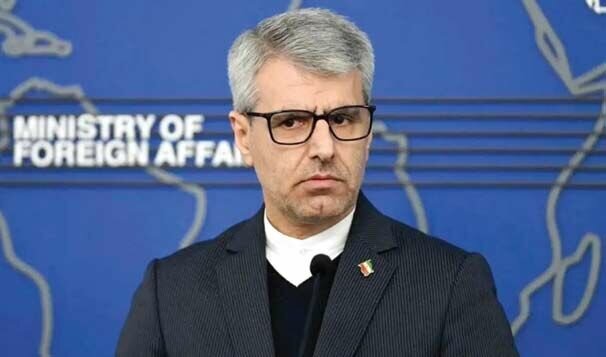
TEHRAN – Iranian Foreign Ministry Spokesperson Esmaeil Baqaei has stressed that the seven conditions set by Tehran for ending the war and resolving the standoff with Washington are an integral part of Iran’s legitimate rights, emphasizing that the country will not abandon them under threats or pressure.
Speaking at his weekly press conference in Tehran on Monday, Baqaei said security in the Strait of Hormuz and the wider region could be restored within the shortest possible time if the United States fulfilled its commitments and met Iran’s conditions.
His remarks came in response to questions about Foreign Minister Abbas Araqchi’s statement that Iran could reopen the strategic waterway within two hours if Washington fulfilled its obligations.
Baqaei said Araqchi’s comments should be understood in their proper context, explaining that Iran’s readiness to implement its commitments promptly should not be interpreted as overlooking the complexities of the situation or the need for the other side to meet its obligations.
He emphasized that Iran remained committed to fulfilling its commitments, provided that the United States did the same.
“The Islamic Republic of Iran knows what it wants, understands the rights of the Iranian people and their full scope, and will under no circumstances back down on this matter,” he said.
The spokesman rejected the characterization of Iran’s seven conditions as extraordinary demands or new preconditions for negotiations, describing them instead as an inseparable part of the country’s legitimate rights.
He said the conditions included the removal of 'cruel and unlawful sanctions,' the lifting of the US naval blockade, and the implementation of all provisions of the memorandum of understanding signed by Tehran and Washington on June 18, 2026.
Baqaei’s remarks followed Iran’s proposal for a two-day roadmap to restore security in the Strait of Hormuz. Under the proposed arrangement, commercial shipping could resume passage through the strategic waterway within 48 hours if Washington lifted its blockade of Iranian ports, ended the war on all fronts, and unfroze Iranian assets held abroad.
The spokesman described the proposal as a logical framework for restoring security, reiterating that the responsibility for creating the necessary conditions rested with the United States.
Iran rejects US threats and naval blockade
Addressing recent threats by US President Donald Trump to sink Iranian oil tankers and target vessels attempting to breach the American naval blockade, Baqaei said such threats were nothing new, noting that Iran had faced similar rhetoric from Washington for nearly five decades.
He said the Iranian people would not abandon their homeland, rights or dignity in the face of intimidation.
Baqaei also rejected the continuation of the US economic and naval blockade, saying Iran would not tolerate such measures and would employ all available means to counter them.
Iran, he added, had devised a combination of military, defensive, political and diplomatic measures to counter the blockade and sanctions, stressing that the issue would be followed by concrete action.
Commenting on a recent trilateral meeting involving the leaders of China, Russia and the United States in Shenzhen, Baqaei said discussions on international and regional issues were a normal feature of high-level diplomatic gatherings.
However, he stressed that Iran was no longer merely an active participant in regional and international developments but had become an influential force in shaping them.
He described Russia and China as friends of Iran, noting that Tehran had maintained contacts with both countries before the meeting and continued consultations through its diplomatic missions afterward.
Referring to the meeting's published final statement, he said Iran was confident in its ability to determine its own course.
“Decisions concerning Iran will not be made anywhere other than Tehran,” he emphasized.
Iran rejects accusations in Qatar-Germany statement
Baqaei also expressed surprise and deep regret over a joint statement issued by Qatar and Germany containing accusations against Iran regarding attacks on regional countries, its nuclear program and maritime security in the Strait of Hormuz.
Tehran stresses respect for Lebanon's sovereignty
On Lebanon, Baqaei reaffirmed that Iran fully respected the country's sovereignty and territorial integrity, identifying the Israeli regime's occupation of Lebanese territory and its continued aggression as the principal threats to Lebanon's independence.
He also said the Hezbollah resistance movement had been established to confront Israeli occupation and aggression, rejecting any suggestion that Iran's position was comparable to the actions of an occupying power.
Iran condemns reports targeting its dams
Responding to US media reports portraying Iranian dams as military facilities and raising allegations about the possible use of a dirty bomb, Baqaei described the coverage as unprofessional and unethical.
He said the reports formed part of a US psychological warfare campaign aimed at creating a pretext for further aggression and justifying flagrant violations of international humanitarian law.
Asked about Iran's response to a potential attack on the country's dams, he said the United States would not dare to take such action.
Baqaei also questioned the timing of the reports, arguing that their circulation following the US elections was intended to justify Washington's previous actions despite opposition among American voters to their government's policies.
The spokesman also criticized attempts by US and Israeli intelligence agencies to arm terrorist groups inside Iran, describing the efforts as a continuation of failed operations over previous decades and an indication that those behind them had failed to understand Iranian society.