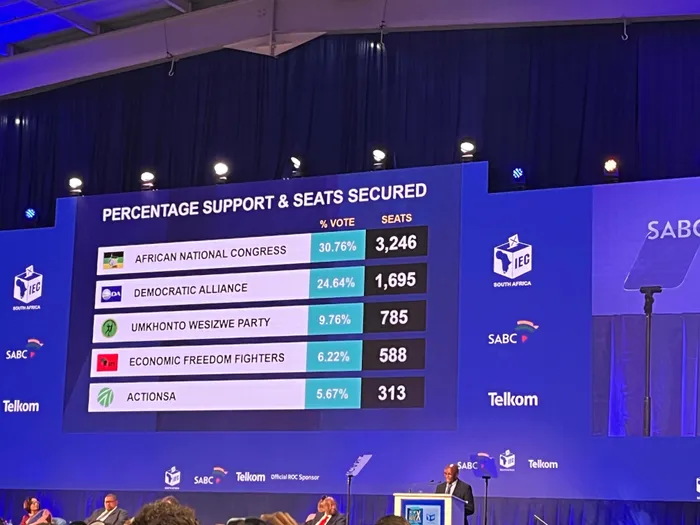
IEC Chairperson Mosotho Moepya announced the final results of the 2026 Local Government Elections at the National Results Operations Centre at the Gallagher Convention Centre in Midrand on Sunday. The results paint a picture of South Africa’s changing political landscape, with the ANC leading nationally, followed by the DA and uMkhonto weSizwe Party. Meanwhile, 137 municipalities have been identified as hung councils, setting the stage for coalition negotiations.
As political parties move to form coalition governments following South Africa’s 2026 local government elections, questions have emerged over what happens when a coalition collapses and parties can no longer govern together.
The elections have left 137 municipalities without an outright majority, meaning several political parties will have to work together to govern councils.
However, the collapse of a coalition government does not automatically mean fresh elections will be held or that a municipality will stop functioning.
South African law allows municipal councils to elect new leaders and establish alternative governing arrangements without requiring residents to return to the polls.
What happens when a coalition collapses?
A coalition can collapse when one or more political parties withdraw their support from a governing agreement, leaving the mayor or governing bloc without sufficient backing in council.
When this happens, opposition parties may introduce a motion of no confidence against the mayor.
If the motion succeeds, the mayor can be removed and councillors can elect a replacement without holding another municipal election.
Alternatively, the remaining parties may negotiate a new coalition or continue governing as a minority administration, relying on support from other councillors to pass important decisions.
However, if political disagreements continue, the municipality could struggle to approve budgets, implement policies and deliver essential services.
Can the provincial government intervene?
Under Section 139 of the Constitution, provincial governments may intervene when municipalities fail to fulfil their constitutional or legislative executive obligations.
In serious circumstances, the provincial executive may dissolve the municipal council and appoint an administrator to oversee municipal functions.
If a council is lawfully dissolved, a fresh municipal election must generally be held within 90 days.
However, the collapse of a coalition alone does not automatically justify provincial intervention or the dissolution of a council.
Government warns against coalition instability
Cooperative Governance and Traditional Affairs Minister Velenkosini Hlabisa has urged political parties to prioritise stable governance and service delivery.
“Differences among coalition partners must not become obstacles to the work of municipalities,” Hlabisa said.
He has also emphasised the importance of cooperation among political parties where no single party has secured an outright majority.
“If you did not get 50% plus one, you are not a majority. You are only bigger. You need to engage other political parties so that you have 50% plus one,” he said.
Lessons from previous coalition failures
South Africa has experienced coalition instability before, particularly following the 2021 local government elections.
Municipalities including Johannesburg, Tshwane and Nelson Mandela Bay experienced changes in political leadership as coalition agreements collapsed and mayors faced motions of no confidence.
In Johannesburg, repeated changes in political leadership highlighted the challenges of governing through fragile political alliances.
Such instability can delay municipal decision-making, disrupt long-term planning and create uncertainty over service delivery.
While a failed coalition does not automatically trigger another election, prolonged political instability could have serious consequences for residents.
Ultimately, the success of coalition governments will depend not only on political parties agreeing to share power, but also on their ability to maintain stable administrations and deliver essential services to communities.