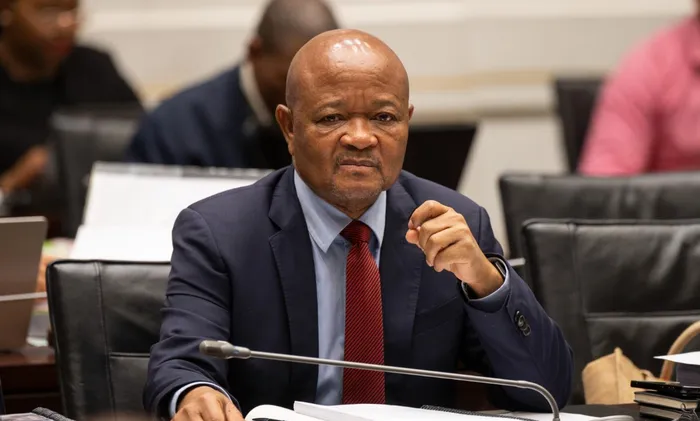
Suspended Police Minister Senzo Mchunu argues police warrant unlawfully covered KZN properties.
Image: Armand Hough / Independent Newspapers
Suspended Police Minister Senzo Mchunu has challenged the legality of the evidence used by police to obtain search warrants against him, alleging that investigators seized a cellphone not covered by the warrant and included properties in KwaZulu-Natal despite the warrant being authorised in Gauteng.
In a replying affidavit filed in the Gauteng High Court in Johannesburg on November 11, Mchunu argues that the September 2026 search operation was unlawful and that the allegations relied on by police do not establish reasonable grounds to investigate him or seize his electronic devices.
At the centre of his challenge is a cellphone seized during a search in KwaZulu-Natal. Mchunu says its International Mobile Equipment Identity (IMEI) number differed from the number specified in the September 21 warrant.
He relies on the confirmatory affidavit of SAPS officer Elethu Talatala, who participated in the search operation.
Talatala reportedly stated under oath: “I seized one handset described in the Search, Access or Seizure Warrant authorised on 21 September 2026 under IMEI number 35360743159268. When I physically checked the device, the IMEI number on the device was as follows: 353607431592687/01; however, I concluded that it is the same device considering that the first 14 numbers of the device were the same.”
Mchunu argues that the officer’s explanation confirms that the device seized did not have the exact IMEI number listed in the warrant.
“By doing so, they seized property for which they did not have a warrant; this is unlawful,” he states.
He wants the court to declare the seizure invalid and unconstitutional and order the return of the device.
Mchunu also challenges the decision to obtain the warrant from the Gauteng Division when three of the four properties listed in it were in KwaZulu-Natal.
He argues that the police relied on section 29(1)(a)(ii)(aa) of the Cybercrimes Act but failed to meet its jurisdictional requirements.
“The 2026 warrant was obtained in the Gauteng Division. Despite the clear terms of this section, the 2026 warrant included three properties in KwaZulu-Natal,” he states.
He further disputes the explanation by the National Commissioner, William Sipho Kunene, that he believed the devices were within the Gauteng court’s jurisdiction.
Mchunu says Kunene’s affidavit also indicated that the outstanding handsets had not been recovered and their locations were unknown.
“He either knew the articles/devices were in the jurisdiction of the Gauteng Division or he did not. It cannot be both,” Mchunu argues.
Beyond the disputed device and jurisdiction, Mchunu questions the evidential basis for linking him to individuals whose communications allegedly featured in the investigation.
He says the allegations rely largely on communications between third parties, including businessman Vusimuzi “Cat” Matlala and Brown Mogotsi, and do not establish his involvement in wrongdoing.
“The suspicion rests on communications between third parties, on call records and on the movement of numbers between,” he states, adding: “I have not been implicated in any alleged wrongdoing. I am not implicated.”
Mchunu also disputes the suggestion that Matlala’s knowledge of the directive to disband the Political Killings Task Team (PKTT) meant that he had communicated it to him.
He says the directive was sent to National Commissioner General Fannie Masemola, with other senior police officials copied in an email sent by his chief of staff, Cedrick Nkabinde, on December 31, 2024.
“It would be speculation to say that,” he states.
He further denies that he solicited or received money allegedly paid by Matlala in connection with the African National Congress’s January 2025 celebrations in Cape Town.
“I neither solicited the money nor did I receive it,” Mchunu says.
He argues that investigators could have examined the relevant bank accounts to establish whether he received any money rather than relying on the seizure of electronic devices.
“A simple evaluation of Messrs Mogotsi, Matlala and my bank accounts would have easily answered Mr Kunene’s concerns or suspicions regarding whether I received money from Mr Matlala, which is clearly not the case,” he states.
Mchunu also relies on evidence given by Lieutenant-General Nhlanhla Mkhwanazi before Parliament’s Ad Hoc Committee on March 18, 2026.
He quotes Mkhwanazi as saying: “A classic example: Minister Mchunu was new in the organisation; I believe he was captured to write that letter. He typed it on his iPad.”
Mchunu argues that the testimony does not establish corruption on his part and says Kunene has not disclosed evidence demonstrating that he was involved in corrupt conduct.
“To date, Mr Kunene has not disclosed any evidence demonstrating corruption on my part,” he states.
He adds that Kunene should disclose the facts that led him to form a reasonable belief that Mchunu may have been involved in corruption.
The former minister also challenges the police’s explanation that the absence of his communications on surrendered devices was consistent with the investigation.
He quotes the answering affidavit as stating: “The absence of the applicant’s own communications on the surrendered devices is therefore an expected consequence of the very state of affairs that the warrant addresses.”
Mchunu responds: “The consequence for me is that Mr Kunene and the SAPS are abusing court processes and harassing me.”
He says the devices contained little or no historical user information relating to the investigation period because he was not communicating with the third parties during the period referred to by Kunene.
The affidavit also explains why the court application was not brought sooner. Mchunu says his attorneys had not been paid for substantial work undertaken during the Madlanga Commission proceedings, leaving him unable to instruct them to launch the application earlier. He says part of the outstanding account was settled only on November 6.
He maintains that the application is urgent because it concerns his constitutional rights to dignity and privacy.
Mchunu concludes by rejecting Kunene’s opposition and persisting with the relief sought in his notice of motion.
The court will have to determine whether the warrant was lawfully obtained and whether the disputed device was seized within its terms. The allegations and arguments in the replying affidavit represent Mchunu’s version and have not been established as findings by the court.