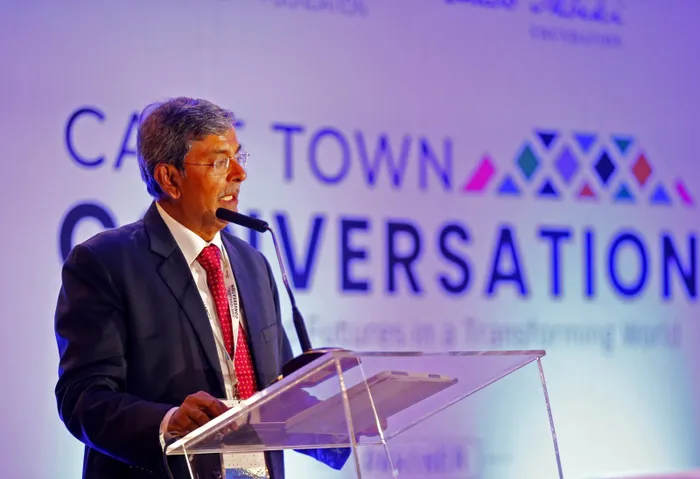
India High Commissioner Prabhat Kumar speaking at The Westin Hotel during the Cape Town Conversation 2026.
Delegates at the fourth annual Cape Town Conversation spent Tuesday discussing how developing countries can work together more closely, from BRICS to rural development, artificial intelligence (AI), and climate action.
The conference was held at The Westin in Cape Town and is hosted by the Thabo Mbeki Foundation and India's Observer Research Foundation. This year's theme is "Shaping Shared Futures in a Transforming World".
Where the first day looked at the world's divisions, day two turned to what countries can actually do about them.
Making BRICS deliver
BRICS, the group of major emerging economies, has recently grown to include more countries from Africa, Asia and the Middle East. Delegates asked how the bloc can move beyond simply having more members and deliver real economic benefits over the next 20 years.
Speakers included India's High Commissioner to South Africa, Prabhat Kumar, and the chairperson of the South African BRICS Think Tank, Mogomme Alpheus Masoga, along with representatives from Russia, Brazil and Egypt. They focused on boosting the New Development Bank's ability to fund infrastructure and local manufacturing in developing countries.
Trade routes and economic pressure
In a session titled "The Return of Geopolitics", panellists discussed how shipping routes, energy supplies, critical minerals and financial systems are increasingly being used as tools of political pressure instead of just for ordinary trade.
Experts from the South African Institute of International Affairs, the International Crisis Group, South Korea and Latvia looked at how developing countries can set up alternative trade routes and financial arrangements without becoming dependent on another powerful country.
Growth from the ground up
With government budgets under pressure and less international development funding available, morning sessions explored growth that starts in local communities.
Swati Sharma of India's Ministry of Rural Development and former Ethiopian Deputy Prime Minister Ato Demeke Mekonnen led discussions on sharing knowledge between countries. One example was linking India's National Rural Livelihoods Mission with African programmes such as Nigeria for Women, to help women start businesses and gain access to digital financial services.
AI and the green economy
Another session looked at how AI can move beyond small test projects and help businesses grow in developing economies.
Afternoon sessions focused on the shift to cleaner energy. Delegates discussed partnerships that would combine South Africa's mineral resources, India's clean-energy manufacturing, Brazil's biofuels and Indonesia's battery industry. They also warned that putting off action on climate change will make economies weaker and food less secure.