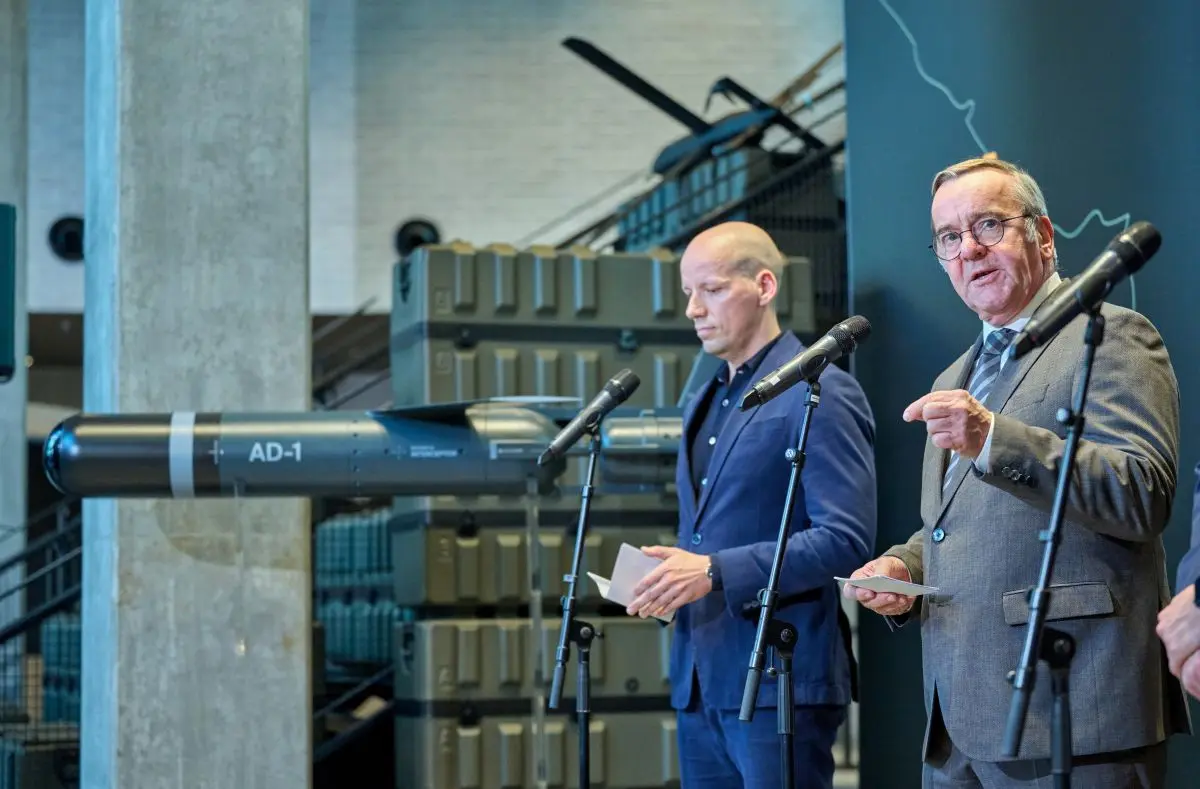
 Defence Minister Boris Pistorius (SPD) pictured with Helsing CEO Gundbert Scherf (left). The AI drone maker is one the companies helping to drive the boom in tech start-up investment in Germany. Photo: picture alliance/dpa | Peter Kneffel
Investments in cutting-edge German start-ups in fields ranging from robotics to defence technology are forecast to almost triple this year to 8.1 billion euros, a study showed Monday.
The influx of money offers some hope for Europe's biggest economy, which is desperately seeking new sources of growth as traditional sectors like auto manufacturing and chemicals suffer.
The study, from the German Start-up Association and the Joachim Herz Foundation, predicted that investments in so-called deep tech start-ups will rise sharply from just 2.9 billion euros last year.
Don't miss our journalists' daily news roundup from Germany
This is a "major success for Germany as a business location and provides a significant boost in several sectors", it said.
Deep tech typically refers to companies developing breakthrough technologies based on advanced scientific research, including areas like artificial intelligence, biotechnology and quantum computing.
READ ALSO: Munich becomes defence tech hub as Europe rearms
The boom was driven by a handful of mega fund-raising rounds by companies including Neura Robotics, which develops humanoid robots, the AI drone maker Helsing and defence tech group Quantum Systems.
About 300 new start-ups in fields classed as deep tech are expected to be founded this year, up 40 percent from 2025, the research showed.
They tend to cluster around cities like Berlin, Munich and Hamburg that are home to leading universities and research institutes.
But many challenges remain, the study said.
It cited a relative lack of funding for deep tech start-ups in Germany compared to the United States, with just 28 percent of capital coming from domestic investors in recent years, it said.
Support for start-ups in moving their innovations out of the lab and into the real world is also not strong enough, it said.
While universities help start-ups in developing and researching ideas, there is not much in the way of support when it comes to entrepreneurial skills or accessing customers, it found.
READ ALSO: Amazon to invest €16 billion in Germany in 2027, including in AI
"Germany has excellent research in many fields," said Sabine Kunst, chair of the board of the Joachim Herz Foundation.
"On the way to application, however, we are too cautious: practical orientation... and the link to entrepreneurship remain side issues in academia," she said.
The study was based on data from founders and directors of German firms collected by the start-up association.
Become a member or log in to continue reading
More
Comments
Join the conversation in our comments section below. Share your own views and experience and if you have a question or suggestion for our journalists then email us at news@thelocal.de.