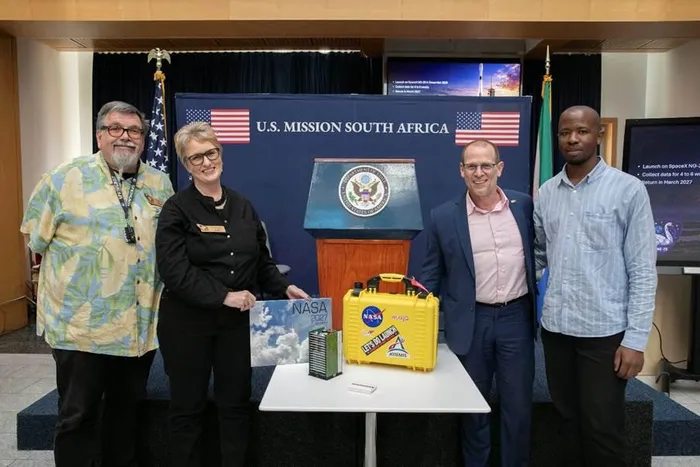
One step closer to space: From left, MaxIQ Space co-founders Bjarke Gotfredsen and Judi Sandrock, US Consulate Cape Town Public Affairs Officer, Sam Werberg, and SA Rooibos Council (SARC) seed technician, Cyril Ngqwala, with the Nanolab that will carry the Rooibos experiment and other school and university experiments to the ISS.
A project linking the Cederberg’s indigenous rooibos industry with space science aims to inspire young learners while exploring new possibilities for agricultural research.
For learners growing up in the Cederberg, where rooibos is part of the landscape and local livelihoods, a familiar indigenous plant is about to become the focus of an experiment beyond Earth.
The Rooibos in Space project will send rooibos seeds to the International Space Station (ISS), bringing together South African agriculture, scientific research and opportunities for young people to explore science and technology.
The initiative is driven by the South African Rooibos Council (SARC), in collaboration with MaxIQ Space and the South African National Space Agency (SANSA).
According to Dawie de Villiers, a SARC director, the idea grew out of a desire to create something that would go beyond promoting rooibos.
The council wanted to raise awareness of the uniquely South African plant internationally while creating opportunities for learners and communities in the Cederberg, where it is grown.
“When the SARC approached the South African space sector to explore what might be possible, the recommendation was to contact MaxIQ Space,” said De Villiers.
MaxIQ Space co-ordinates access to orbit through its International Space Station ride-share programme, bringing different experiments together in a shared payload to make space research more accessible to schools, universities and research partners.
The rooibos experiment has been booked aboard a Northrop Grumman Cygnus cargo resupply mission, alongside 14 other experiments from institutions across Africa and the Americas. The launch is currently scheduled for the December 2026 to January 2027 window, although an exact date has not been confirmed.
1MaxIQ Space said the mission would also connect young people with practical scientific activities, including environmental measurements, coding and investigations using Springbot instruments.
“The message is that young South Africans can contribute to this work, bringing questions and ideas that matter to their communities,” the organisation said.
Beyond its educational value, the project could contribute to future agricultural research by investigating how exposure to the space environment affects rooibos seeds.
Once the seeds return to Earth, they will be planted alongside control batches that have remained on Earth and been prepared in the same way. The comparative study will involve seven Cederberg schools: Sederberg Primary, Môrester Akademie, Hoërskool Piketberg, PW De Bruin Primary, Clanwilliam Sekondêr, Graafwater Primêr and Cederberg Academy. Parklands College will also participate.
Over 18 months, learners and researchers will monitor germination rates and seedling growth and development under identical conditions to see whether microgravity and space radiation measurably affect the seeds.
SANSA said comparing the space-exposed seeds with those kept on Earth would help researchers investigate possible differences in plant development. The findings could contribute to knowledge relevant to agricultural challenges such as drought and heat.
However, the agency cautioned that exposure to space does not automatically make seeds more resilient. Any potential benefits would need to be demonstrated through controlled experiments and further trials.
Learners participating in the study are receiving dedicated science, technology, engineering and mathematics (STEM) training to prepare them to plant the seeds, monitor their growth and collect research data.
The educational programme also extends beyond the participating schools. SARC launched a national competition inviting learners aged 12 to 18 to design the official Rooibos in Space mission patch, while more than 8 000 infographic posters explaining the project have been distributed to schools across the country.
By connecting an indigenous crop with an international space science mission, Rooibos in Space hopes to show young learners that scientific discovery does not have to begin far from home.
Instead, it can start with something growing in their own communities.