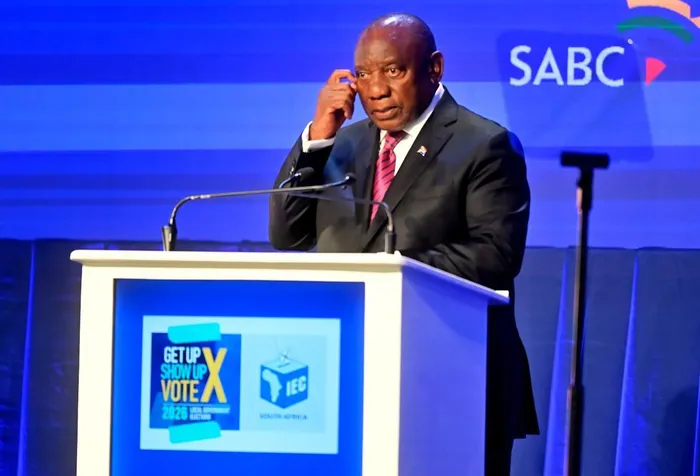
President Cyril Ramaphosa has urged political parties to put their differences aside and co-operate in establishing municipal councils, as 127 hung councils leave parties facing coalition negotiations following the 2026 local government elections.
President Cyril Ramaphosa has urged political parties to put their political differences aside and work together to establish functioning municipal councils, as 127 municipalities face coalition negotiations following the 2026 Local Government Elections.
In his weekly letter to the nation, Ramaphosa said parties needed to reach agreements on the election of office-bearers to ensure councils could be constituted and begin addressing the needs of communities.
The appeal comes after the Electoral Commission of South Africa (IEC) announced the final election results on Sunday, revealing that 72 of the country's 213 councils had parties with outright majorities, while 127 were hung, leaving political parties to negotiate coalition arrangements to establish governing majorities.
The African National Congress (ANC) remained the largest party nationally, securing 30.76% of the vote, but its support dropped significantly from the 45.59% it received in the 2021 local government elections.
The Democratic Alliance (DA) came second with 24.64%, followed by the uMkhonto weSizwe (MK) Party with 9.76%, the Economic Freedom Fighters (EFF) with 6.22% and ActionSA with 5.67%.
The results mean political parties will have to negotiate coalition arrangements in many councils, with the outcome of those negotiations determining the political leadership of councils for the next five years.
Ramaphosa said parties should not allow political differences to stand in the way of establishing accountable local government.
"Winning the confidence of the electorate at the ballot box must never be taken for granted," he said.
"Political parties must co-operate in good faith to reach agreement on the election of office-bearers so that councils can be constituted and they can get to work."
Those elected needed to find common ground from the beginning, regardless of their political affiliations.
Ramaphosa says voters want better service delivery
The President said the election had demonstrated that South Africans expected those entrusted with public office to deliver on their responsibilities, particularly on issues affecting their everyday lives.
The priorities of voters included employment and economic opportunities, reliable and affordable water and electricity, properly maintained public spaces and safer neighbourhoods.
Municipalities also needed to be well-run, with local government finances managed responsibly.
Ramaphosa said these demands should guide the work of incoming councillors as they took up their positions.
Their responsibilities would extend beyond addressing immediate community needs to helping reshape the local government system, guided by recommendations in the revised White Paper on Local Government.
The proposed reforms include measures to strengthen municipal finances, direct more funding towards infrastructure maintenance and improve the reliability of services reaching communities.
"We need to make local government an engine room of service delivery, a driver of development and a creator of opportunity," Ramaphosa said.
Councillors needed to put the interests of communities ahead of other considerations, listen to residents and carry out their responsibilities with humility.
More than 15 million South Africans cast ballots
The President also congratulated the IEC for conducting the elections, which he described as free, fair and peaceful.
He commended the police, the defence force and other government officials for helping ensure that voting proceeded smoothly and securely. He also praised political parties and candidates who campaigned responsibly.
The elections, held on November 4, attracted approximately 14.9 million voters from the country's 29.2 million registered electorate, representing a national turnout of 52%.
This was an increase of 6.1 percentage points from the 45.9% turnout recorded in the 2021 local government elections.
Ramaphosa said the improved participation, alongside the number of parties and candidates contesting, demonstrated that South Africa's democracy remained active and vibrant.
More than 540 parties and close to 137,000 candidates contested the elections, giving voters greater political choice than at any time since 1994, he said.
The elections also coincided with the 30th anniversary of the signing of the Constitution into law, which established South Africa as a multi-party democracy in which every adult has an equal vote and those in power must regularly return to the electorate for a fresh mandate.
"At a time when democracy is being tested in a number of countries, last week’s poll shows that these foundations remain sound," Ramaphosa said.
President calls for accountable local government
Ramaphosa said the issues shaping South African voters' decisions were not unique to the country, with economic opportunities and basic services also influencing political choices in democracies around the world.
The election results should serve as a reminder to political parties and elected representatives that public confidence had to be earned through their performance in office.
The incoming councillors now face the responsibility of ensuring that municipalities become more effective, financially sustainable and responsive to the communities they serve.
Ramaphosa said ensuring that democracy delivered for all South Africans required collective responsibility beyond election day.
"It is up to all of us to ensure that democracy delivers for every South African and that local government works better for all," he said.