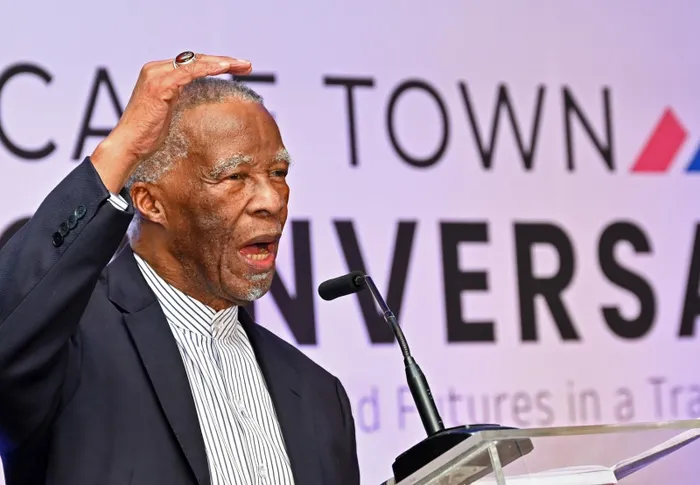
Former president Thabo Mbeki warns world is running out of time to meet UN development goals.
Former President Thabo Mbeki has warned that the world is running out of time to deliver on the Sustainable Development Goals (SDG) and has challenged the Cape Town Conversation to produce a plan to save it.
Delivering the valedictory address at the fourth Cape Town Conversation, Mbeki said the world is now three years away from 2030, with only a minority of the goals likely to be achieved.
“We are now three years away from 2030. Maybe that 15% would have grown to 17 and a half percent of that, but it would still remain the minority of things that were certain in terms of the SDG project," he said.
Mbeki says SDGs must address inequality
Mbeki said the SDGs were never meant for the wealthy few.
“There are enormous disparities or inequalities in our societies,” he said.
“The Sustainable Development Goals were designed exactly to address this large section of the human population, which needs a kind of intervention visualised in the SDGs,” he said.
He challenged the two foundations behind the Conversation, the Thabo Mbeki Foundation and India’s Observer Research Foundation to make the SDGs the centrepiece of their fifth meeting next year.
“I think we should make a contribution with regard to this,” he said.
He said if the fifth session produced a clear plan on what should happen with regard to 2030, the world would listen.
Dialogue focuses on Africa’s economic agency
“I’m saying I’m quite certain millions of people across the globe will stand up and give you a standing ovation,” he said.
He said that voice could force action from those with the power and resources to act.
“Because that voice, it may very well be that voice, may very well be the voice that’s needed to shame all of the people who’ve got the ways and means, to shame them or encourage them or incite them or whatever to do what is right,” he said.
The two-day dialogue, held on 23 and 24 November at The Westin under the theme “Shaping Shared Futures in a Transforming World” brought together policymakers, business leaders and researchers to consider how African countries can turn global disruption into greater economic agency.
Key areas of discussion included BRICS, AI governance, maritime connectivity, development finance and the energy transition, alongside practical issues such as local-language artificial intelligence, rural transformation and public-sector capacity building.
A key focus of this year’s edition was the evolving India-Africa partnership, which the organisers describe as significant for the future of the two regions and the wider Global South.
Earlier, Thabo Mbeki Foundation Chief Operating Officer Lukhanyo Neer said South Africa and India both faced pressure over the sovereign choices they made over the past year.
South Africa and India face pressure over sovereignty
Neer said South Africa had faced what many South Africans regard as “the open hostility of the present administration of the United States.”
“This has found expression in punitive tariffs on our exports, in public allegations against our country that have no basis in fact, and in the decision of that administration to stay away from the G20 Leaders' Summit in Johannesburg last year,” he said.
Neer said India had faced similar pressure, despite its progress and its close relationship with Washington.
"Our friends in India, notwithstanding the considerable advances they have made in their own development and the close relationship they have. In both cases, the message has been the same: that the countries of the South may exercise their sovereignty only within limits determined elsewhere," he said.
Observer Research Foundation associate fellow Samir Bhattacharya said the main message for the Global South knows how to lead.
“The primary message is that the Global South knows how to lead. If you look at the G20, the most successful G20 presidencies were those of Indonesia, India and South Africa. So, the three Global South countries. So this is a dialogue where we want to discuss, we want to be part of the decision making, we want to be part of the norms. It is where we are deciding what the global future, the future of the globe, will be,” he said.
“We should shape it, the Global South countries. So this is why, you will see, it’s not just India, South Africa, there are people from everywhere and not just the Global South, also the Global North. So we don’t want to exclude the Global North from the decision making. We want to make it together. So that is the idea. And we have divided the sessions based on the needs.”
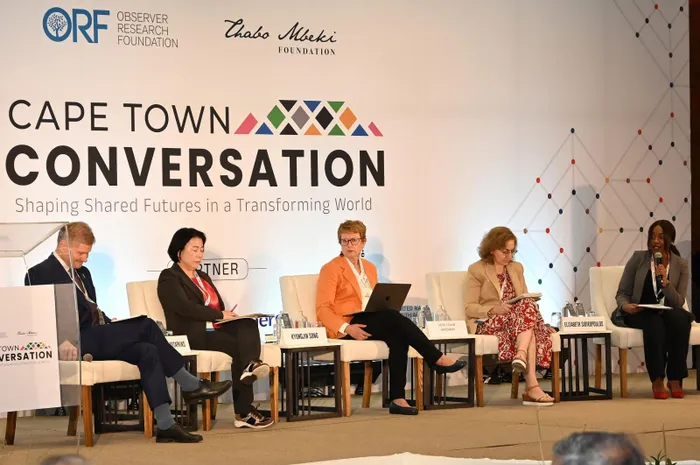
Panelist at The Westin for the Thabo Mbeki Foundation Cape Town Conversation.
BRICS offers platform for a changing global order
Head of the BRICS Expert Council–Russia, Deputy Director of the Primakov National Research Institute of World Economy and International Relations of the Russian Academy of Sciences (IMEMO), and Russia’s W20 Sherpa, Dr Victoria Panova, said the Conversation remained valuable because of who it brings together.
"It is always a really enriching event, because there is a variety of people coming from all over Africa, all over the world, and so it’s a possibility to touch base with the people on what are the most important issues that are now on the agenda.”
For BRICS, she said, that exchange mattered because after expansion, the bloc had brought in Egypt and Ethiopia in addition to South Africa, which had “enhanced African voice greatly.”
Panova said the current system was under severe strain, describing a poly-crisis in which institutions were not dealing efficiently with upcoming crises.
“We do believe in BRICS, that the UN should remain and remains the centerpiece of international relations,” she said.
“In BRICS we’re trying to think of a new model that would be more fair, more responsive to the needs of the global majority.”