Ancient humans were using cannabis far earlier in history than we thought
New findings from a Siberian tomb offer the earliest direct evidence for human marijuana use
By Mary Randolph edited by Claire Cameron
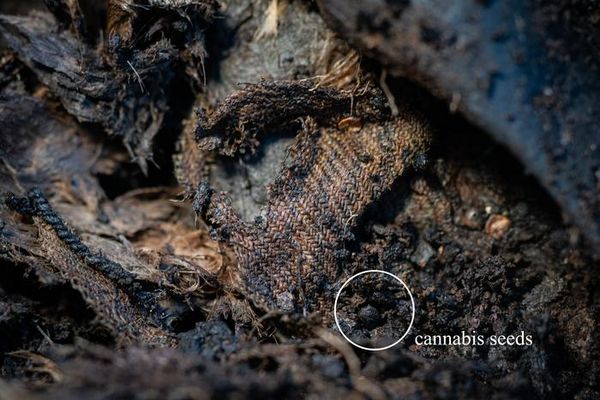 Archaeologists discovered the 2800-year-old cannabis use through analyzing a combination of plant seeds and human hair. Frozen Corpses Golden Treasures, T.Wallace & G. Caspari
Whether you’re eating, smoking or drinking it, cannabis is commonplace; in the U.S., more people use it on a daily or near-daily basis than any other intoxicating substance, including alcohol or cigarettes. But how far back does humanity’s relationship with cannabis stretch?
In new research, archaeologists have dated the earliest known human use of cannabis to 2,800 years ago. The drug was likely used in a burial ritual at a tomb discovered in what is now Siberia. The archaeologists found direct evidence of its use, gathered from a combination of seeds and human hair—together these provide new insights into ancient societies and their cultural legacies’ potential influence on our world today, experts say.
“There is a lot of speculation about the use of psychoactive substances in the past,” says Gino Caspari, the paper’s lead author and an archaeologist at the Max Planck Institute of Geoanthropology in Jena, Germany. “It is extremely rare to find real evidence for it. We bring a bit of realism into these debates, and we show that cannabis has a deep cultural history which might factor into ongoing societal discourse on legalization and medical use.”
On supporting science journalism
If you're enjoying this article, consider supporting our award-winning journalism by subscribing. By purchasing a subscription you are helping to ensure the future of impactful stories about the discoveries and ideas shaping our world today.
Caspari’s team excavated Tunnug 1, a burial mound used by the Scythian people in southern Siberia that dates to between the eighth and ninth centuries B.C.E. While studying the tombs, the archaeologists found more than 1,000 cannabis seeds. Radiocarbon analysis dated them back to the early eighth century B.C.E.
The real breakthrough, though, was in the human hair recovered from the burial sites, Caspari says. It contained cannabinol, a chemical produced from tetrahydrocannabinol, or THC—the compound that makes cannabis psychoactive.
“We had our suspicions when the little seeds first appeared in the tomb, but when we spotted the netlike pattern on the surface, this was a real moment when we knew we were holding something very special in our hands,” he says. “A little later we saw that there was also preserved human hair in the same burial—that was almost too good to be true.”
Researchers already knew that humans have a long history with cannabis. People have been cultivating the plant for agricultural reasons for at least 6,000 years. Until now, the earliest evidence of cannabis use dated to around 2,500 years ago: charred marijuana remains found in eastern China that contained high levels of THC. That evidence, however, was indirect because it only showed the plant remains—whereas the newly found combination of seeds and human hair offers a “smoking gun of evidence” for humans using the plant to get high, says Casper Meyer, an archaeologist at Bard College, who was not involved in the new study.
Meyer says that the finding challenges our modern assumptions of religion, drugs and the intersection of the two.
“It’s an interesting way of looking at what ritual can be, what religion can be, and how it can bring people together,” he says. “There’s also a rethinking of what intoxication in a communal context is.”
Because the Scythian culture had no written language, researchers must rely on sites such as Tunnug 1 for clues to the people’s empire, which spanned from as early as the ninth century B.C.E. to as late as the third century C.E. and across the Asian continent.
As archaeologists continue to uncover the site, there will certainly be more plants that reveal secrets of these steppe societies, says William Taylor, an archaeologist at the University of Colorado Boulder, who was also not involved in the new work.
“It’s easy to look at this stuff and say, ‘Oh, the Scythians toked the reefer,’” Taylor jokes. “But in fact, it is a tremendously powerful snapshot into an interconnected world in which the people and cultures of the steppe were starting to shape life on both ends of a massive continent.”
Cannabis can often carry stigma or exist on the outskirts of research, Taylor says, but the new evidence, published today in Science, “fills this really important gap in our understanding of human history.”
Great science journalism requires human expertise, time, effort and creativity. And it costs money. That’s why I and the journalists here at Scientific American hope you’ll join our community.
When you subscribe, you are supporting staff and freelance journalists who are passionate about telling science stories that are true, important and compelling. Our editors and reporters are often experts in their fields, which means they understand the nuances of big discoveries and can untangle the breakthroughs from the hype. With a subscription, you are also supporting rigorous fact-checking to ensure the words we publish are precise and accurate. And you’re supporting original illustrations, graphics and photos that bring you closer to an advanced laboratory, an ice sheet in Antarctica or a space mission in orbit. You’re helping us craft other types of high-quality journalism as well: Our newsletters are carefully written, edited and curated by staffers you have or will come to know and love. Our Science Quickly podcast is based on original reporting, collaboration with editors and scientists and exacting production.
Subscriptions keep this engine running so we can continue to deliver thoughtful, rigorous and independent science journalism to you. In an era of viral misinformation, this work is crucial. If you value what we do, I hope you’ll consider joining us as a subscriber