More than 92,000 people have registered to attend the COP31 climate summit in Antalya, Turkey, potentially making it the largest COP in history.
Carbon Brief analysis of the provisional lists of delegates, published by the United Nations Framework Convention on Climate Change (UNFCCC), reveals that more than 14,000 delegates have been registered as “host country guests”.
For comparison, the final list for COP30 in Belém, Brazil, last year included only around 1,300 delegates in this category.
As with COP30, Donald Trump’s US government has not sent a delegation. Other no-shows include Israel and Myanmar.
It was reported ahead of the summit that Taliban officials from Afghanistan had been registered for the event as observers; however, there are no delegates from observer states in the provisional lists.
With more than 3,000 “virtual” delegates signed up to attend the summit online, the total number of people registered for the event surpasses 95,000.
Party delegates
With 92,934 participants registered, COP31 is provisionally the largest COP in history – topping COP28 in Dubai, which was attended by more than 80,000 people.
This total is based on the delegates that have registered to be at the summit in person. The UNFCCC releases the final figures – based on participants collecting a physical badge at the venue – after the summit has ended.
The chart below shows how the provisional figures for COP31 compare to the final totals in previous COPs – going back to COP1 in Berlin in 1995.
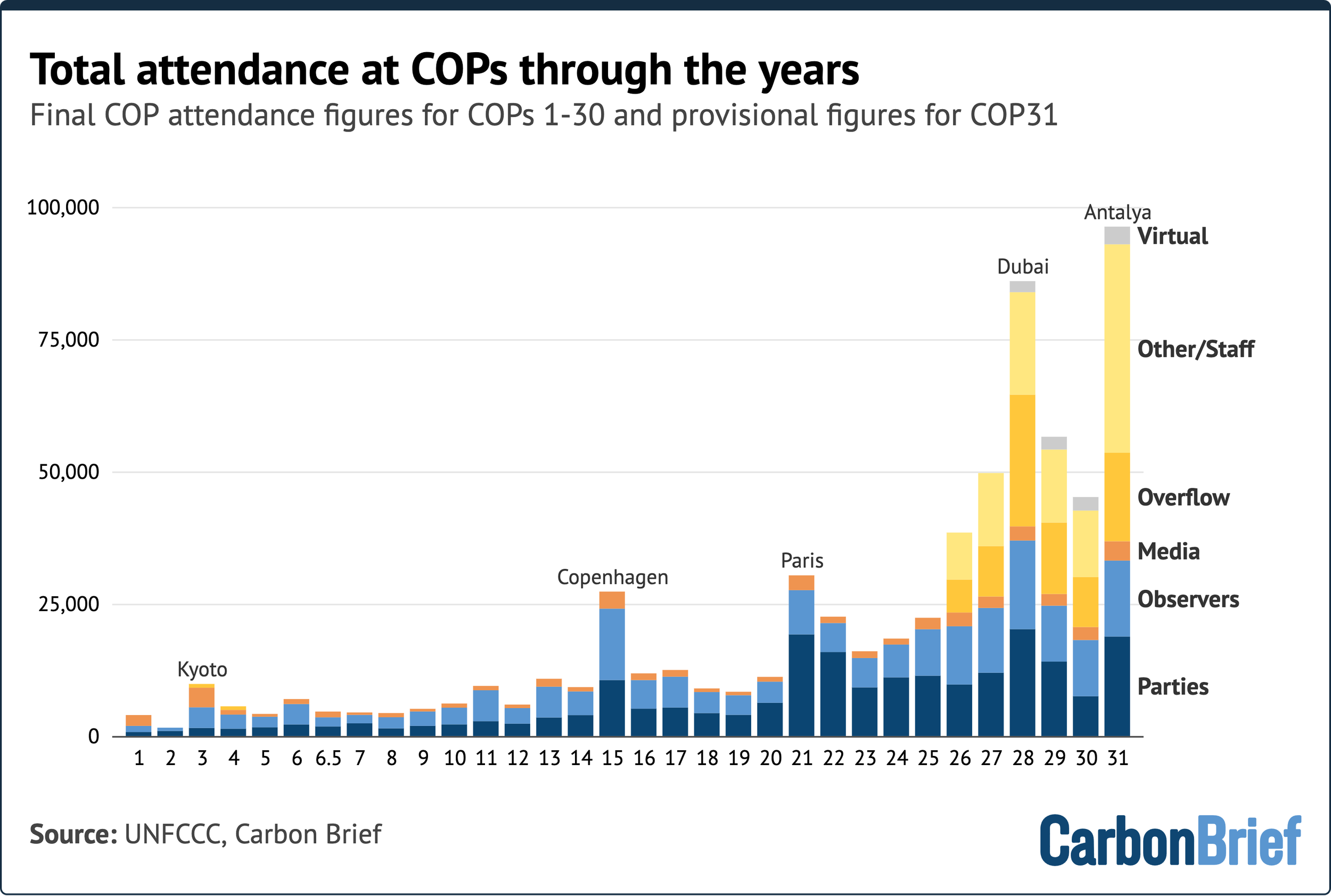 Overall totals for delegates from parties, observers and the media for all COPs, as published by the UNFCCC (see this article for more details on the data). Data for COPs 1-30 are the “final” figures, while COP31 data is “provisional”. The figures for COP31 breakdown as follows: parties (18,812), observers (13,388), media (3,645), overflow (16,726), other/staff (39,400) and virtual (3,335). Chart by Carbon Brief.
The participant lists provided by the UNFCCC are divided between the different types of groups and organisations attending the summit. The largest group at COP31 is for delegates representing parties. These are nation-states, plus the European Union, that have ratified the convention and play a full part in negotiations.
This group adds up to 18,812 delegates – the second largest after COP28.
Membership
Support award-winning climate journalism
Join CB+(In keeping with recent COPs, the UNFCCC has published spreadsheets that name every single person that has registered for the summit – excluding support staff. Previously, COPs have typically included thousands of “overflow” participants in which countries and UN agencies could nominate delegates without their names appearing on their official lists.)
For consistency with Carbon Brief’s analysis of previous COPs, the above chart includes overflow delegates as a single group. However, the participant lists do divide the overflow delegates between parties and observer groups. Including the overflow numbers takes the total for party representatives to more than 34,000.
Unusually, COP31 has a very large number of “host country guests”. This is a category that has only been included in the COP participant lists over the last few years. The provisional number for COP31 – 14,285 – far exceeds the final number of host guests at COP30 (1,324), COP29 (1,651) and COP28 (4,202).
Nations
The map and table below present the delegation size – split between party and overflow badges – for all the countries registered for COP31. The darker the shading, the more delegates that country has signed up.
Unsurprisingly, host nation Turkey has registered the largest delegation for COP31 – with 2,950 people.
Following behind are Brazil (1,994 people), Nigeria (1,506), China (1,021) and Indonesia (978).
The rest of the top 10 is made up of Australia (835), Uganda (627), Italy (607), Japan (588) and Kazakhstan (557).
The UK comes someway down the list with a delegation of 255.
The smallest delegation comes from North Korea (two), followed by Eritrea and Nicaragua (three) and San Marino and Trinidad and Tobago (four).
(It is worth noting that some countries – such as Brazil – allocate some of their party badges to NGOs, which can artificially inflate the size of their official delegation.)
Gender balance
The UNFCCC’s participant lists typically provide a title – such as Mr, Ms, Sr or Sra – for each registered delegate. In the past, this has allowed Carbon Brief to work out the balance of men to women in the delegations that each country has sent to a COP.
(This analysis always carries the caveat that the titles are designated by UNFCCC and not by Carbon Brief. In addition, Carbon Brief recognises that gender is not best categorised using a binary “man” or “woman” label and appreciates that the UNFCCC’s lists may not be wholly accurate.)
Overall, the COP31 provisional list suggests an average gender balance of party delegations of 59% men to 41% women.
As the chart below shows, COP31 is slightly less balanced than the last two COPs, but broadly continues a trend that has seen COP delegations become a more even split between men and women.
(Note: Since COP28, the UNFCCC has also used titles that do not indicate gender – such as Dr, Prof, Ambassador and Honourable. Therefore, for this analysis, these non-gendered titles – which make up 1.3% of party delegates at COP31, for example – have not been included.)
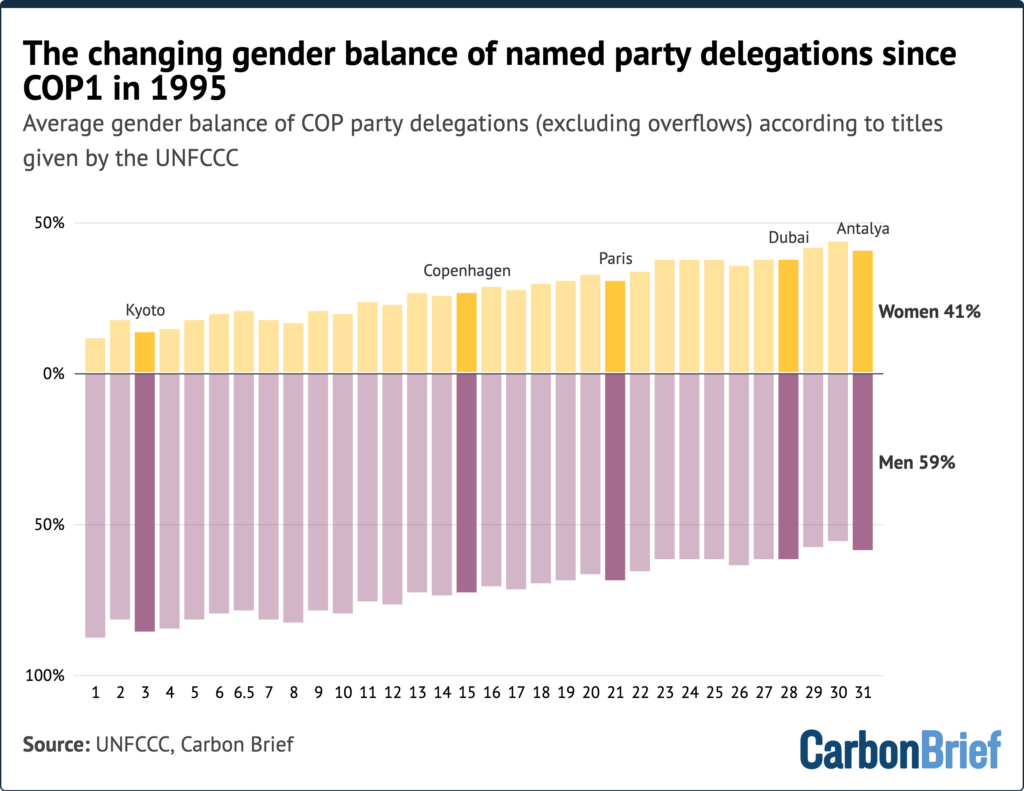 The average percentage split between women (orange) and men (purple) across party delegations (excluding overflows) for each COP, according to titles given by the UNFCCC Data for COPs 1-30 collated from “final” participant lists published by the UNFCCC, while COP31 data is based on the “provisional” list. Note that a small number (<1%) of delegates are not included because there is no information on their gender. Chart by Carbon Brief.
Including overflows, there are two delegations of only men at COP31 – Eritrea (three people) and North Korea (two). There are no delegations that are only women.
The full list of COP31 party delegation sizes can be found here.
(For previous COPs, see Carbon Brief’s delegate analysis for COP21, COP23, COP24, COP25, COP26, COP27, COP28, COP29 and COP30.)
Observers and media
After party delegates, observers of the negotiations are typically the next biggest group at COP summits.
These delegates receive their observer status through their not-for-profit organisation. This can be a UN body, a “specialised agency” – such as the World Bank or International Atomic Energy Agency, an intergovernmental organisation – such as OPEC or the Inter-American Development Bank – or an NGO.
The vast majority of observers at COP31 – more than 12,000 – are representing NGOs. These can include charities, such as WWF, 350.org and Amnesty International, as well as philanthropic organisations, such as the Rockefeller Foundation and the IKEA Foundation, and lobby groups, such as the International Gas Union and the UK’s National Farmers Union.
At COP30 last year, the UNFCCC registration process introduced the option for observers to disclose the “immediate source(s) of funding” for their participation.
This option has been included again at COP31.
Of the 12,413 NGO observers registered for COP31, 14% chose not to disclose funding. The most common funders were NGOs (56%) and academic or research institutions (12%). Around 8% declared funding from “private sector or business”.
In addition, observers were “invited to declare their participation's alignment with the objective of the convention and the goals and principles of the Kyoto Protocol and the Paris Agreement”.
Overall, 13,108 delegates selected “yes” for this section, with the remaining 2,247 delegates leaving the answer blank.
Finally, there are 3,645 media representatives registered to attend COP31 in person, which is provisionally the second-largest media group in COP history – behind COP3 in Kyoto, Japan, in 1997 (3,712).
The way that media organisations are described in the list is very inconsistent, which makes overall totals difficult to tally. Nonetheless, the Turkish Radio and Television Corporation (TRT) is comfortably the most-represented media group at COP31 with more than 200 delegates.
Other media outlets with at least a dozen participants include CNN, the Associated Press, Financial Times, Bloomberg, Agence France-Presse, Reuters and Sky News.
ARTICLE INFORMATION
Update: This article was updated on 11/11/2026 to add further analysis on gender balance, observers and media at COP31.
Related
Analysis: Climate-finance pledges fall 70% as countries meet at COP31
11.11.2026 COP31 Antalya
Q&A: What is the Belém-Antalya mechanism for a ‘just transition’?
09.11.2026 COP31 Antalya
Interactive: Tracking negotiating texts at the COP31 climate summit
05.11.2026 COP31 Antalya
Interactive: Who wants what at the COP31 climate change summit
02.11.2026 COP31 AntalyaThe post Analysis: Which countries have sent the most delegates to COP31? appeared first on Carbon Brief.