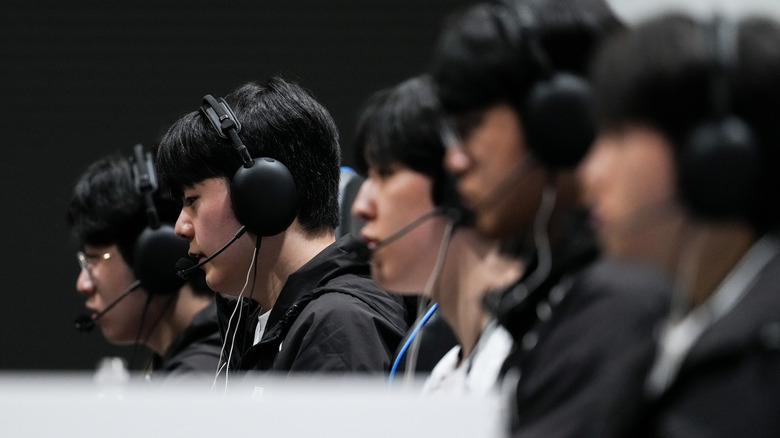
Despite being beloved by AV enthusiasts, OLED hasn't really cracked the esports scene. Big tournaments continue to favor LCD monitors, though perhaps not for the reasons you suspect. Don't worry, we'll get into that shortly. Though pro players have specific reasons for using smaller LCD/IPS screens, for normal gamers, OLED displays remain the pinnacle of TV tech.
Many of the best gaming monitors are OLED, and there's no denying the underlying strengths of this TV type. Phenomenal black levels! Incredible contrast! Excellent viewing angles! Though some folks still sweat over OLED burn-in, it's generally not as big an issue as it used to be. Let's get into why pro gamers don't regularly play on OLED monitors at tournaments, before bigging up the strengths of OLED and comparing how the technology stacks up against LCD.
Are OLED monitors worse for competitive gaming?

Generally speaking, no. OLED monitors aren't worse, than say, IPS monitors, for esports/competitive gaming. As a technology, OLED displays are exceptionally good at handling motion, thanks to their almost instantaneous pixel response. On a good OLED monitor, you're going to see very little ghosting, which makes them great for playing fast-paced first-person shooters.
The real reason pro gamers don't tend to use OLED monitors at tournaments is actually pretty simple and doesn't throw any shade on the technology. For the most part, monitors at competitive events are chosen by sponsors, not individual participants. This is largely a money-making decision, but it's also one that ensures consistency if all those budding esports champs are playing on the same model of monitor.
Because tournament organizers usually supply the hardware for events, they tend to go with monitors that have been in vogue for a good while. At time of writing, 24-inch, 1080p displays remain the preferred size for pro gaming events. This screen size is seen as ideal, with a compact view ensuring players can scan their in-game surroundings quickly and with ease. Put simply, there are far more LCD monitors available at 24-inches than OLED models. In 2026, most OLED monitors start at 27 inches and up, and the generally larger footprint of these displays is probably the main factor why they're not more commonly seen at tournaments.
That's not to say OLED monitors are non-existent in the competitive gaming space. In early 2025, Sony specifically developed its 480Hz M10S OLED display for the Apex Legends Global Series Year 4. That's a mighty high refresh rate for OLED, though many IPS models can go well above 600Hz (another reason LCDs are often favored at competitive events).
Why OLED monitors are great for normal gaming
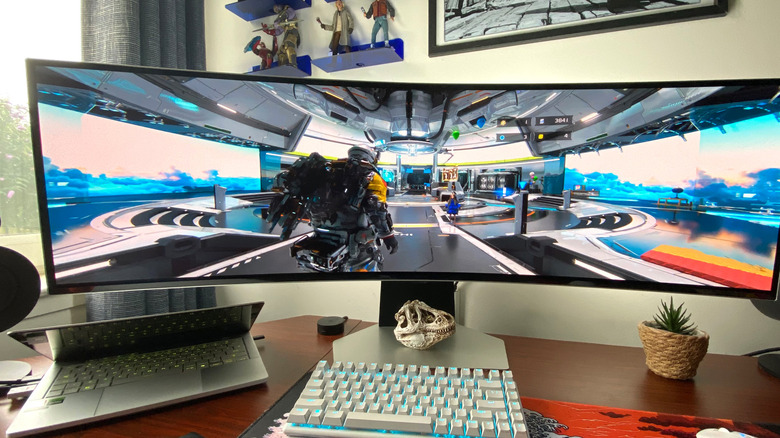
Forget pro gamers for a minute. It doesn't matter if the cream of the esports crop are headshotting each other on LCDs. For normal gaming, OLED is absolutely where it's at. Perfect black levels that lead to sensational contrast. That aforementioned lightning quick pixel response. Exceptional handling of HDR content. Often super slim bezels that help immerse you completely in a world. Far wider viewing angles than LCD TVs. Top tier color reproduction. I've been using OLED TVs since 2015 and OLED monitors since around 2019. I would never in a million years consider buying another LCD display.
Are OLED TVs still worth the premium in 2026? No question, as are OLED monitors. Granted, these displays are normally more expensive than their LCD counterparts. Yet OLEDs have definitely become more affordable over the past few years, especially when the likes of Amazon Prime Day or Black Friday roll around. You can often find 27-inch OLED gaming monitors on Amazon for comfortably less than $500. If you have the budget, and are in the market for a new gaming display, I can't recommend OLED highly enough.
Should I buy an LCD or OLED gaming monitor?

This choice boils down to a number of factors. In the majority of instances, OLED wipes the floor with LCD. It's simply a vastly superior TV technology. That said, there are definitely still reasons why you might want to opt for an LCD/LED monitor over an OLED model.
The advantages LCDs monitors have over OLEDs? One: they're usually considerably cheaper than OLED displays. Two: many LCD monitors are brighter than their OLED counterparts, making them more suited for gaming or working in bright rooms. Three: LCD panels are far less prone to being struck by image retention, whereas OLED burn-in is definitely still a thing. Should you still worry about OLED burn-in in 2026? Kind of. This defect is way less of an issue than it was on previous generations of OLED displays though, and most modern panels have pixel shifting tech to help combat this pesky phenomenon.
That's where LCD's advantage over OLED pretty much dries up. In every other area, OLED trounces LCD. Contrast, motion clarity and image uniformity are all far more impressive on OLED panels. Vertical banding in near-black scenes can still be a little bit of a problem for OLED — think thin vertical lines that you can faintly see during panning shots. Still, that issue is nowhere near as distracting as Dirty Screen Effect. Many LCD displays are terrible for exhibiting this defect, which stems from the fact that LCD backlights can't evenly light their panels, leading to on-screen blotches that become very apparent when watching sports, in particular.
The main reason you want to buy an OLED gaming monitor over an LCD model really boils down to one major factor: OLEDs can do perfect black levels, and LCDs just can't. That's because OLED is a self-emissive technology. In other words, OLED displays generate their own light and color. As they don't need a backlight, they can also turn off every single on-screen pixel when they're not in use, leading to the tech's famously infinite black levels.