The ESA’s Hera mission has begun capturing images of the aftermath of DART’s impact.
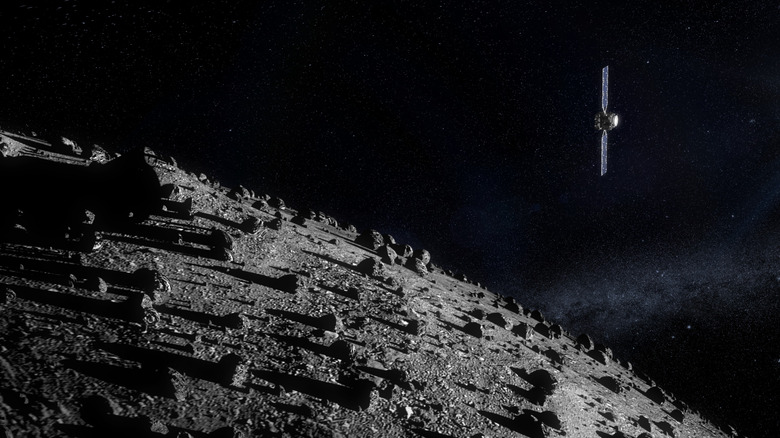
In March, NASA revealed it successfully altered the orbit of Dimorphos and its parent asteroid Didymos around the Sun with its Double Asteroid Redirection Test (DART), and now thanks to new images captured by the ESA's Hera spacecraft, we have a better idea of what that mission actually did to the smaller of the two asteroids. The 2022 controlled crash created an "impact crater the size of a sports stadium," according to Patrick Michel, the Director of Research at France's National Centre for Scientific Research (CNRS) and Hera's principal investigator.
The crater extends across the entire width of Dimorphos, according to Michel, yet it didn't alter the fields of boulders that cover the rest of the asteroid. Besides physically altering the surface of Dimorphos, the ESA found that the DART impact sent the asteroid tumbling in its new orbit. Hera also revealed that both Dimorphos and Didymos are surrounded by hundreds of orbiting boulders.
All of these new details were captured by Hera's monochrome Asteroid Framing Camera, multi-spectral Hyperscout H and JAXA-developed Thermal Infrared Imager from about 25 to 30km away from the asteroids, the ESA says.
"NASA's DART mission demonstrated that we can change an asteroid's orbit," Hera mission manager Ian Carnelli said. "Hera is now revealing what happened to the asteroid itself. By combining these two missions, humanity is taking a decisive step towards making asteroid deflection a reliable tool for protecting our planet."
NASA and other space agencies are exploring altering asteroids' orbits as one way of protecting the Earth from potentially dangerous future impacts. In December, the ESA plans to move Hera closer to Dimorphos and Didymos to capture even higher-resolution images of the impact site. In January, Hera will also deploy shoebox-sized CubeSats to collect other types of data. The Juventas CubeSat, created by a Luxembourg-led research team, will use radar to probe the asteroid's interior and eventually land on its surface. An Italian-led team will use the other CubeSat, Milani, to prospect asteroid dust and other surrounding materials.