BAGUIO, Philippines – When I arrived at the Dap-ay of the John Hay Hotels, the fire was roaring, and so was the art.
Around the bonfire, black-and-white photographs stood on easels, illuminated against the evening darkness. There was a hallway filled with sunlight, a stack of firewood, a motorcycle, the rough bark of a tree, and familiar corners of Baguio that most of us probably pass without a second glance.
I moved from one photograph to another, admiring the angles, textures, and careful use of light. Some were beautifully simple. Others made me look twice.
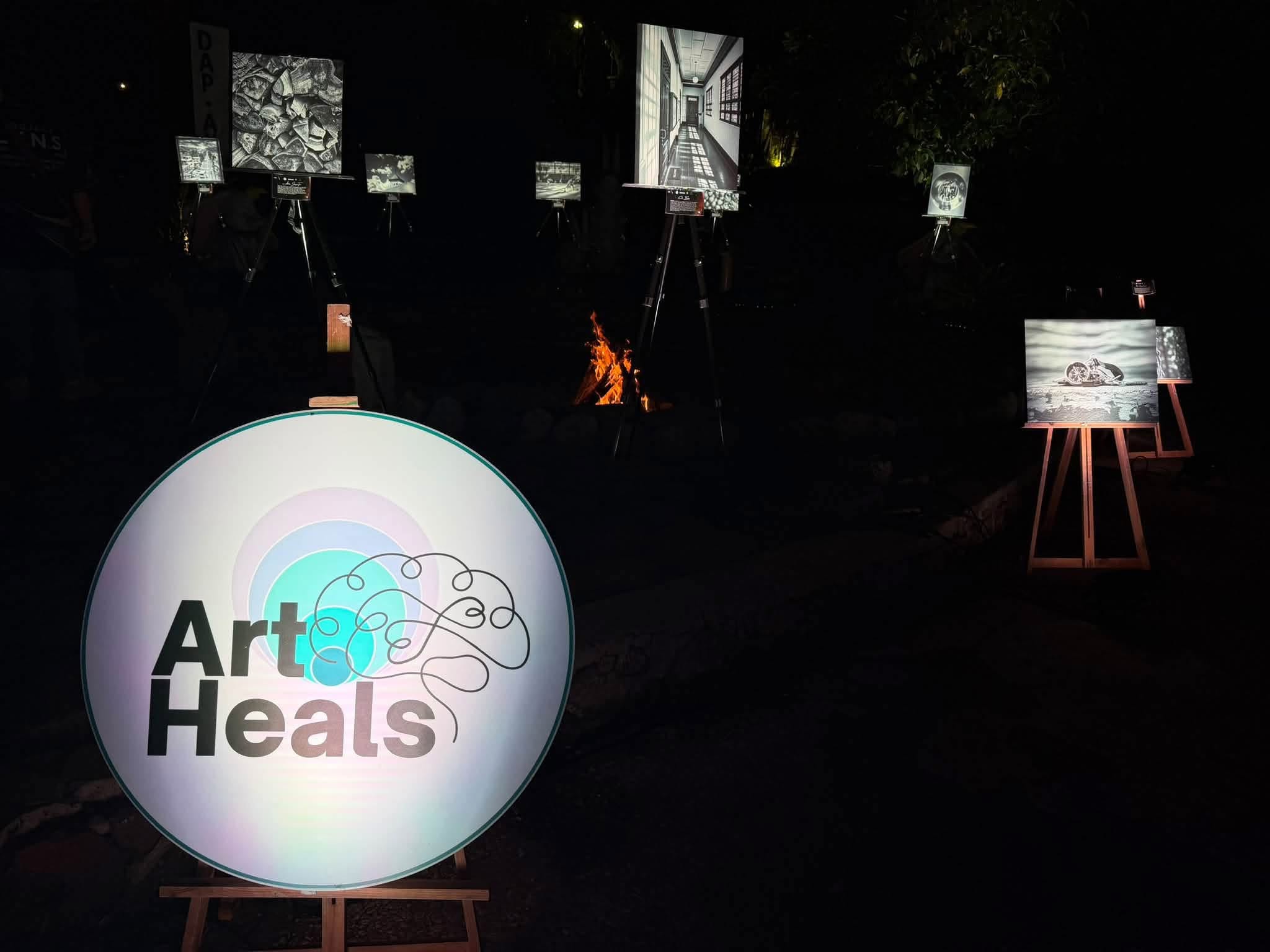 ART HEALS. An Art Heals sign welcomes guests to an outdoor photography exhibition at the Dap-ay of John Hay Hotels, where photographs by 12 artists with autism are displayed around a bonfire.
The photographs were the work of 12 photographers, aged 16 to 33, with diverse abilities and perspectives, participating in The Thinking Photographer, an exhibition organized by Art Heals as part of Project LENS, or Livelihood Empowerment through Nurturing Skills.
Their works were impressive enough to merit an exhibition on their own. But the organizers also wanted to turn artistic interests into practical skills and, eventually, opportunities to earn a living.
For families of children with autism, that possibility addresses a question that becomes more pressing with time. What opportunities will be available to their children when they become adults?
The photographer who learned from his studentsPhotographer and designer Eros Goze mentored the participants in a workshop that grew from one session into two.
When I interviewed him beside the exhibition, he struggled to contain his emotions.
Goze admitted that he had initially been apprehensive about teaching photographers with autism. His previous workshops generally involved participants without autism, and he was uncertain how to adjust his approach.
“Challenge accepted,” he recalled telling himself.
 MENTOR. Photographer and mentor Eros Goze explains the composition techniques used by his students. From leading lines to texture and negative space, the photographs show how the participants interpreted his lessons in their own ways. Mia Magdalena Fokno/Rappler
The participants already had some experience through Photography with a Difference, a program of the Autism Society Philippines (ASP) Baguio Chapter, which was supported by the Baguio Photographers Club under the leadership of the late Ompong Tan.
Goze built on that foundation, teaching composition techniques such as leading lines, contrast, texture, framing, negative space, and the rule of thirds. Instead of directing every shot, he gave the photographers assignments and allowed them to interpret the concepts independently.
The results surprised him.
As we walked around the exhibit, Goze enthusiastically pointed out how the participants had applied what they learned. One image explored the texture of tree bark. Another used the lines of a corridor to guide the viewer’s eye. Ordinary objects became studies in contrast and composition.
“Let the photos speak for themselves,” he said.
Some photographs had been taken using ordinary mobile phones. For Goze, understanding composition and developing an eye for an image mattered more than owning expensive equipment.
What pleased him most was that the participants could apply the lessons on their own. He gave them challenges, and they returned with their answers.
The experience even inspired him to consider another workshop, this time exploring photography with people who are blind. It remains an idea, but one he said he was willing to pursue.
A familiar chapel through someone else’s eyesAmong the photographs, one immediately caught my attention. It showed a church steeple rising toward a sky filled with clouds and sunlight. I recognized it. It was the chapel at Brent International School, where I had worked for nine years.
Naturally, I wanted to meet the photographer.
His name was Manuel Martin Teodoro, a 22-year-old who goes by Sky. He enjoys nature photography and hopes to become a teacher for students with special needs.
When Goze asked him about his composition, Sky identified negative space, one of the techniques covered in the workshop.
I told Sky why I loved his photograph. That chapel had been part of my life for nearly a decade, and he had captured it in a way that made me appreciate it all over again.
Nearby, I met Carlo Bañez, 33, whose interest in photography goes back years. He enjoys photographing nature, people, and sporting activities, and hopes his images will encourage young people, particularly aspiring athletes.
When I asked what he liked about the workshop, he talked about taking pictures and going outdoors.
Then I asked how he felt seeing his work displayed.
“I feel proud of myself,” he answered.
And why shouldn’t he?
Carlo was among 12 photographers whose individual interests gave the exhibition its variety.
Nathan Carlos Clemente, 16, enjoys capturing people, emotions, and details others might overlook. Onel Osbert Gundran, 30, dreams of becoming an internationally recognized photographer, while John Ray Joaquin, 22, hopes to master the craft.
Lyera Joaquin, 29, wants to build a collection of beautiful images. Lynette Joaquin, 33, enjoys photography and paper crafts, while Andrei Nisperos, 21, is interested in both photography and drawing.
Emarnel Pasana, 26, loves documenting festivals and landscapes. Andres Joaquin Tano, 18, is drawn to nature photography, while Josef Noli Vizcocho, 33, enjoys close-up subjects, patterns, shadows, and symmetry.
Then there is Danielle Louise Marquez, 29, known online as Lori, a digital artist who enjoys finding stories in everyday surroundings. She describes herself as stubborn, creative, and observant, and wants to continue making art while developing greater independence.
She is also the daughter of Melan Ku Marquez, the woman behind Art Heals.
 Participants of The Thinking Photographer pose with their mentor, Eros Goze, during the Art Heals exhibition. The artists presented their black-and-white photographs after completing workshops on composition and visual storytelling. courtesy of Melan Ku Marquez
When art becomes an opportunity
For Melan, Art Heals began with a personal belief in creativity.
“When I wrote my book as a legacy for my children, and we started Art Heals, we had one simple belief: that creativity has the power to heal, connect, and transform lives,” she said in her message.
Over the years, the organization explored artistic expression through workshops, exhibitions, and community collaborations. Eventually, Melan and her collaborators began thinking about what could come after those experiences.
“Art does not only heal. It can also empower,” she said.
That thinking led to Project LENS, which seeks to develop creative skills and eventually connect participants with livelihood opportunities.
For Melan, inclusion means more than accepting individuals as they are.
“It is giving them the opportunity to GROW and live meaningful lives,” she said.
The initiative addresses a concern shared by many families. Much of the attention surrounding autism focuses on childhood, particularly education, therapy, and early intervention. Yet the need for support does not disappear when a person turns 18.
Adults with autism may want to pursue careers, earn money, and make decisions about their own lives. Their opportunities depend partly on whether communities and employers recognize their abilities and accommodate their needs.
ASP Baguio chapter president Ma. Teresa Wanchakan addressed this concern during the fundraising dinner.
“These children grew up, supported, understood, and valued. They become adults. Young adults with autism who have beautiful talents, big dreams, and deep desire to be independent,” she told the gathering.
“The funds raised tonight will kickstart a vital livelihood project dedicated to adults with autism,” she added.
Wanchakan said the project aims to provide training and employment opportunities in creative fields.
The exhibition was therefore both a celebration of the photographers’ work and a fundraiser for an initiative whose success will depend on sustained training, partnerships, and actual livelihood opportunities.
Weaving different perspectives togetherJohn Hay Hotels general manager Roberto A. Garcia offered a distinctly Cordilleran perspective during his inspirational message.
“We call tonight Habi, the art of weaving. Watch any Cordillera weaver at her loom and you will notice that no two threads are the same. She never tries to make them identical. She knows the beauty of the cloth comes precisely from how different each thread is.”
Garcia had spent time studying the photographs and noticed how several photographers used windows, doorways, tunnels, and frames to compose their images.
“Our young photographers were not only showing us what they saw. They were showing us where they were standing when they saw it,” he said.
He connected that observation to his experience in hospitality, where making people feel welcome begins with recognizing the person in front of you.
But his most practical message concerned the future of Project LENS.
“Applause is wonderful, but it does not last. What lasts is a skill that has been cared for, and a livelihood that has been made possible. Those are the things that truly change a life, and a family.”
The photographs had drawn an appreciative audience. The challenge now was to create opportunities beyond the exhibition.
Beyond the exhibitionThe evening brought together Art Heals, ASP Baguio, John Hay Hotels, Le Chef, and community supporters.
Chef Billy King and his team prepared dinner, while the Smooth Band and Cordillera Earth Beats provided music. The photographs were also offered at auction to raise funds for Project LENS.
Melan acknowledged the support of Garcia, chef Billy, Venus Tan of CBCC, the Youth Leadership Council of Baguio International School, and other partners. The Philippine Chamber of Commerce and Industry, represented by lawyer Rowena Tabanda, was also recognized for its involvement.
The support matters because meaningful opportunities for adults with autism cannot rest on families and advocacy organizations alone. Different individuals have different interests, abilities, and support needs, and no single livelihood program can serve everyone.
As I made another round of the exhibition, I found myself returning to the simplest photographs. Firewood. A corridor. A motorcycle. A familiar chapel.
The photographers had taken ordinary subjects and made deliberate decisions about light, perspective, and composition.
Their work deserved appreciation as photography, not merely because its creators were people with autism.
I remembered Carlo’s pride when he talked about his work and Sky explaining the technique behind his photograph of the Brent chapel.
As a journalist, I spend much of my time looking for stories. That evening, I met 12 people telling theirs through photographs.
I hope their work finds its way into homes, offices, galleries, and future exhibitions. Better yet, I hope some of them eventually get commissioned to photograph portraits, events, products, or whatever subjects interest them.
Their photographs deserve to be seen, and their skills deserve the chance to earn them a living.
The bonfire at the Dap-ay would eventually burn out.
I hope the opportunities being built around it won’t. – Rappler.com