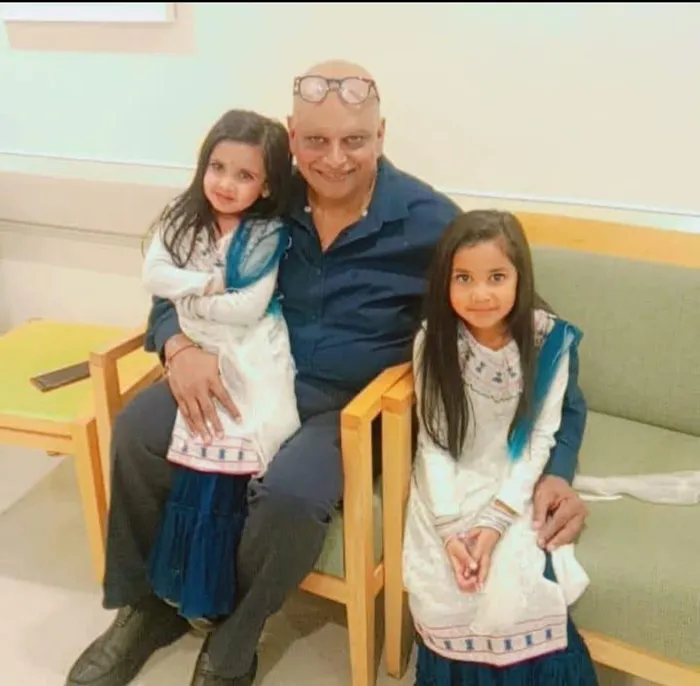
Roshan Jainath with his granddaughters, from left, Jahnvi and Jiah.
THE house smelled of cardamom and ghee. It was the morning of Diwali, and the air was already thick with a sweet, chaotic energy. My two granddaughters, Jiah, aged 9, and Jahnvi, aged 6, were perched on the kitchen counter, their legs swinging, watching me tie the final string on a parcel of mithai.
Jahnvi tilted her head, her small brow furrowed in thought.
"Grandpa," she said, "at school my teacher told me that Christmas is a time for family, for love and even forgiveness. Is Diwali the same?"
I paused, my fingers still on the string.
"Yes, Jahnvi, beta. Diwali has significant value for those same reasons and more. It's a celebration of light, of hope, of the victory of good over evil."
"But it feels different. At Christmas, everyone is on holiday and relaxed. Here, you and Mum are rushing. We have to give out mithai parcels, visit family... it feels like a checklist."
"You're right, Jiah. At Christmas, most of us are on annual holiday and we are relaxed. Diwali is often on a workday and therefore it is rushed. We have to give out mithai parcels and visit close family. It is rushed, beta, but it's very important. Because it's not only for that day. It's how we should live our life."
Jahnvi hopped off the counter and climbed onto my lap, her small hands cupping my face.
"But Grandpa, how is Diwali teaching us about how to live our life? We dress up in beautiful punjabis, eat yummy snacks, and eat and eat the whole day. Yes, we do the hawan, but nothing else during the day. The fun is at night because of the fireworks. Mum says it's too expensive and that we are burning money. No one teaches me how to live my life."
I put down the mithai box, my heart swelling at her innocent, profound question. I pulled her close.
"Beta," I said, "we are having a conversation and we both learn from each other."
"I am six, Grandpa. How can I teach you?"
"By asking good, innocent questions, we all learn. I sometimes have to challenge my own thinking to answer you. You are my little teacher today."
"Let me tell you a story. You see, Diwali is about good over evil. Lord Raam went to the forest for 14 years at the behest of his stepmother, who wanted her son to be the heir to the throne."
"It was, beta. It was a great injustice. But Raam didn't fight it. He went with grace. He faced demons, challenges, and a terrible war. He could have used his power to take the throne back, but he chose to honour his father's word. He showed us that true strength is not just in winning, but in doing what is right, even when it is hard."
"So he's like a superhero?" Jiah asked, leaning in.
"And when he finally returned home to Ayodhya after 14 long years, the people were so happy, so full of love, that they lit thousands of diyas to welcome him and his wife Sita, and brother Lakshman. They lit the path for them to find their way home through the darkest night."
"Yes. But they are more. Every Diwali, we light the diyas to remind ourselves to find our way back home. Not to a place, but to our true selves. To our goodness."
Jiah furrowed her brow. "What do you mean?"
"Think of your heart as a house. Sometimes, it can get dark. We get angry, we are selfish, we say unkind things, or we are unkind to ourselves. These are the little demons we all have. And we light the diyas to say, 'I will not let the darkness win. I will choose kindness over anger. I will choose forgiveness over holding a grudge.'"
"So the diyas are like little flashlights for our hearts?" Jahnvi asked, her voice full of wonder.
"That is a perfect way to put it. And that's why we share mithai. It's not just a snack. It's a sweet way to say, 'I love you. I forgive you. Let us be friends.' When we visit family, even when we are tired, we are building bridges. We are stitching our family together with love. That's not a chore; it's a blessing."
Jiah was quiet for a moment, then looked up.
"But Grandpa, you didn't finish the story. What happened in the forest? What happened to Sita?"
"Ah, you are right. The story is not complete. In the forest, Raam, Sita, and Lakshman lived simply, but their peace was shattered. A demon king named Ravana, who had ten heads and immense power, coveted Sita. He was clever and cruel. Using trickery, he lured Raam and Lakshman away from their hut and then kidnapped Sita. He took her to his island kingdom of Lanka, far across the sea."
"It was the greatest evil. Raam's heart was broken, but his resolve was unshaken. He vowed to find Sita and bring her home. To do this, he needed an army. And to find her, he needed help from the most unlikely of places."
"Yes. Raam formed an alliance with the vanara, the monkey people. Among them was Hanuman, the mighty monkey god. But Hanuman was more than just strong; he was the perfect disciple. His devotion to Raam was absolute. He was the son of the wind god, and he could fly, change his size, and had incredible strength. But his greatest power was his love for Raam."
"Even more, beta. Hanuman's love was his superpower. When Raam needed to send a message to Sita in Lanka, who did he send? Hanuman, of course. He leapt across the entire ocean in one bound. He found Sita, who was imprisoned, and gave her Raam's ring as a sign of hope."
"No, but he did something even more important. He offered to carry her back, but Sita refused. She said that Raam must come himself, to defeat Ravana and restore dharma. Her refusal showed her own strength and her faith in Raam. On his way back, Hanuman allowed himself to be captured, just so he could meet Ravana. He told him to return Sita, and when Ravana mocked him, Hanuman used his tail to set the entire city of Lanka on fire. He showed the demon king that even one follower of Raam could bring his kingdom to its knees."
"Hanuman is my favourite. He's like a superhero who is also a loyal friend."
"Exactly. He shows us that our strength is not for ourselves. It is for the ones we love and for the cause of good. Hanuman's loyalty was his light, and it burned brighter than any fire. And then, with Hanuman's help and the entire monkey army, Raam built a bridge across the ocean to Lanka. In a great battle, Raam defeated the ten-headed Ravana, and Sita was returned to him. Good had finally conquered evil."
Jiah sat back, her eyes distant, processing it all. Then she spoke, her voice quiet but certain.
"So... when I light a diya... I'm not just lighting a lamp. I'm making a promise to be a good person. To be like Raam. To fight my own demons."
"You've taught me something today, my little teacher. You've reminded me that the real battle isn't in the storybooks. It's inside all of us, every day."
"And the mithai! That's our kind words. Our 'I'm sorry' and 'I love you.'"
I paused, then looked at both of them seriously.
"But let me ask you something. When you are angry, how do you treat Gogo? How do you speak to her when she is cleaning or cooking?"
"Sometimes I shout at her when I can't find my shoes."
"And I get cross when she doesn't understand what I want,"
Jahnvi admitted quietly.I nodded gently.
"We all do, beta. But this is exactly what the diya teaches us. When we are angry, that is our demon talking. And the diya reminds us to choose kindness. Gogo is not just our helper. She is part of our family. She deserves the same love and respect you give to me. Would you shout at your grandma like that?"
"Then remember this. Every time you light a diya, make a promise to treat everyone with kindness, especially those who serve us. A Gogo should be treated like your own grandma. That is the real light of Diwali."
"So the diya is like a reminder to be nice to everyone. Even when I'm grumpy."
"Especially when you're grumpy," I said with a smile.
That night, as I watched them light their diyas, their faces glowing with a magic that came from a much deeper well than the sparklers they held, I knew the conversation was the real celebration. The real Diwali is not just the one day we rush through. It is the quiet, daily practice of lighting the lamp within our own hearts, and teaching the next generation how to keep theirs burning bright.
It is in the small acts of kindness, the gentle words of forgiveness, and the respect we show to every person in our lives, from the family we are born into to the family who cares for us every day.
Roshan Jainath is a community activist, writer and grandpa
** The views expressed do not necessarily reflect the views of IOL or post.co.za