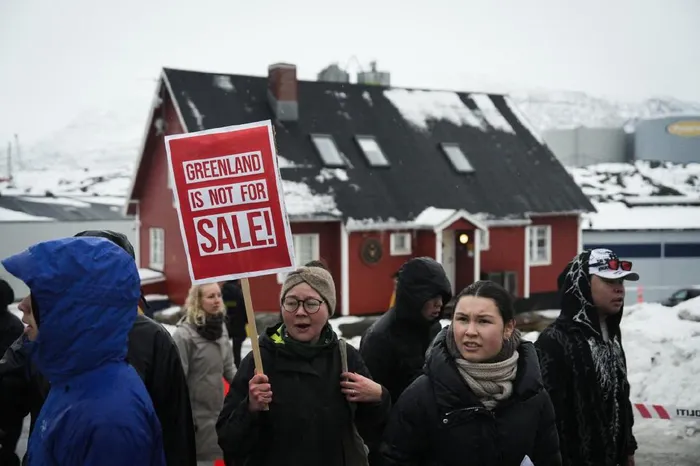
Protesters take part in a demonstration to protest against the US president’s plans to take Greenland, in Nuuk, Greenland. Twenty-six Greenlanders are now suing the Danish government for damages over a discriminatory colonial-era system that denied legal paternity and inheritance rights to thousands of children born out of wedlock to Danish fathers.
Tida Ravn told a landmark Danish court hearing Wednesday of the lifelong agony left by the "mystery" over who her father was, as she and 25 other Greenlanders pursued their claim for damages from the government over a state secrecy system.
Between 1938 and 1963 in western Greenland, and until 1974 in the rest of the territory, children born out of wedlock to a Danish father did not have their paternity legally recognised, unlike children living in Denmark.
A related trial has become part of the historical and political reckoning of colonial ties between Denmark and Greenland, which is today an autonomous territory.
"I know my mother's side, but all my life I carried a mystery within me: I have a father, but I did not know who he was. And yet it is my fundamental right to know where I come from," Ravn, 69, told the judges.
"It is important to prove that there was a failure; it shows that our rights were violated. For me, it is both very personal and a matter of principle," added the former journalist, who dons traditional Inuit facial tattoos.
Ravn says the Danish state should pay damages for the system, which was maintained in Greenland for more than 20 years after it was abolished in mainland Denmark.
She and the other plaintiffs argue that the different treatment, based on their origin, constituted discrimination and deprived them among other things of their inheritance.
"We would have preferred not to come to this, but Denmark must take responsibility," Ravn said.
Apology awaited
"We filed a complaint three years ago and I really hoped the government would turn to us, take responsibility and offer compensation," Ravn said.
The 26 plaintiffs are each seeking 125,000 kroner (R316,000) in damages. Two of them died before the trial started, but their families are still making claims.
"If the political system does not want to take care of us, we are forced to take it to court," Ravn said.
In Ravn's generation, nearly a quarter of Greenlanders are "legally fatherless".
According to Denmark's social affairs ministry, there were 8,000 such people born between 1911 and 1974 in Greenland.
This lack of filiation affected her youth and a good part of her adult life, Ravn said.
Since 2014, the "fatherless" can initiate proceedings to have their paternity legally recognised and, where an estate has not yet been settled, they can assert their inheritance rights.
The Danish government is also considering making an apology for the cases after the publication of a report on ties between Denmark and Greenland -- but the date of its completion has not been decided.
Witness accounts and academic research have meanwhile revealed other abuses, such as Greenland children being taken from their families in the 1950s and women subjected to forced contraception. These victims have received apologies and compensation.
The plaintiffs' lawyer, Mads Pramming, said the state's actions had breached the European Convention on Human Rights.
He highlighted "the scale of the psychological impact".
"It was shameful to grow up without a father and, as society was also more Christian at the time, it was also shameful to be born out of wedlock," he said ahead of the trial.