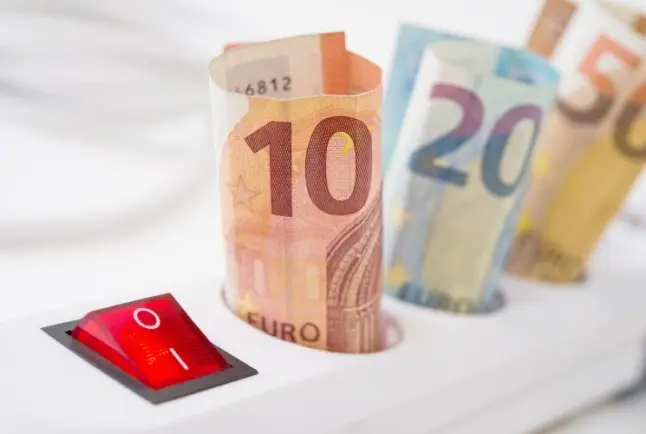
 Energy bills are expected to rise next year, according to analysis by Verivox. Photo: dpa-tmn | Andrea Warnecke
Households in Germany could face higher electricity and gas costs around the start of 2027. But the effect on your bill will depend on where you live, how much energy you use and your tariff.
Anyone budgeting for winter heating costs should brace themselves for higher charges in 2027.
Calculations from comparison portal Verivox point to rising electricity and gas grid fees in the coming year, while higher wholesale costs could also feed through to customers.
That doesn’t mean every household will receive a sharply higher bill on January 1st.
Here's a look at where, and by about how much, energy prices appear set to rise in Germany in the coming year.
Don't miss our journalists' daily news roundup from Germany
The biggest potential increase identified by Verivox concerns household gas tariffs. The comparison portal expects widespread gas-price rises at the turn of the year as suppliers pass higher procurement costs on to customers.
It says affected tariffs could rise by 10–20 percent, depending on the customer’s existing plan.
For a household heating a detached home, Verivox says this could mean additional gas costs of up to €500 a year. This is a maximum estimate, not an average, and the actual increase would depend on consumption and the existing tariff.
READ ALSO: Germany says it has enough gas for winter after missing storage target
Higher gas prices can also affect electricity customers.
In Germany, power stations are used in order of their operating costs – cheaper sources are used first, followed by increasingly expensive sources until there’s enough electricity to meet demand.
In an arrangement known as the 'merit-order principle', the most expensive source used to meet that demand sets the wholesale market price. In Germany, that price-setting plant is often gas-fired.
So when gas becomes more expensive, the price set on the electricity exchange can rise too – even though gas accounts for only a relatively small share of electricity generation.
Grid fees are another source of upward pressure. Verivox expects the electricity grid-fees to rise by an average of 1.9 percent nationwide at the turn of the year.
For a household using 4,000 kWh annually, its model shows average grid costs increasing from €428 to €436 gross – a rise of €8.
Grid fees vary sharply by region, however. Verivox expects annual electricity grid costs for the same model household to rise by €52 (nine percent), in Hamburg, and by €33 (eight percent), in Berlin.
In Rhineland-Palatinate, by contrast, it expects grid costs to fall slightly.
READ ALSO: How much money can you get for installing a new heat pump in Germany?
Gas-grid fees are also forecast to rise by an average of three percent, equivalent to about €19 a year for a household using 20,000 kWh. Again, the effect varies by region.
One reason electricity grid fees are increasing is reduced federal support for transmission-grid costs. The government provided €6.5 billion in 2026, but €5.525 billion is planned for 2027 – a reduction of 15 percent.
Gas networks face a different pressure. Germany’s gas consumption has fallen significantly since Russian pipeline gas was discontinued in 2022. Network costs therefore have to be spread across fewer consumed kilowatt-hours, which tends to increase the charge per unit.
READ ALSO: Seven expert tips to reduce your heating bills in Germany
Become a member or log in to continue reading
More
Comments
Join the conversation in our comments section below. Share your own views and experience and if you have a question or suggestion for our journalists then email us at news@thelocal.de.