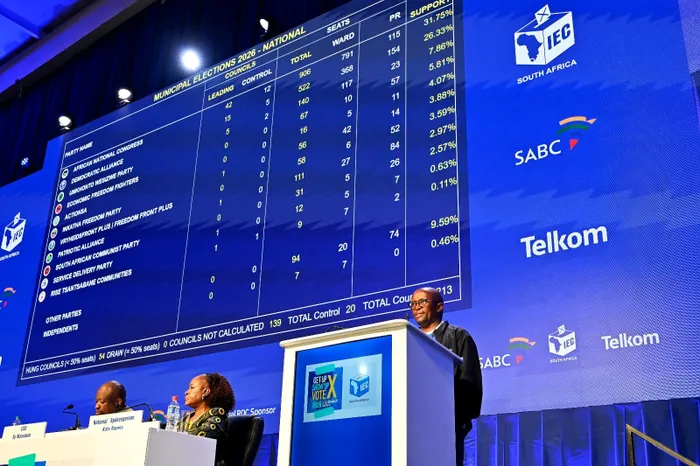
IEC Chairperson Mosotho Moepya speaking at the Results Operation Centre (ROC) at the Gallagher Convention Centre in Midrand on Thursday.
The battle to govern South Africa's municipalities is shifting from the ballot box to the negotiating table, with political parties preparing for coalition talks as early results from the 2026 Local Government Elections point to more hung councils.
While some parties have welcomed their early performances and positioned themselves for a greater role in municipal government, others remain cautious as votes continue to be counted and the final balance of power remains uncertain.
The emerging results have brought coalition politics into sharp focus, with parties outlining the ideological principles, governance commitments and conditions they would require before entering into agreements with potential partners.
The uMkhonto weSizwe (MK) Party has indicated it will not enter into governing arrangements simply to secure political positions, with spokesperson Sifiso Mahlangu insisting partnerships must be based on shared political and ideological principles.
Mahlangu welcomed the party's early performance, saying the results suggested it was expanding beyond its traditional regional support base.
“We will only go in with parties that believe what we believe. For us, it's not simply to just go into municipalities, but it's to go in and do what we had promised our people,” he said.
The Freedom Front Plus (FF Plus) has also anticipated an increase in hung councils, with representative Peter de Necker saying early results pointed to more municipalities where no party would secure an outright majority.
With less than 30% of votes counted at the time of his interview, De Necker cautioned that it was too early to determine the full extent of coalition negotiations.
“We see that we will have many more coalition governments and hung councils where not one party (has) the majority,” he said.
He said negotiations in one municipality could influence arrangements elsewhere, as parties were likely to adopt a national approach when deciding which formations they were prepared to work with.
De Necker also warned that parties would face time pressure, with legislation requiring municipal councils to hold their first meetings within 14 days after the final results were declared.
The FF Plus is open to coalition discussions but says service delivery and tackling corruption will be central to its decisions.
“If a party is not prepared to renounce corrupt activities, to deal with corrupt officials, then obviously we will be lying to our voters,” he said.
De Necker said the party's experience in coalition governments across Gauteng's metros and more than 10 Western Cape municipalities had provided important lessons.
ActionSA has also signalled its intention to play a significant role in coalition negotiations across Gauteng, particularly in Johannesburg, Tshwane, and Ekurhuleni.
Party representative Matthew George said the party was encouraged by its early electoral performance, claiming it had made significant gains in townships previously dominated by the ANC and EFF.
“In Tshwane, in Ekurhuleni, in Joburg, residents can expect to see ActionSA being at the centre of any coalition formations that are taking place in this province.”
However, George said the party would require firm commitments from potential partners, including addressing illegal immigration, ensuring equitable service delivery and taking decisive action against corruption.
The DA's Helen Zille also expressed satisfaction with the party's early performance but said it was too soon to disclose details of possible coalition arrangements.
“It's very good to see the DA’s numbers; we have more votes, more black people voted in Johannesburg for the DA than they voted for the MK or the EFF, which I'm pleased about. So that was a very nice outcome for us. And Johannesburg is looking very good. I am not mandated to speak about any other election other than Johannesburg,” she said.
The ANC, meanwhile, is taking a cautious approach, with first deputy secretary-general Nomvula Mokonyane saying the party would await the final results before determining its next steps.
Mokonyane acknowledged that poor service delivery in traditional ANC strongholds, including persistent water shortages and uncollected rubbish, had contributed to voter disillusionment and low turnout.
She said the party was still working through its internal processes and required a mandate from its national leadership before making decisions.
“The results are as yet to be concluded. The national elections team will put together a report and take it through the SGO for the officials and the committee to present to the NWC, and we get a mandate from them.”
The differing positions come amid concerns about the performance and stability of coalition governments during the previous local government term.
Political analyst Sandile Swana previously cautioned against attributing South Africa's broader municipal governance problems solely to coalitions, pointing to KwaZulu-Natal's experience of political cooperation.
“The province of KZN can probably be given the title of 'Masters of Coalition Politics',” Swana said.
He cited the history of cooperation between the ANC and the Inkatha Freedom Party, arguing that governance challenges in some municipalities were instead driven by internal political battles and competition for resources.
Middle East Africa Research Institute research fellow Kenneth Kgwadi offered a more critical assessment, saying coalition politics had exposed deeper weaknesses in municipal governance.
“We've had the bad taste of coalition politics in South Africa where parties do as they please because they are not governed,” Kgwadi said.
He said infighting among coalition partners had direct consequences for residents, particularly in Johannesburg, where political disagreements had affected municipal administration.
In an update at 6 pm yesterday, IEC Chairperson Mosotho Moepya said the capturing and verification process was progressing steadily, with more than 60% of the 66 073 expected results captured by 5 pm.
A total of 40 202 result slips had been scanned, while 32 238 had undergone independent auditing. At municipal level, 65 of the country's 213 municipalities, representing 31%, had completed the capturing, scanning, auditing and exception process.
Gauteng had not completed the process in any of its nine municipalities, while the Northern Cape was leading, with 21 of its 26 municipalities having completed the process.
Moepya said the commission anticipated concluding the results collation process by the weekend.
He cautioned that the figures remained provisional until objections material to the election had been finalised.
The final results will determine the composition of municipal councils and the coalition arrangements parties will need to establish administrations.