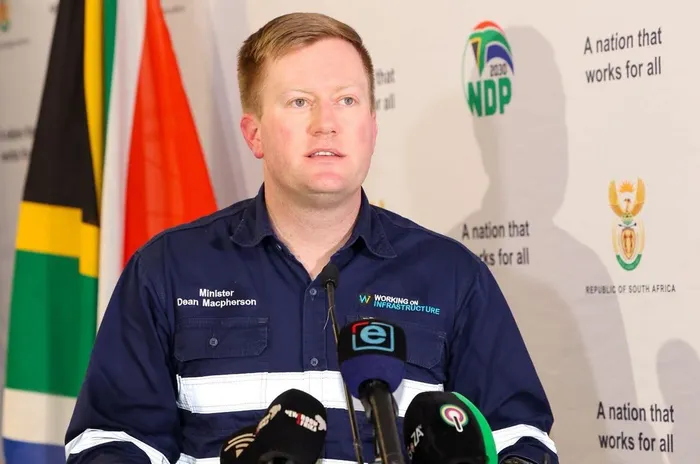
Minister of Public Works and Infrastructure Dean Macpherson.
The national Department of Public Works and Infrastructure (DPWI) has made progress in its nationwide investigation into 6 238 state-owned residential properties, despite facing capacity constraints in executing the audit.
In July, DPWI Minister Dean Macpherson requested DPWI Director-General Sifiso Mdakane to conduct a comprehensive investigation into the state-owned residential properties allocated to government departments and occupied by officials across the country, and to develop a comprehensive strategy for the disposal of properties that are not required for legitimate operational purposes.
Of these properties, 3 626 are in KwaZulu-Natal, 566 in the Western Cape and 407 in Gauteng. An estimated R39.6 million was spent from its Day-to-Day Maintenance budget during the 2025/26 financial year, although the available expenditure information relates to only 108 of the 6 238 properties.
DPWI Real Estate Management Services acting Deputy Director General Molatelo Mohwasa said they picked up that most of these properties, when they are allocated to their client departments, are allocated in terms of their own state policy or housing policies. But when they leave these properties, they leave them in bad condition, and sometimes they do not inform the department.
“We find out after a long time that either these properties have changed hands, or they are no longer in the hands of the employees that the departments have entered into. They are in the hands of other people. So you could even find that they are making money out of these properties because they are subleasing them,” Mohwasa said.
“I think the minister has actually gone to a few and has understood that this thing is happening, and he directed the department to actually do a comprehensive overview and audit. And we tried to do that, but we realised that there are some challenges in terms of capacity.”
Mohwasa said they have engaged with one of their branches, Facilities Management, to enter into a memorandum of understanding with one of the entities to help them undertake the audit.
He said that once the review is finalised, they will be able to know who is in those properties and whether they are allowed in terms of the policies of those departments. If they are not allowed, the properties must revert to DPWI. They can be repurposed or disposed of if they are no longer needed by the departments. They are regarded as surplus in terms of the Government Immovable Asset Management Act (Giama), he explained.
DPWI Minister Macpherson said they have started making progress, but it is a much bigger task than they imagined.
“But the fact is that we need to understand why we own so many properties, why we are paying so much in terms of rates and taxes for them when they’re being used by other departments and people who are occupying them are either government employees who received housing subsidies, or we don’t even know who’s sitting in them, and that’s also equally problematic for us,” Macpherson explained.
KZN DPWI MEC Martin Meyer added that they own fewer properties; therefore, it was easier for them to complete their audit, and those are on their recently launched property finder portal.
He said the majority of the houses are in Ulundi, where the old Zululand government was based. There are a few current government officials, former government officials, and children and grandchildren of former government officials who still live there.
“Now we are going through the process and seeing what options are available to us through rent-to-buy and other options to regularise that because the rates we pay on these over 1 000; well, in Ulundi alone, it’s over 500 properties,” Meyer explained.
He said exorbitant property rates exceed the departmental budget, while rentals are standardised at R900 regardless of size or location. The department aims to find a fair resolution for long-term occupants while safeguarding taxpayer funds.