As the £20 million UK Preclinical Translational Models Hub opens its doors, the laboratory will help to usher in a world of new possibilities for patients.
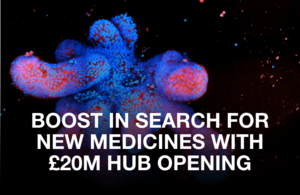
Faster access to treatments, a better understanding of how medicines behave inside the body, and fewer animal experiments will all be supported through a new lab opening in Cambridge today (27 November).
As the £20 million UK Preclinical Translational Models Hub opens its doors, the laboratory will help to usher in a world of new possibilities for patients. The site will use organoids - tiny versions of human organs made from tissue donated by NHS patients - to help researchers build up a more accurate picture of the most promising new drugs to take forward for clinical trials.
Some studies show that lab-grown organs could actually reduce total pharmaceutical R&D costs by between 10% to 26%. It also has the potential to slash the time it takes for the most promising drugs to move into full scale development by nearly a fifth – meaning a quicker route to get cutting-edge treatments into the hands of health workers.
Growing tiny organs from donated tissue may sound like the domain of science fiction writers, but this hub highlights the very best of British science, research, and innovation.
The work being led here will deliver faster and more effective treatments which could transform outcomes for patients, while backing a growing British industry which has the potential to attract investment and sell its expertise around the world.
A year ago, we set out to make Britain a world leader in replacing animal testing in science, and it’s through projects like this that we’re now working to make that vision a reality.”
Marking one year since the launch of the Replacing Animals in Science Strategy, the UK’s moves to find alternatives to using animals in research and testing are gathering speed.
While animal studies continue to play an important role in many areas of research and testing, they cannot always fully predict how the human body will respond. The government’s strategy which launched last November is backed by £75 million and looks to tackle this problem head on - with research carried out on human tissue giving earlier, potentially more accurate insights.
Other steps to support replacing animal testing include:
Today’s opening of the UK Preclinical Translational Models Hub builds on the strengths of a thriving UK life science’s sector.
Worth £147 billion, it currently employs some 360,000 people and has received £4 billion in private backing since July 2025.,
As the UK continues to deliver its strategy on replacing animals in science, our booming life sciences sector is firmly establishing our place as the global destination to design, develop, and sell the next generation of testing technologies.
Professor Matthias Zilbauer, Director of the Preclinical Translational Models Hub, said:
The UK is already at the forefront of developing innovative models of human biology and disease. The challenge now is to turn these scientific advances into technologies that can be reliably used in drug development.
Our Hub will bring together expertise from across academia, healthcare and industry to accelerate the development, validation and adoption of these new approaches. By doing so, we aim to improve how medicines are developed, reduce reliance on animal testing and establish the UK as a global leader in translating scientific innovation into real-world patient benefit.”
Dr Cynthia Bullock, Life Sciences Programme Director at UK Research and Innovation (UKRI), said:
The opening of the £20 million UK Pre-clinical Translational Models Hub, core-funded by the Office for Life Sciences in partnership with UKRI, will help strengthen the UK’s ability to turn scientific discoveries into new treatments.
It will support the development and use of new innovative methods such as human-relevant models and computational approaches that can generate better evidence, help promising innovations move more quickly towards clinical trials and improve how potential new medicines are assessed and developed.
By bringing together expertise from academia, industry and the NHS, the Hub will support alternatives to animal use in research and strengthen the UK’s position as a global leader in life sciences.
Dr Vicky Robinson CBE, Chief Executive of the NC3Rs said:
We have made significant progress on developing alternatives to the use of animals in testing and research over the past twenty years but there is still a long way to go before their full potential is realised. The establishment of a UK Centre for the Validation of Alternative Methods (UKCVAM) and an Alternative Methods Expert Committee (AMEC) are important new additions to the UK infrastructure to help drive and coordinate the development and use of alternatives both in academic research and regulatory testing. The NC3Rs looks forward to bringing our expertise to deliver these important initiatives
Richard Torbett, Chief Executive of the Association of the British Pharmaceutical Industry (ABPI) said:
Before a new medicine is tested in people, scientists need models that can predict its safety and effectiveness. If those models get it wrong, promising medicines can fail late in development, after years of work. The pre-clinical translational models hub is designed to change that.
The idea for the hub came from ABPI member companies, and it’s fantastic to see it become a reality. By investing in more human-relevant models in the UK, the hub will help bring new medicines to patients faster, reduce the use of animals in research and give global companies another strong reason to choose the UK for their research, which is vital to our life sciences goals.
ABPI members are committed to making the hub a success, and I applaud the Government’s backing for it.”
Dr Penny Hawkins, Head of RSPCA Animals in Science Department said:
The RSPCA welcomes the opening of the Preclinical Translational Models Hub and the positive momentum highlighted in today’s progress update. While vital work remains to keep the strategy commitments on track, this investment marks an encouraging step towards replacing animal use and modernising UK science.
Dr Branwen Morgan, Chief Executive of Understanding Animal Research (UAR) said:
Expanding the range and quality of in vitro tools and methods can help researchers make better decisions about which potential treatments to pursue, improving the prospects of success and shortening some of the stages in the research and development of a new medicine. This hub offers an opportunity to expand this toolkit available to researchers, complementing scientifically justified work in animals and recognising the strengths and limitations of each approach. Used together, these approaches could also advance all three Rs: replacing animal use where possible, reducing the numbers needed and refining studies to minimise suffering.
Dr Sally Robinson, Chair Animals in Science Committee:
The Animals in Science Committee was privileged to be commissioned to advise BIST on the establishment of the Alternatives Methods Expert Committee (AMEC) and are pleased to see our advice on AMEC and on the UK Centre for the Validation of Alternative Methods (UKCVAM) have been accepted. Alongside the UK Preclinical Translational Models Hub, these two additions to the UK infrastructure will provide greater coordination across the system and will be supported by the UK NC3Rs who have over 20 years of experience in implementation of the 3Rs.
The government will replace animals wherever the science allows. Each replacement will be backed by robust validation so patients and the public can trust the alternatives. Responsible, justified use of animals will continue to be supported where alternatives are not yet available.
A full update on progress against the Strategy’s 26 commitments has been published on GOV.UK
With co-leads at the MRC Laboratory of Molecular Biology and the Wellcome Sanger Institute, the Preclinical Translational Models Hub will draw on a Cambridge research community of around 60 principal investigators. Based on the Cambridge Biomedical Campus it will: