
TEHRAN - A bench that displays weather information and offers mobile phone charging, a vehicle equipped with a system to inspect asphalt and its underlying layers, and a thermal-imaging drone designed to detect fire hotspots and locate people trapped in hard-to-reach areas were among the products unveiled at Tehran’s CITEX exhibition.
Held under the slogan “Progressive Iran,” the CITEX exhibition took place at Milad Tower in Tehran from November 17 to 20. More than 100 knowledge-based companies gathered at the event, hosted by Tehran Municipality, to help establish an integrated ecosystem for urban technology and innovation.
Transportation, municipal services, energy, water and the environment, and information technology were among the event’s main themes. Energy management, waste management, the digital economy, and sustainable financing for urban projects were also addressed.
Companies and industry professionals active in fintech, municipal services and citizen welfare, smart transportation and traffic management, artificial intelligence, cybersecurity, ICT infrastructure, water management, agriculture, and the urban environment showcased their latest achievements and ideas.
One of the notable technologies presented at CITEX was a vehicle-mounted system designed to inspect road surfaces and the layers beneath the asphalt. The system collects data that can be used to assess layer thickness, the condition of road foundations, and potential inconsistencies in construction work.
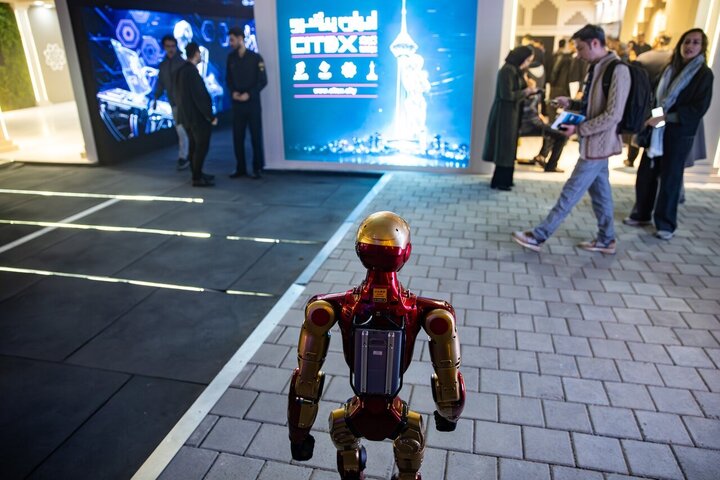
Another section of the exhibition was dedicated to robotics, featuring equipment designed for various applications, ranging from watering and firefighting assistance to rescue operations in aquatic environments and the inspection of difficult-to-access routes. A firefighting robot equipped with a water-spraying system, for example, is designed to operate in situations where approaching the flames would put human firefighters at risk.
In the crisis management section, technology was showcased both as a tool for educating citizens and as a means of gathering information for urban authorities. A virtual reality earthquake simulator was one example of its educational applications. Users are placed in a simulated environment to familiarize themselves with potential hazards and the decisions they may need to make during an earthquake.
Another technology on display involved image processing to monitor water flows in urban canals and waterways. The system analyzes camera footage to detect rising water levels and potentially hazardous conditions, sending alerts to the relevant authorities for timely action.
In the transportation section, the National Metro Train was displayed to highlight domestic manufacturing capabilities and support the expansion of public transportation fleets. The train has an 85-percent localization rate and is expected to join Tehran’s existing metro fleet.
Visitors also had the opportunity to experience virtual cycling along a simulated route through one of Tehran’s parks. Using a camera and a virtual reality headset, participants could pedal along the route and enjoy a virtual tour of the park. The experience is based on digital twin technology, which enables the recreation of a real-world location in a digital environment, preserving its details and dimensions.
According to the organizers, showcasing a product at an exhibition is only the first step. Bringing an innovation into the urban services system requires a clearly defined process for evaluation, testing, financial support, and eventual procurement or deployment.