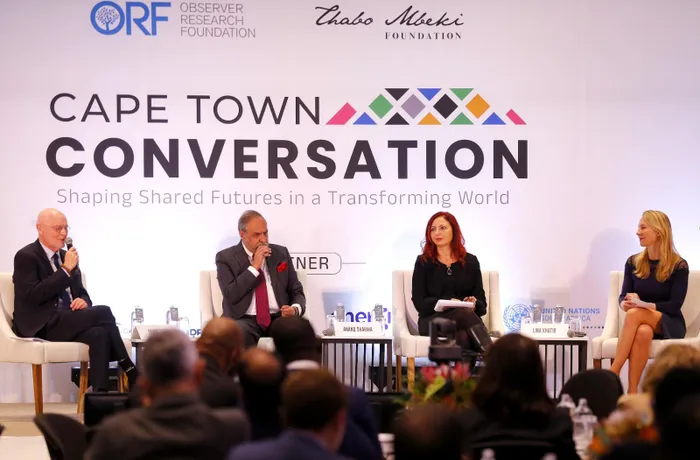
The fourth edition of the Cape Town Conversation kicked off on Monday at the Westin Hotel.
INDIA and the Southern African Customs Union (SACU) will begin negotiations next month on a Preferential Trade Agreement that could become a template for deals across Africa, India’s High Commissioner to South Africa, Prabhat Kumar has announced.
High Commissioner of India to South Africa and Lesotho, Kumar, announced the development at the Cape Town Conversation dialogue event yesterday.
The event, held under the theme Shaping Shared Features in a Transforming World, brought together representatives from India, Africa, the wider Global South and the Global North to examine how shared priorities can be translated into practical action.
"India and SACU, the Southern African Customs Union, comprising five countries - Namibia, Botswana, Lesotho, Eswatini and South Africa - signed the Terms of Reference for a Preferential Trade Agreement in August. The first round of negotiations is scheduled for next month. Both sides are committed to agreeing quickly," Kumar said.
He said momentum was already visible in two high-level visits from South Africa to India in the past year.
Deputy President Paul Mashatile was accompanied by five ministers for a bilateral visit, with productive engagements with their Indian counterparts and business in Hyderabad.
President Cyril Ramaphosa followed with a visit for the BRICS Summit, where he also held a number of meetings with business leaders. "These engagements signify South Africa's growing interest in India," he said.
Kumar also proposed an India-Africa Fertiliser Security Partnership, with value addition in Africa, saying India and Africa must act as insurance for each other on food security as climate change.
He pointed to growing investment on both sides, including Vedanta’s second zinc plant at Gamsberg, and acquisitions by Solar Industries, Varun Beverages and Hetero in South Africa.
"Fertiliser security is closely tied to food security. Africa is also a critical partner in India's food security, supplying pulses and edible oils to India, apart from cashew and copra. While India exports rice, wheat, maize and sugar to Africa, the African continent's landmass is approximately 9.2 times that of India.
However, our populations are comparable, with India having a population of approximately 1.46 billion and the African continent approximately 1.5 billion.
With the availability of arable land in Africa, the continent can further enhance its own food security as well as that of India, with India contributing to agricultural improvements. With climate change making rainfall and drought increasingly difficult to predict, it is imperative that India and Africa collaborate in this area to strengthen food security and act as an insurance for each other in the event of climate-related shortages," he said.
The Conversation, hosted by the Thabo Mbeki Foundation and India’s Observer Research Foundation (ORF), key focus on strengthening Africa-India cooperation, with both regions seeking greater control over their development priorities and international partnerships.
The Conversation was first held in 2023, the year the African Union joined the G20, raising hopes of a more representative global order.
“The Cape Town Conversation exists so that Africa, India and their partners can move from shared aspiration to shared action and shape the institutions and rules that will govern our common future,” said Max Boqwana, chief executive officer of the Thabo Mbeki Foundation. "The Global South cannot be a bystander to what comes next."
William Leshilo, vice-president: Government Relations and Community Business Partner at AngloGold Ashanti, said African leaders needed to speak with one voice and overcome divisions to strengthen the continent’s bargaining power in international engagements.
He said divisions among African countries weakened their collective influence and made it easier for external powers to take advantage of the continent’s vast mineral resources.
Leshilo questioned why individual countries, such as Malawi and Mozambique, negotiated separate agreements with the United States on similar matters, arguing that a more unified approach through the African Union would give African countries greater leverage.
He said African leaders needed to agree on common positions before engaging with global powers, including Russia, China and the US.
“Once we are united in Africa, we'll be able to do much more. But being divided, we become worthless, and it's easier to be taken advantage of,” he said.
United Nations Resident Coordinator in South Africa, Nelson Muffuh, warned against romanticising South-South cooperation, saying it must be judged on whether it builds local capacity and widens opportunity.
He said pharmaceuticals and health manufacturing, agriculture and food systems, digital public infrastructure, renewable energy, skills and enterprise development are areas where Africa, India and the Global South can do much more together.
The question, he said, is how much can be done jointly.
"Not simply technology transfer from one place to another, but knowledge developed together. Not simply commodities traded, but value chains built between economies. And not simply government-to-government relationships, but deeper connections between businesses, universities, cities and entrepreneurs, especially young ones," he said.
"This gives deep contemporary economic meaning to a relationship whose political foundations were laid several generations ago. And this is also something that is the responsibility of the Global South and the countries within it to take forward."
He also called Africa’s underrepresentation in the United Nations Security Council increasingly difficult to justify, saying reform was long overdue.
"Africa's underrepresentation, particularly in the Security Council of the United Nations and other international financial institutions, has become increasingly difficult to justify. So reform, as the UN Secretary-General has indicated, is long overdue. But greater representation should also mean greater responsibility," Muffuh added.