This new section spans about 560 football fields and can accommodate the world's largest container vessels.
An Intelligent Guided Vehicle (IGV) moving through the "Living Lab" testbed section of Tuas Port, Nov 20, 2026. (Photo: CNA/Wallace Woon)
An Intelligent Guided Vehicle (IGV) moving through the "Living Lab" testbed section of Tuas Port, Nov 20, 2026. (Photo: CNA/Wallace Woon)



SINGAPORE: The second phase of Tuas Port, the largest of its four development phases, will begin operations from 2028, with 21 deepwater berths expected by the mid-2030s, PSA Singapore said on Friday (Nov 20).
Spanning nearly 400 hectares of reclaimed land, or about 560 football fields, the phase has water depth of 23m and 8.6km of wharf. It is designed to accommodate the world’s largest container vessels, PSA said.
Speaking at the groundbreaking ceremony, Minister for Transport Jeffrey Siow said that when the port is fully completed in the 2040s, Singapore will consolidate all its container operations in one location, making Tuas Port the world’s largest fully automated port.
The completed port will have 66 mega berths and the capacity to handle the equivalent of 65 million 20-foot containers a year.
Tuas Port currently has 15 operational berths and has handled 25 million twenty-foot equivalent units (TEUs) since opening in 2022.
As a small island nation without natural resources, maritime connectivity is Singapore’s “lifeblood”, said Mr Siow. The seaport connects the country to more than 600 ports worldwide and supports more than 140,000 jobs, as well as the wider manufacturing and services economy, he added.
That connectivity depends on an open, rules-based maritime order and a thriving maritime ecosystem, he said.
CNA Games
 Guess Word
Crack the word, one row at a time
 Buzzword
Create words using the given letters
 Mini Sudoku
Tiny puzzle, mighty brain teaser
 Mini Crossword
Small grid, big challenge
 Word Search
Spot as many words as you can
Show More
Show Less
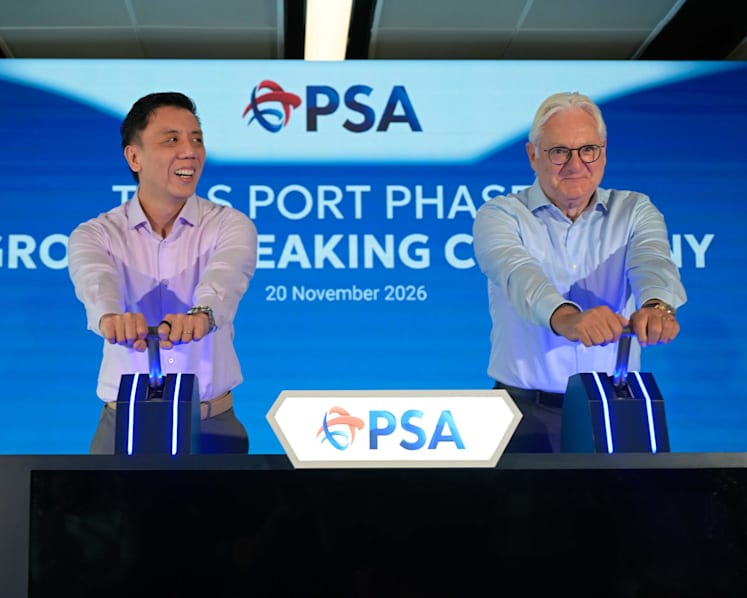 Minister for Transport Jeffrey Siow and group chairman of PSA International Peter Voser break ground for Phase 2 of Tuas Port, Nov 20, 2026. (Photo: CNA/Wallace Woon)
“But we know our competition is never far behind. Other maritime hubs around the world are rising fast, they are copying our playbook, investing heavily in port capacity, technology and maritime services. So we have to plan ahead,” he said.
Minister for Transport Jeffrey Siow and group chairman of PSA International Peter Voser break ground for Phase 2 of Tuas Port, Nov 20, 2026. (Photo: CNA/Wallace Woon)
He added that the government has been engaging stakeholders to develop the next Maritime Singapore Master Plan, which will be launched in April next year.
The plan to consolidate Singapore’s container port activities at Tuas was first mooted in 2012. Reclamation works for the first phase began in February 2015 and were completed in November 2021.
PSA expects to move all operations at Tanjong Pagar, Keppel, and Brani terminals to Tuas Port by 2027, with Pasir Panjang Terminal operations following by the 2040s. When completed, Tuas Port will span 1,337 ha, or about the size of Ang Mo Kio.
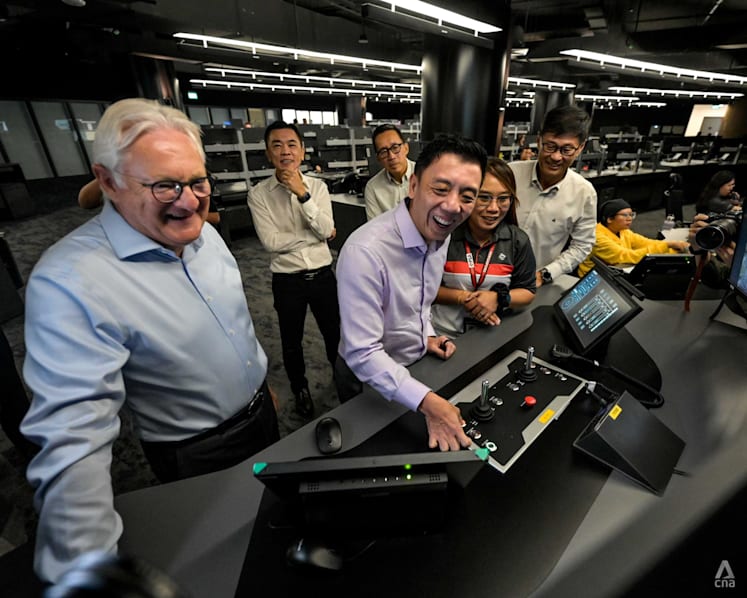 Minister for Transport Jeffrey Siow (centre) and group chairman of PSA International Peter Voser (left) inspect a terminal in the control centre of Tuas Port, Nov 20, 2026. (Photo: CNA/Wallace Woon)
AUTOMATION AND INFRASTRUCTURE
The second phase will also extend advanced automation and artificial intelligence capabilities to support operations, PSA said.
Tuas was designed as a fully automated port, and PSA already uses automated quay cranes and guided vehicles there. Once the second phase is complete, close to 1,000 autonomous, AI-enabled guided vehicles will move containers across the terminal. About 30 of these vehicles are currently on trial.
Unlike earlier automated guided vehicles, these calculate and optimise their own routes on the go, adjusting to traffic in real time while operating alongside manned port vehicles, said Mr Siow.
He added that PSA is also trialling shore-to-ship drones to ferry urgent spare parts and fuel samples, or deliver fresh food and supplies.
“Over time, the aim is for artificial intelligence, digital twins, autonomous systems and real-time data to enable the entire port to operate as one integrated system,” he said.
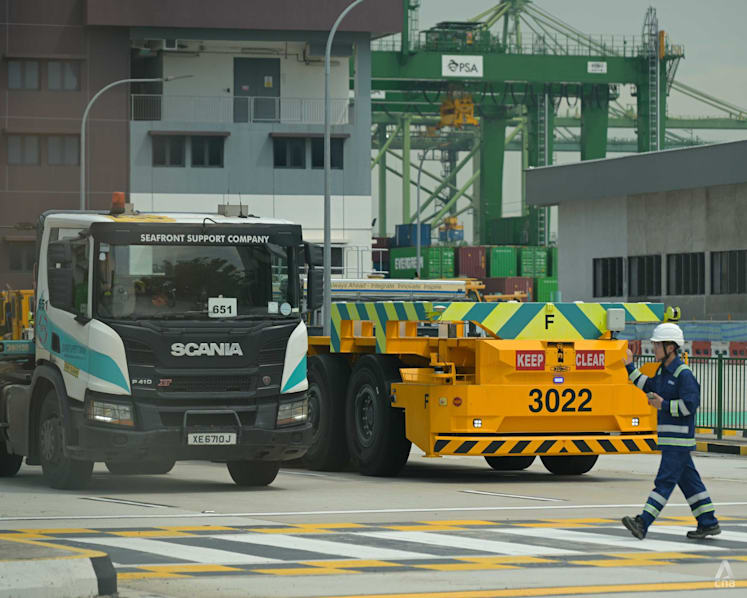 A man crosses in front of a container truck and an Intelligent Guided Vehicle (IGV) stopped at a pedestrian crossing in Tuas Port, Nov 20, 2026. (Photo: CNA/Wallace Woon)
Beyond growing physical capacity, Singapore is improving the reliability and value it delivers, said Mr Siow. PSA’s new Supply Chain Hub @ Tuas, for example, will anchor logistics and warehousing directly alongside the port.
The government is also strengthening Singapore’s position as a global maritime capital, he said.
Under plans outlined in the Economic Strategy Review, Singapore wants to anchor more global and regional headquarters of maritime companies, including in ship financing, insurance and data, so that more commercial decisions and transactions behind global shipping are made here, he added.
“Taken together, the port and the business ecosystem reinforce each other,” he said.
“A thriving port at Tuas draws ships and cargo to our shores, generating demand for maritime services. At the same time, a deep maritime business hub in the city gives our shipping lines and cargo owners more reasons to choose Singapore.”