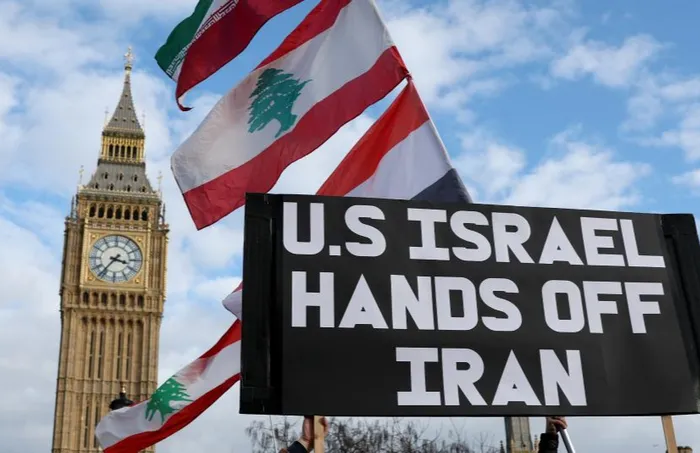
People hold a placard during a protest against U.S.-Israeli attacks on Iran, at the Parliament Square in central London, Britain, on Feb. 28, 2026. The United States and Israel on Saturday launched "major combat operations" against Iran, plunging the war-torn Middle East into a new round of violent conflicts.
When the American midterm results came in, Israel’s reaction was not the usual polite interest in a foreign election. It was closer to vertigo. A columnist in Yedioth Ahronoth, the country’s best-selling newspaper, described a “generational sea change” and accused Benjamin Netanyahu’s government of reaping a storm of its own making. Opposition politicians queued to agree. The prime minister, once the confident whisperer of Washington’s elite, said nothing at all.
The deeper shock lay in who delivered the message. Israel was a live issue on the campaign trail. Many Democratic candidates were openly critical of its conduct in Gaza and the West Bank, and the cost of the joint American-Israeli war on Iran weighed heavily on voters. Donald Trump himself blamed that war for his party’s rout, and Mr Netanyahu is widely believed to have urged it upon him. Then JD Vance named the American relationship with Israel as one of four reasons voters had deserted the Republicans. Israelis had braced for Democratic coolness. They had not prepared for a Republican vice-president treating the alliance as an electoral liability. One Israeli analyst suggested this may prove more damaging than the results themselves.
Money is the visible symptom. Days earlier, Mr Trump announced in a television interview that he would end $3.8bn in annual military aid two years ahead of schedule. Israel’s president called it a bolt from the blue. The sum matters less than the signal: American aid makes up under a tenth of Israel’s defence budget, but the signal was that Israel is now a partner to be managed rather than a ward to be protected. The real vulnerability is operational. Israel’s air force flies American aircraft, and its missile defences depend on American interceptors and spare parts. A Democratic Congress cannot override a presidential veto without a two-thirds majority, yet it can slow, condition and scrutinise arms sales and joint projects. What once passed smoothly may now grind.
This is where the Iran war comes in. Only nine months ago Israeli and American forces fought side by side, their coordination a daily boast of spokesmen and ministers. That unity now looks like a political burden in Washington. Analysts expect a Congress less willing to indulge renewed hostilities, and an administration pressed to demand restraint in Gaza and Lebanon and to forbid Israel from undermining any settlement with Tehran. The crux is dependence. Any Israeli decision to resume strikes, or to sabotage a deal, rests on munitions and diplomatic cover that can no longer be assumed. The war, in short, is becoming harder to continue and harder to restart, and diplomacy gains room it did not have before.
None of this amounts to a rupture, and the caveats matter. A senior American official suggested the bedrock of the relationship will survive, with Washington simply more willing to criticise when warranted. The American ambassador to Israel signalled little change in core positions, and Israel’s envoy to the United Nations pointed out that Mr Trump remains in office for two more years, with the American veto at the Security Council intact. Yet even that envoy conceded that criticism now comes from both parties, and that life will be harder.
The timing could hardly be worse. Israel’s own inconclusive election has left Mr Netanyahu and his centrist rival, Gadi Eisenkot, competing for the chance to form a government. Mr Eisenkot has promised to rebuild the bipartisan foundations of the alliance. Yair Lapid has gone further, invoking the rule that served Israel for seventy years: do not choose sides in America. It broke, he argues, when Mr Netanyahu addressed Congress in 2015 against a Democratic president’s nuclear diplomacy. Mr Netanyahu’s allies counter that a moment of upheaval demands continuity and a leader who knows Washington’s players.
The likeliest outcome is not a divorce but a repricing. For decades Israel enjoyed American support as something close to unconditional. It is becoming conditional, and conditions are usually written in the language of what a partner may and may not do. For Iran, that suggests a conflict increasingly shaped by American restraint, congressional scrutiny and negotiation. Israel can still be heard in Washington, but it can no longer count on being obeyed.
Past chairman of the BRICS Business Council and co-chairman of the BRICS Media Forum and the BRNN
**The Views expressed do not necessarily reflect the views of Independent Media or IOL.
** MORE ARTICLES ON OUR WEBSITE https://bricscg.com/
** Follow @brics_daily on Twitter for daily BRICS+ updates and instagram @brics_daily