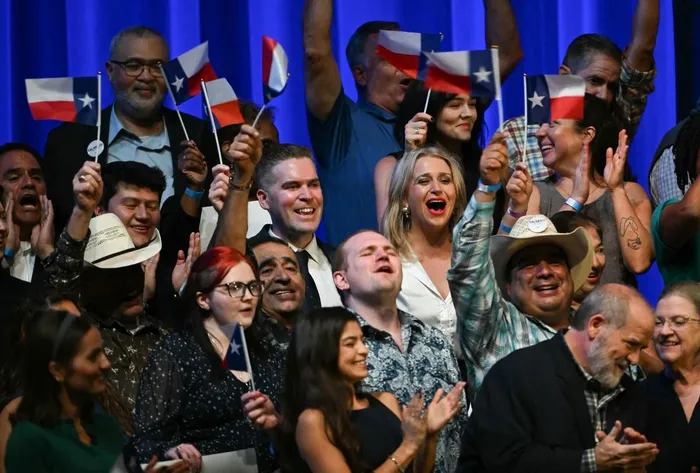
Supporters of Democratic US Senate candidate James Talarico cheer after news of his victory in the Texas race during a US midterm election night watch party at the Long Center for the Performing Arts in Austin, Texas, on November 3, 2026.
Young American voters who helped Donald Trump secure a stronger showing among younger generations in 2024 swung sharply back towards Democrats in the 2026 midterm elections, helping the party secure a major victory in congressional races.
Polling cited in the results shows Democrats winning younger voters by more than 30 percentage points, with those under 25 choosing Democratic candidates by more than a two-to-one margin.
The shift marks a significant reversal from the 2024 presidential election, when Republicans made major gains among young voters, traditionally considered a left-leaning demographic.
Trump secured about 43% of voters under 30 in 2024, his party’s strongest performance among that age group in decades. His Democratic opponent, then vice-president Kamala Harris, received 54%.
In the midterms, 66% of voters in that age group backed Democrats.
Democratic strategists and party officials made a concerted effort to win younger voters back, adopting a more reactive digital strategy and focusing their messaging on the cost of living. Pre-election polling had indicated high levels of economic anxiety among young Americans.
The outcome was “a generational statement”, said John Della Volpe, a pollster and expert on young voters.
“It was a near complete rebuke of all things Trump, all things Washington,” he said.
Della Volpe attributed the backlash to a sense of “betrayal” among young people, who felt let down by Trump and other politicians who had promised to lower living costs and keep the United States out of wars.
However, he cautioned against assuming young voters would remain firmly aligned with Democrats.
“The lesson is that they’re not Republicans, they’re not Democrats - they’re available,” he said.
Cost of living emerges as key concern for young voters
About 50 million Generation Z Americans were eligible to vote in the midterms. The generation is more racially and ethnically diverse than older age groups.
Asian, Black and Hispanic young voters gave Democrats their strongest support in House races.
In competitive House districts, Democrats won 71% of voters under 25 and 59% of those aged between 25 and 29.
Younger voters also shifted towards Democrats in closely contested Senate races.
In Michigan, Democratic candidate Abdul El-Sayed won voters aged 24 and under by 37 percentage points, representing a 43-point swing from the 2024 presidential election, when Harris lost that demographic by six points.
The enthusiasm was visible among students at the University of Michigan, where young people waited in a receiving line to greet El-Sayed on Tuesday, at one point blocking traffic.
One young man hugged him and exclaimed, “Oh my god, oh my god”, while another young woman said: “I am losing my mind.”
Matt Palumbo, a 28-year-old Detroit city worker who had not voted since supporting Democrat Hillary Clinton in the 2016 presidential election, returned to the polls to vote for El-Sayed.
He compared Republican rhetoric accusing El-Sayed of being a socialist to McCarthyism and the Red Scare of the 1950s, when accusations of communist sympathies were used to discredit political opponents. El-Sayed has said he is not a socialist.
“Why is socialism so bad when the goal of it is just trying to feed people or give us health care?” Palumbo said.
Democrats make gains in Texas and Kansas
In Texas, Democrat James Talarico flipped a Senate seat and shifted the youngest counties in the state 30 percentage points to the left.
Chloe Wilkinson, a 28-year-old assistant campaign manager for local Democrats, said Republican campaign messaging had failed to address voters’ economic concerns.
“Here in Texas and across the country, Republicans were running these anti-trans ads because they didn’t have anything economic to run on,” said Wilkinson, who is transgender.
“Some Democrats were scared of that. But this showed that didn’t work.”
Young voters also moved sharply towards Democrats in Kansas, where Democratic Senate candidate Adam Hamilton won the counties with the highest proportions of young residents by 23 percentage points.
Republicans urged to address young voters' concerns
Scott Walker, president of the Young America’s Foundation, an organisation promoting conservative ideology on college and high school campuses, said the shift among young voters was not unexpected.
He said feedback gathered from young people before Election Day had pointed to widespread dissatisfaction with politicians over the cost of living.
“On the issue of cost of living, they were completely dissatisfied with everyone in power,” Walker said.
He said Republicans needed to do more to address younger voters’ concerns.
“You can’t just criticize. You’ve got to offer a solution. You’ve got to offer something that shows you hear them.”
The results suggest that economic concerns and the ability of political parties to connect with younger voters could play an important role in future US elections. But, as Della Volpe cautioned, the shift should not be taken as proof that young Americans have permanently aligned themselves with either party.