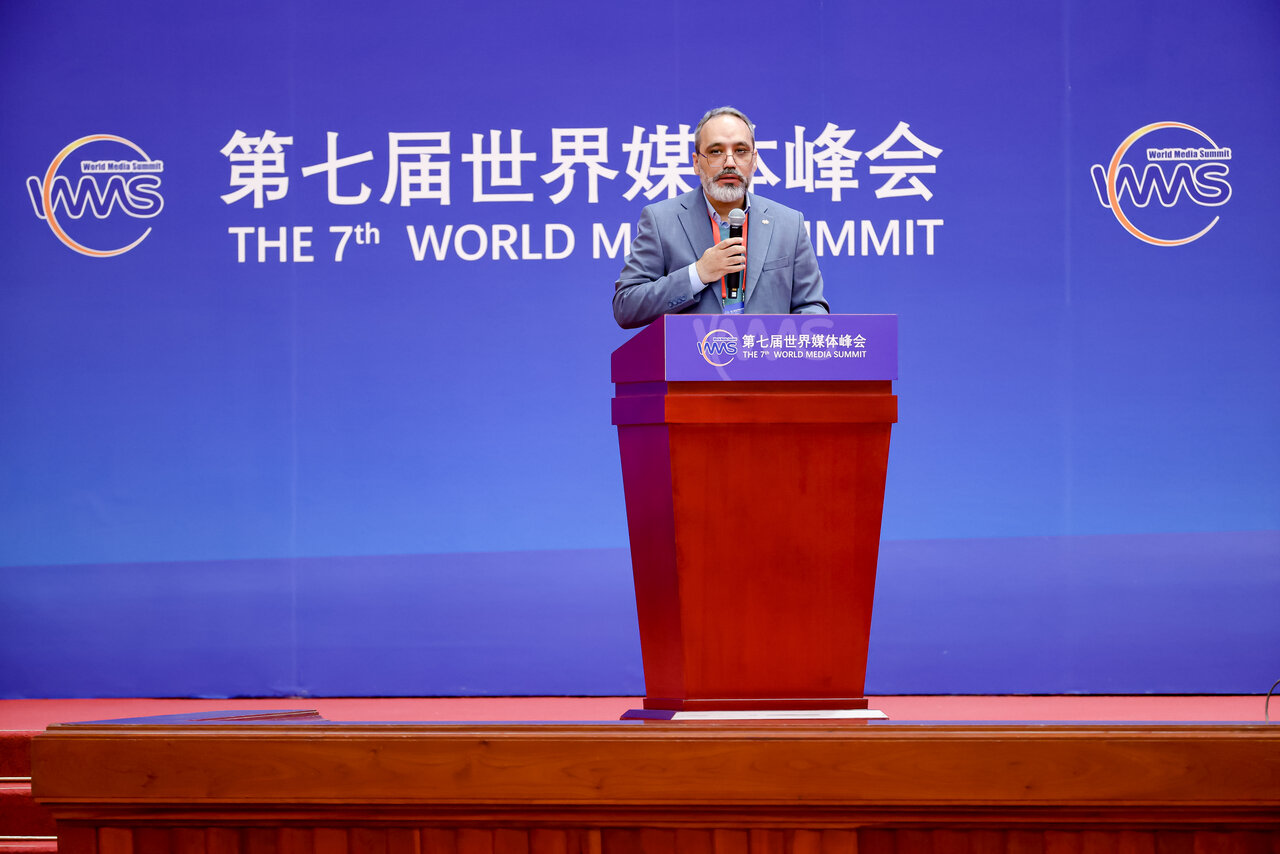
TEHRAN- Mohammad Mahdi Rahmati, CEO of Mehr Media Group, has proposed the establishment of an international working group for cooperation and knowledge-sharing on artificial intelligence in journalism, as well as joint investment in developing an open-source AI-powered editorial management system, during the 7th World Media Summit in Beijing.
Speaking on Saturday at the international gathering, Rahmati highlighted the opportunities and challenges artificial intelligence presents to the media industry, stressing the need for international cooperation to ensure that intelligent technologies contribute to shared development, credible journalism and a fairer global information environment.
The 7th World Media Summit, which is being held in Beijing from November 5 to 9, has brought together nearly 500 representatives from close to 330 mainstream media outlets, think tanks, government bodies, the United Nations and other international organizations across 112 countries and regions.
Held under the theme “Media in the Intelligent Age: From Consensus to Action,” the summit is jointly organized by Xinhua News Agency and the Beijing Municipal People's Government. It addresses the growing impact of artificial intelligence on the production, distribution and interpretation of information, as well as the challenges facing media credibility in an era of increasingly sophisticated digital technologies.
Rahmati, who heads Mehr Media Group, comprising Mehr News Agency and the English-language daily Tehran Times, drew on Iran's recent experience of war to illustrate the dual role of AI in contemporary conflicts, both in military decision-making and in reporting their human consequences.
Referring to the Minab school tragedy, in which 168 children and teachers were martyred, he said investigations had indicated that inaccurate analysis by an AI system used by the US military was the most likely cause of the incident, while AI had also helped media outlets document the event and convey the suffering caused by the loss of the children.
He argued that such experiences underline the responsibility of media organizations to safeguard truth and human values when intelligent technologies increasingly influence both critical decisions and public understanding of events.
Rahmati also called for a shift away from restrictive approaches to technological development, emphasizing that no society should be excluded from shaping the future of the media industry.
At the outset, I would like to express my sincere gratitude to Mr. Fu, his colleagues at Xinhua News Agency, and everyone involved in organizing this summit for providing us with a valuable opportunity to discuss the future of media in the age of artificial intelligence.
The theme of this summit raises a fundamental question: In a world where AI is rapidly changing the way information is produced, distributed, and interpreted, how can we ensure that this new system for producing and processing knowledge serves all of humanity? And what kind of future do we want for the world’s media?
I come from a country that has faced two wars over the past two years, wars in which AI has been used for both beneficial and harmful purposes.
Leaving aside the possibility of a deliberate US attack on the Minab school, for which there is also evidence, in which 168 children lost their lives, investigations indicate that inaccurate analysis by the AI system used by the US military was the most likely cause of this crime. At the same time, AI also helped the media tell the story of what happened and describe the suffering caused by the loss of these children.
This raises a second question: When intelligent technologies play a role both in making critical decisions and in shaping the public account of events, what is the responsibility of the media toward the truth, human beings, and public opinion?
This experience draws our attention to a broader issue: the relationship between knowledge, power, and responsibility in the age of intelligent technology. Access to AI, by itself, does not mean better understanding or fairer dialogue. We must work to better understand how the media can turn the power that comes from knowledge into an opportunity for cooperation and shared development.
We need to build a fair world through shared development. To build such a world, we need more bridges of cooperation and less of the mindset of “small yard, high fence,” so that no society is denied the right to help shape the future.
On this basis, I would like to put forward two proposals to strengthen the media’s capacity to use and provide AI.
First Proposal: Establishing a Working Group for Cooperation and Knowledge Sharing on AI in the Media
This proposal involves bringing together interested and active media organizations to strengthen their knowledge and expertise in AI.
The working group could take the lead in identifying key topics for exploring the future of AI. It could assess how media organizations use AI, examine changes in audience behavior and media consumption patterns, share knowledge and experience about the practical uses of AI, and work with international organizations to propose a desirable future for the media and ways to achieve it.
Second Proposal: Joint Investment in the Design and Development of an Open-Source, AI-Powered Editorial Management System
This system could provide a set of adaptable tools to support journalistic work, from searching and organizing documents and data to speech transcription, translation, preliminary fact-checking, keyword suggestions, support for producing multilingual content, and information verification.
As a first step, we could establish a joint group of media organizations, AI specialists, universities, and research centers to identify the actual needs of newsrooms, design the system’s initial structure, and develop a pilot version with the participation of several media organizations.
Through cooperation, joint investment, and respect for the diversity of civilizations, we can choose a shared path. The question is not only what AI makes possible for us. The question is what kind of future we, as media organizations, will build with its help.
The proposals reflect a broader call for media organizations to move beyond competition and work together in developing accessible technological resources, sharing expertise and ensuring that artificial intelligence serves journalism and the public interest. The summit provides an international platform for such discussions, bringing together media professionals and policymakers to explore practical responses to the opportunities and challenges of the intelligent age.