The Philippine economy grew by a measly 2.1% in the third quarter of 2026, the Philippine Statistics Authority (PSA) reported on Monday, November 9. That’s down from 4% in the same quarter last year and 2.4% in the second quarter, after revisions.
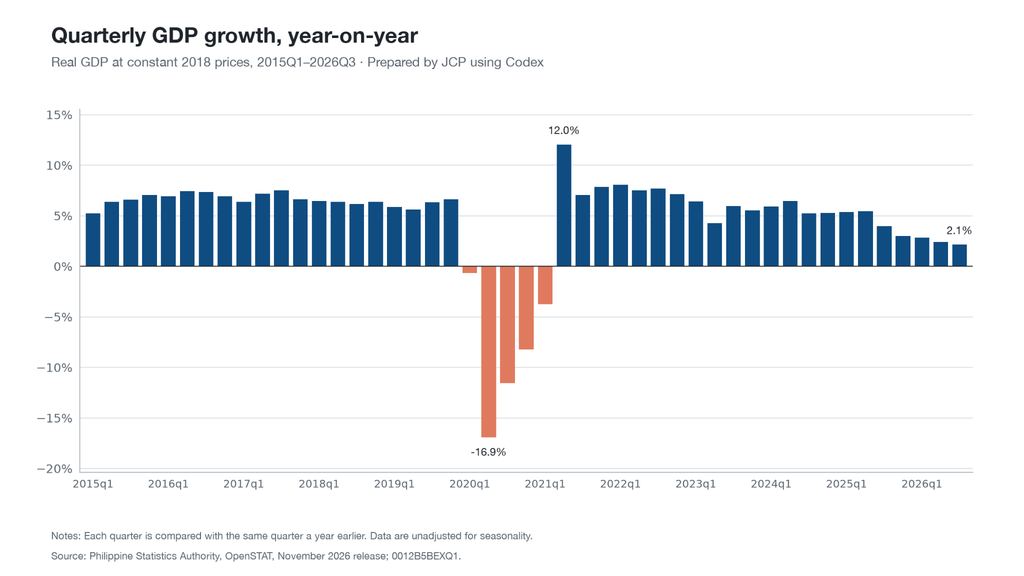
This is a deeply disappointing result. Growth fell 0.9 percentage point short of the 2.7% median forecast in a BusinessWorld poll of economists. And we’ve now had two quarters of unusually weak growth alongside high inflation. By my own calculations, we’ve entered stagflation territory.
How much did the economy grow from the second to the third quarter itself? Once you account for the usual seasonal ups and downs, gross domestic product (GDP) grew by just 0.1%. In other words, the amount of goods and services we produced barely changed from one quarter to the next.
That leaves growth at about 2.5% for the first nine months of 2026. To reach even the bottom of the government’s reduced target of 3.5% to 4.5% for 2026, the economy would have to grow by 6.3% in the last quarter. Where would that growth come from? Your guess is as good as mine.
Households are feeling itLet’s start with household spending, which accounts for nearly three-fourths of the economy. It grew by just 2.4% from a year ago, after adjusting for inflation. Spending on food and nonalcoholic drinks grew by only 1.6%. Spending on transport fell by 5.3%, its second straight quarterly decline from a year earlier.
One reason for weaker spending is very high inflation, which reached 7.8% in October, up from 7.2% in September. October falls outside the GDP report, which covers July to September, but it gives us an early indication of the squeeze on households going into the final quarter.
Meanwhile, agriculture, forestry, and fishing contracted by 4.8%, and industry was essentially flat. Services grew by 3.7% and contributed about 2.5 percentage points to overall growth. That’s more than the economy’s 2.1% growth because losses elsewhere ate into those gains.
 Investment looks worse up close
The PSA reported that total investment, or gross capital formation, fell by just 0.2%. But when I broke down the numbers, the near-flat figure concealed a much bigger decline. Fixed investment, which includes things like buildings and equipment, fell by 4.4%. Spending on durable equipment alone fell by 7.8%.
What made up most of the difference? Inventories, or goods that businesses hold in stock: in the third quarter last year, businesses ran down their inventories by P14 billion. This year, they added P37 billion, both measured at 2018 prices. That swing of P51 billion added roughly 0.9 percentage point to GDP growth.
The national accounts tell us stocks went up. But we need more evidence to know whether firms were building them up deliberately or had trouble selling what they already had.
The construction figures also deserve a closer look. Government construction fell by 15.1%. That’s a smaller drop than the 33.4% contraction in the second quarter, but still quite substantial. Corporate construction grew by just 0.3%, while construction by households and nonprofit institutions grew by 1.1%.
Interestingly, government consumption grew by 6.8% in the same quarter. That covers the cost of providing public services, including salaries and operating expenses. Public works are counted separately as investment. The government spent more on running its agencies and less on building things.
Perhaps most consequentially, the drastic slowdown is pulling us farther from our pre-pandemic path. In my analysis, actual seasonally adjusted output in the third quarter was P5.95 trillion at 2018 prices, or about 22% below where it would be if the pre-pandemic trend had continued. It gives us a sense of how much ground we have yet to make up.
Stagflation is hereWhen asked by journalists, Socioeconomic Planning Secretary Arsenio Balisacan said he would wait until year-end before thinking of stagflation, the combination of weak economic growth and high inflation. So I looked at how often the two have occurred together in the Philippines since 2000.

In a paper I’m writing, I use two tests. First, inflation must average more than 5% that quarter. Second, the economy’s growth from a year earlier must fall more than two percentage points below its average pace over a 10-year stretch ending in that quarter. Think of an economy that usually grows at 5%. Under this rule, growth below 3% would count as unusually weak.
The second and third quarters of 2026 both pass those tests. The third quarter is the clearer case. The second quarter was so close to the line that a small revision to the GDP figures could change the result.
Both quarters still qualify if I leave the 2020 lockdown slump out of the growth average, or if I leave out the 2021 reopening bounce as well. Under all three versions, this is the first back-to-back pair of qualifying quarters in the data going back to 2000.
We’re already in stagflation territory, but let’s see if we’re still there by year-end.
There’s a lot of lost growth to catch up on, especially since many if not most of our neighbors are performing well in terms of growth. In fact, it’s quite embarrassing to be chairing the ASEAN this year while our growth figures are relatively dismal.

For its part, the Marcos administration can start by explaining which vetted public works it can get moving again, when workers can expect those projects to resume, and how it will keep another round of questionable projects out of the pipeline.
For the rest of us, we haven’t felt the full headwinds yet, what with the effects of Super El Niño on inflation and growth lasting until early 2027. Prepare for tougher times ahead. – Rappler.com
Jan Carlo “JC” Punongbayan, PhD, is an associate professor at the University of the Philippines School of Economics. His professional experience includes the Securities and Exchange Commission, the World Bank Office in Manila, the Far Eastern University Public Policy Center, and the National Economic and Development Authority. JC writes a weekly economics column for Rappler. He is also co-founder of UsapangEcon.com and co-host of Usapang Econ Podcast.
His first book, False Nostalgia: The Marcos “Golden Age” Myths and How to Debunk Them, was published by Ateneo de Manila University Press in February 2023. His second book, Twin Plagues: How Duterte and COVID-19 Wrecked the Philippine Economy, was published by Penguin Random House SEA in June 2026. Follow him on Instagram (@jcpunongbayan).
Below are In This Economy pieces you may have missed:
[In This Economy] This Halloween season, what scares me the most is the 2027 budget
[In This Economy] Handa ka na ba sa ‘super El Niño’?
Click here for other In This Economy articles.