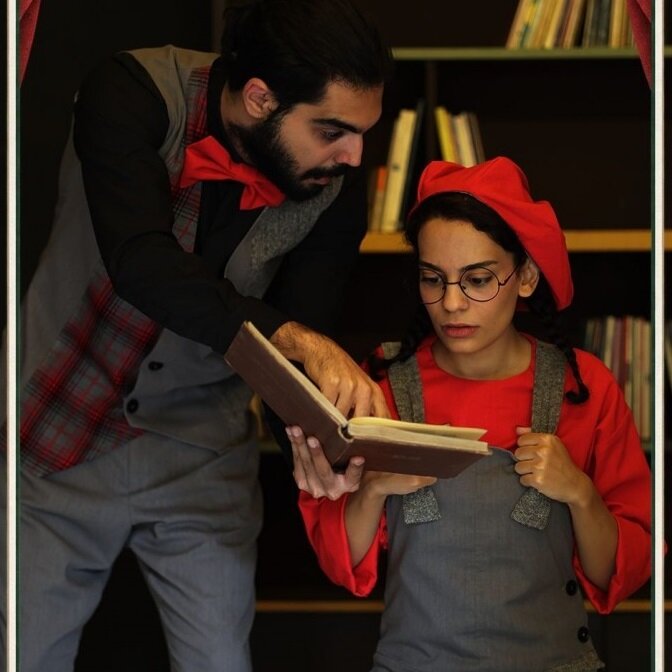
TEHRAN – Mehregan Theater in Tehran is hosting “The Lesson,” a one-act play by French-Romanian playwright Eugène Ionesco.
Directed by Ali Najimi, the play has Amir Saeed Afshar, Ensieh Shafiee, and Mahboubeh Zarkesh in the cast.
It was first performed in 1951. Since 1957, it has been in permanent showing at Paris' Théâtre de la Huchette, on an Ionesco double-bill with “The Bald Soprano”. The play is regarded as an important work in the "Theater of the Absurd".
The play takes place in the office and dining room of a small French flat. The Professor, a man of 50 to 60, is expecting a new Pupil (aged 18). The Professor's Maid, a stout, red-faced woman of 40 to 50, worries about the Professor's health.
As the absurd and nonsensical lesson progresses, the Professor grows more and more angry with what he perceives as the Pupil's ignorance, and the Pupil becomes more and more quiet and meek. Even her health begins to deteriorate, and what starts as a toothache develops into her entire body aching.
At the climax of the play, after a long bout of non sequiturs (which are frequently used in Ionesco's plays), the Professor stabs and murders the Pupil. The play ends with the Maid greeting a new Pupil, taking the play full circle, back to the beginning.
In the text of Ionesco's play, the story ends with the Maid handing the Professor an armband with a swastika on it. She instructs him to put it on, because then no one will ask any questions about all the students he has murdered, asserting that it's "good politics." For many years, however, productions have deleted this detail, claiming that audiences would be too shocked by it, or that it narrows a more universal message of the play. Many scholars, however, argue that this deletion defangs the play and intentionally obscures Ionesco's point.
Eugène Ionesco (1909 – 1994) wrote mostly in French and was one of the foremost figures of the French avant-garde theater in the 20th century. Ionesco instigated a revolution in ideas and techniques of drama, beginning with his “anti-play,” “The Bald Soprano,” which contributed to the beginnings of what is known as the “Theater of the Absurd”.
He wrote a number of plays that, following the ideas of the philosopher Albert Camus, explore concepts of absurdism and surrealism. He was made a member of the Académie française in 1970, and was awarded the 1970 Austrian State Prize for European Literature and the 1973 Jerusalem Prize.
“The Lesson” will remain on stage until November 21 at Mehregan Theater, located at No. 3, Farhangi (Behnam) Alley, Vesal Shirazi St., Enqelab St.