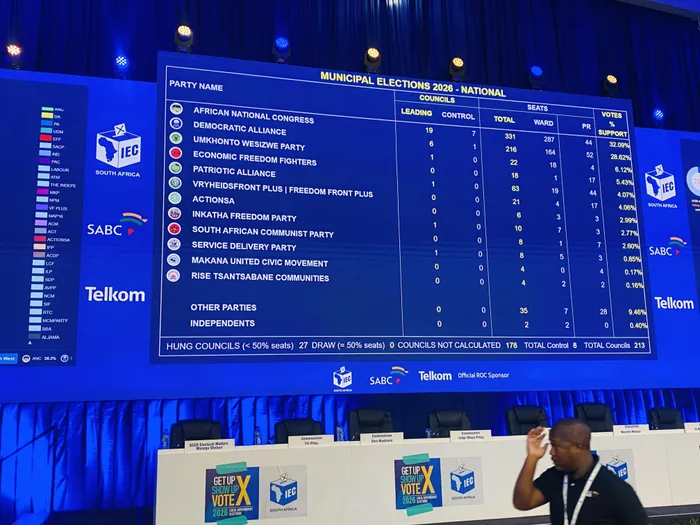
At least 22 parties have secured representation in the City of Cap Town following the local government elections.
Some of the small parties that contested elections in the City of Cape Town have blamed a lack of resources and funding as among the reasons they were unable to increase their number of seats.
Despite the disappointing performance by some, they were adamant that they will go back to the drawing board to prepare for the 2029 national elections and the municipal polls in five years’ time.
There were 55 parties that contested the local government elections in the City on November 4, but only 22 secured representation.
The Patriotic Alliance and ActionSA were the biggest winners when they garnered nine and seven seats each.
Parties blame campaign strategy and voter apathy
The first-time contestants in the City’s elections such as Build One South Africa, Mk Party, African Transformation Movement, People’s Movement for Change and Hold Leaders Accountable obtained one seat each.
The GOOD Party lost three seats, National Coloured Congress two, ACDP three, and one each in EFF, African Restoration Alliance, Cape Muslim Congress and Cape Independence Party.
The Al-Jama-ah increased its seats by three, Freedom Front Plus four and the UDM two while the PAC and African Independent Congress clung to their single seats.
ACDP provincial leader Ferlon Christian said the party’s poor show was due to being without resources and volunteers like other parties had.
“We had a good manifesto, a good message to get the people to vote for us, good policies and make meaningful contributions, but we did not have the people to go out and tell people about our message,” Christian said.
He also said they had been invited to fewer election debates to get exposure.
“We will go to the drawing board and see what we can do better. We are here to stay and we won't give up. ACDP has got a role to play and we must be stronger,” added Christian.
However, Cape Independence Party’s Jack Miller blamed the DA's campaign against small parties in its push to block the ANC and EFF.
He also said during the campaign many voters they approached were dissatisfied with the DA, but it managed to keep its majority.
“What happened on the election day is disappointing to see that the Cape Town voters that they would rather, out of fear, vote for the DA,” he said.
Cape Muslim Congress questions seat allocation
Miller also blamed the low voter turnout, saying there was apathy.
“We will make sure that the people who did not vote, get out and vote in the next elections,’ Miller said.
Cape Muslim Congress’ Yagyah Adams said his party had hoped for six seats but lost one of their two seats despite garnering more votes.
“We tripled our votes but we still got one seat. It is very strange,” said Adams, adding the counting for PR votes was complicated.
“We ran the campaign out of our pockets. We received no funding like other parties,” he said, adding that they were invited by four radio stations to the election debates and attended three.
Identity politics shapes Al-Jama-ah’s support
Adams said they will continue serving communities regardless of the size of representation in council.
Al-Jama-ah leader Ganief Hendricks said although his party was for all communities, it was perceived as a Muslim party because its values were universal and compatible with Islamic values.
"In Cape Town, people see us as a Muslim party and they don't see us as a party for all communities. What has happened is that the religious leaders have said that it is a sin for Muslims to vote for the DA because of their position on the genocide in Palestine,” he said.
He also said Al-Jama-ah had also campaigned on the need to hold the DA accountable and pointed at uneven service delivery between townships and suburbs.
Analyst says small parties struggle to broaden appeal
Political analyst Dirk Kotze said small parties hardly grew with the exception of ActionSA.
“Their focus, normally, is very small. The possible voters that they can attract are very sort of identity or religious parties like Al-Jama-ah or the ACDP,” he said.
“For a party to attract sufficient votes, they must have a package of issues that they concentrate on depending on what type of election it is."
Kotze added that the charisma of the leader of the party mattered in attracting voters.
“Many of these parties are completely unknown. You see them for the first-time on the ballot paper and you don't know who they are. That is why campaigning is important because they must make themselves known to the voters and they must make themselves visible and they must explain what they stand for. Most of these small parties don't do that."
“Some of the small parties are formed now with this local government election. There are many parties who were established just for a particular area.”
Kotze noted that some of the small parties in Cape Town were largely drawn from the Coloured constituency.
“None of them in the end got significant votes because they split it amongst themselves.”