For many informal workers in Kenya, earning a living also means paying for the right to do so. A motorbike taxi rider, a hawker or a small trader may be asked for money by a police officer or a county inspector. It is not a tax set by law, nor necessarily a fine for an offence. It is an informal payment that becomes part of the daily conditions of running a business. According to the World Bank, informal workers can lose up to 20 percent of their daily earnings this way.
The figure appears in the Kenya Economic Update published on 4 November 2026, which looks at how weak governance holds back growth and job creation. The report describes a country that keeps growing but where growth struggles to improve living conditions: GDP expanded by 5.2 percent year on year in the first half of 2026, yet 83.8 percent of workers are in the informal economy, where incomes are unstable and protection is thin.
It is worth being clear about where the 20 percent comes from. In the body of the report, the most detailed estimate concerns motorbike riders: sources cited put bribes at between 5 and 20 percent of daily earnings, or KSh 50 to 100 a day, with occasional larger demands on top. These are estimates, not findings of a systematic survey, and the report itself acknowledges that survey evidence on how corruption affects workers’ livelihoods is still sporadic. They nonetheless indicate an order of magnitude that is significant for people who live on the day’s takings.
Corruption here takes on a meaning different from the one usually associated with political scandals. It is not only about officials steering a tender or executives paid for a licence. It also concerns the daily relationship between citizens and the state, especially when the ability to work depends on the discretion of whoever holds authority.
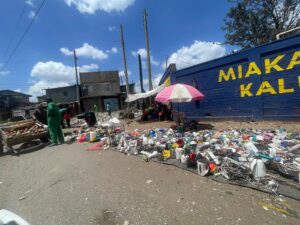
Street vendors display second-hand household goods and electrical items in Korogocho, Nairobi. Informal trade provides livelihoods for many residents, often in public spaces where access to work is precarious. July 2026 Photo: Fabrizio Floris
For a registered company, a bribe request is an extra cost, an administrative obstacle or a reason not to invest. For someone who lives on daily earnings, the same request comes directly out of the money that buys food, pays rent or covers family expenses. The difference lies not only in the sum but in its weight relative to what a person has. The World Bank notes that frontline corruption lowers workers’ take-home earnings and makes them less predictable.
These payments can be described as a parallel tax, but unlike taxes they follow no public rules, are not proportionate to ability to pay, and entitle the payer to nothing. They depend on the balance of power between whoever asks and whoever pays. The data cited in the report suggest that the burden does not fall evenly. The World Bank’s analysis of 2024 Afrobarometer data finds that people in the highest quartile of “lived poverty” are 14 percentage points more likely than those in the lowest to pay a bribe to the police, among those who had a police encounter they had not sought out. Afrobarometer’s 38-country report points the same way: across the continent, people in moderate or high lived poverty are 13 to 15 points more likely than better-off respondents to pay bribes to police, officials and health staff. Kenya stands out in that survey, with 50 percent of those who encountered the police saying they paid a bribe to avoid a problem and 68 percent of those who asked the police for help saying they paid. And among traders, hawkers and vendors, the World Bank report’s cross-country comparison of 2023 data shows that the likelihood of paying after police contact is higher in Kenya than anywhere except Uganda.
The effects extend beyond the street. In 2025, 39 percent of Kenyan firms called corruption a major or severe constraint, up from 25 percent in 2013, and 36 percent said they had received at least one bribe request in the previous year. Firms exposed to bribery are over 30 percent less likely to innovate and see weaker productivity and sales growth. For the state, a conservative World Bank estimate suggests that corruption and collusion have likely widened annual deficits by about two percentage points of GDP.
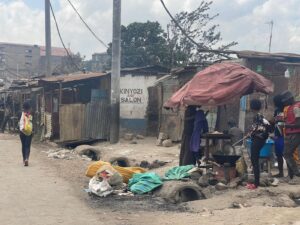
Small businesses and roadside food vendors in Korogocho, Nairobi. Informal enterprises are an important source of employment and income in Kenya’s urban economy.
The report also addresses the political dimension. It acknowledges that access to state resources remains central to managing political coalitions in Kenya: appointments in state-owned enterprises, preferential licences, non-competitive procurement and power purchase agreements can all be used to spread benefits among influential groups. In the Bank’s reading, this rent-sharing and co-optation of rising leaders has contributed to relative political stability. The costs are less competition, less productive investment, higher costs for business and slower economic transformation.
On this reading, corruption is not only a deviation from the rules but part of how institutions work. At the top, the distribution of public resources helps balance power among groups; at the bottom, the ability to demand informal payments becomes a resource for those who control access to economic activity. The activities through which millions of people support themselves in the absence of formal jobs become the object of arbitrary levies.
What could change? The report’s summary says that moderate anti-corruption reforms could raise GDP by 8.7 percent by 2035 compared with no reform, and stronger measures by 22.3 percent. Another passage puts the gain at around 13 percent if Kenya reached the control of corruption of Ethiopia or India. These are simulations, not forecasts, but they indicate how much the quality of institutions could matter. The recommendations include more transparent procurement, stronger oversight bodies, simpler administrative procedures and fewer opportunities for abuse in encounters between officials and citizens.
For informal workers, however, progress can also be assessed on a smaller scale: how much of the day’s takings remains in their hands. A country can grow, attract investment and improve its headline indicators without those gains reaching people who depend on daily work. Where part of that income is removed through arbitrary payments, the distributional question is not only how much is produced but who is able to appropriate it. The report’s own finding, that frontline corruption lowers and destabilises take-home earnings, points to a concrete test of reform: whether informal workers keep more of what they earn.
The post Paying to work: bribery and the earnings of Kenya’s informal workers appeared first on African Arguments.