PART 1 | Why the Lopez cousins are breaking up — and what other feuding dynasties teach us
What months of fighting in boardrooms, shareholders’ meetings, and public statements could not accomplish, the buying and selling of shares may finally achieve: a separation of the Lopez family businesses.
Between August and November 2026, Eugenio “Gabby” Lopez III’s branch sold its 25.68% stake in apex parent Lopez Inc. to Ramon Ang for ₱11.56 billion and agreed to buy First Philippine Holdings’ (FPH) controlling stake in Rockwell Land for ₱15.92 billion. In between, cousin Federico “Piki” Lopez locked down the boards of Lopez Holdings and FPH, securing his grip on the group’s energy and industrial core. (Click on these links below for the author’s special reports on these developments:
Part 1 | The Lopez heirs who ran Rockwell but never controlled it
Part 2 | Why Gabby Lopez wants Rockwell as ABS-CBN struggles
Part 3 | Why Piki Lopez is letting Rockwell go
The cousins appear to be finding a way to stop running the same businesses together. But separating a family business is not as simple as dividing an inheritance, especially when the family’s interests are held through layers of private and publicly listed companies with other shareholders, employees, creditors, and business partners whose interests cannot simply be divided among the cousins.
Who decides what each business is worth? Who approves the sale? What happens when the buyer and seller are connected to rival branches of the same family? And what protects shareholders who were never part of the quarrel?
In the first story of this series, we examined why business families fight and why some choose to stay together while others separate. The Lopezes are hardly the first to confront these questions. Other families have negotiated settlements, divided companies, bought out dissatisfied relatives, or found ways to continue working together. Their experiences offer lessons on how families can manage either choice without damaging the businesses they own.
Who gets to decide?One source of conflict in family businesses is that relatives often wear several hats at once. A person may be a grandson of the founder, a shareholder, a director, and an executive, but these positions do not give him the same authority. Being a member of the family does not automatically entitle him to run the company, just as owning shares does not necessarily give him the right to dictate daily operations. Problems arise when relatives begin treating their different roles as though they were interchangeable.
Family-business advisers Josh Baron and Rob Lachenauer explain these distinctions through their Four-Room Model. Imagine a family enterprise as a house with four rooms: the family room, the owners’ room, the boardroom, and the management room. The family discusses shared values, relationships, and what it wants to preserve for future generations. Shareholders exercise ownership rights, including electing directors. Directors oversee the company, approve major corporate decisions, and hold management accountable, while executives handle operations, employees, budgets, and the implementation of strategy.
Play Video
The same relative may enter all four rooms, but his authority in one does not automatically extend to another. Family-business adviser Enrique Soriano discussed these overlapping responsibilities during a webinar we conducted in June, when the Lopez feud was already unfolding.
The Lopez dispute illustrates why these distinctions matter. Gabby’s branch exercised ownership rights through its stake in Lopez Inc., while Piki had spent decades managing and directing the group’s energy businesses. When the cousins disagreed about investments, valuations, and corporate direction, their disagreement became a contest over who had the authority to make those decisions.
By September, Piki had secured the chairmanship of Lopez Holdings and FPH, while his brother Benjamin “Jay” Lopez became president, chief operating officer, and chief finance officer of Lopez Holdings, taking over three positions previously held by longtime executive Salvador Tirona. Piki remained chairman and chief executive officer, placing the two brothers in the principal leadership positions of the listed holding company.
The significance went beyond replacing one executive with another. Lopez Holdings sits above FPH in the ownership structure, and the people leading it exercise considerable influence over the group’s investments and corporate direction. Tirona had been a senior professional executive for decades, while Jay was a member of the controlling family branch. His appointment brought operational and financial leadership at the holding company more directly into Piki’s family circle.
Winning control of a board may settle who has corporate authority to make certain decisions. It does not necessarily resolve what the different shareholders want from the business.
Rules before the fightingThe Aboitiz family offers a useful contrast. I interviewed the late Jon Ramon Aboitiz in 2017 for a story about the Cebu-based conglomerate and how it had evolved through generations of owners and managers. When my profile of him was published in 2018, shortly after his death, the family had already established a constitution, a family council, rules governing who could enter the business, and a succession process that included preparing members of different family branches and generations for leadership.
These arrangements were part of a larger philosophy about managing family wealth. Jon Ramon recalled how his grandfather, Ramon Aboitiz, required young family members to learn the business from the ground up, sometimes literally cleaning toilets aboard the family’s ships. Relatives who wanted to become executives had to work and prove themselves. The family also learned to distinguish its attachment to one another from its attachment to a particular business.
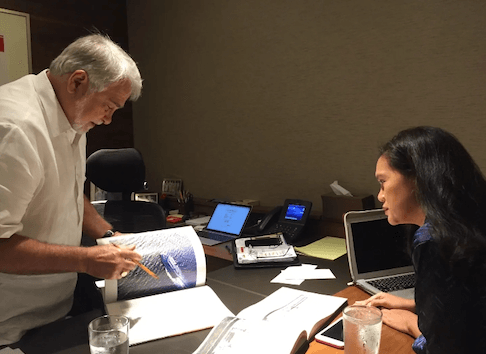 The author interviewing Jon Ramon Aboitiz in 2017. Lala Rimando
“One of the first things my grandfather imparted was: ‘Never fall in love with your business,’” Jon Ramon told me. The Aboitizes eventually sold their shipping business under well-known brands SuperFerry and SuperCat, which were once central to the family’s identity, as they redirected capital and management attention toward businesses, such as power, which they believed had better prospects. If it was the right time to sell, for the right reason and at the right price, the family should sell and move on. (READ: Q&A with Jon Ramon Aboitiz: ‘Never fall in love with your business’)
The Po family, whose businesses include Century Pacific Food, also developed formal arrangements to manage family participation. In a 2019 Esquire profile, I wrote about Nanette Medved-Po becoming the first chairperson of the Po Family Council, a position that gave her a role in the family’s governance distinct from the management of its operating companies.
The Aboitiz and Po experiences show how family governance can provide a place for relatives to discuss shared interests and expectations without requiring every disagreement to become a corporate dispute. A family council can help relatives who are not executives remain informed and involved, while a family constitution can establish values, expectations, and policies concerning succession, employment, and the stewardship of family wealth.
Play Video
The Lopez family, however, never finalized a family constitution. Efforts were made while second generation Oscar Lopez was the family patriarch, and again after the third generation assumed leadership of the businesses. Neither effort produced a completed constitution before the cousins’ war erupted in 2026.
That is a significant distinction. The Lopezes had a long family history, established businesses, and experienced professional managers, but they did not have a finalized family constitution that could provide a common reference for the competing branches when disagreements over investments, control, and leadership intensified.
A constitution, however, would not necessarily have prevented the feud. Soriano has emphasized that a family constitution is not enough, because an agreement on shared values is different from a contract establishing enforceable rights. Families may also need shareholders’ agreements specifying how shares can be sold, how their value will be determined, whether relatives have the first opportunity to buy, and how disputes will be resolved.
The bitter dispute behind another familiar Philippine brand, Green Cross rubbing alcohol, offers a warning about relying on family trust without written agreements. Gonzalo Co It, who established the business in 1952, said he placed shares in the names of his parents and siblings when he incorporated the company, believing they were holding those shares for him. He later accused relatives of taking control and diluting his ownership, allegations that became the subject of a long-running court dispute. In a 2014 interview, Gonzalo said his mistake was failing to document the arrangements because he trusted his family.
His attempt at reconciliation brought another painful lesson. In 2011, Gonzalo withdrew his appeal before the Supreme Court, hoping to settle the dispute with his siblings. The reconciliation never materialized, and the withdrawal threatened to end his legal remedies. In October 2016, the Supreme Court allowed him to reinstate his petition, although it did not decide who owned the disputed shares. The case illustrates why families need more than goodwill when they negotiate ownership and settlement arrangements: even an agreement to stop fighting should specify what each side is giving up, what it will receive, and what happens if the promised reconciliation fails.
A family council can help relatives discuss disagreements. A code of conduct can establish boundaries on how they treat one another. A shareholders’ agreement can address what happens when they no longer want to remain business partners. None guarantees that relatives will agree, but the arrangements can establish rules before every proposed decision is interpreted as an attempt by one branch to outmaneuver another.
The best time to negotiate an exit is when nobody is yet trying to leave.
How families negotiate an exitSome families settle their differences without dividing their businesses. Others decide that separation offers a better chance of preserving both the enterprises and whatever remains of their relationships.
In Singapore, the Kwek family’s February 2025 boardroom confrontation at City Developments Limited ended after trusted intermediaries helped broker a truce. Father Kwek Leng Beng and son Sherman Kwek retained their executive positions, while the two independent directors whose appointments had sparked the dispute stepped down. The Ortigas family, meanwhile, ended its dispute over OCLP Holdings through a 2014 compromise involving Ayala Land and SM Prime Holdings, preserving the property business while sharing influence with powerful outside investors.
India’s Ambani family chose to divide operating businesses, with mother Kokilaben mediating the 2005 settlement between brothers Mukesh and Anil. The Murdochs reached a different arrangement in September 2025, strengthening Lachlan Murdoch’s future voting control over Fox Corporation and News Corp while compensating three siblings who exited the relevant trust arrangements.
These families took different routes, but each had to confront the same practical questions: Who would control the business, what would each relative receive, who would finance the arrangement, and what would happen to the companies afterward?