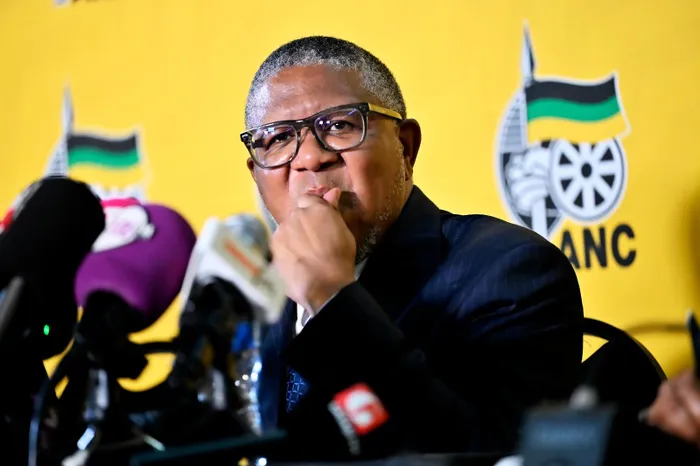
ANC secretary-general Fikile Mbalula described the election results as catastrophic and acknowledged that the party must take responsibility for local government failures, poor service delivery, internal divisions, and distant representatives. Mbalula addressed the media at the National Results Operations Centre at the Gallagher conversion centre in Midrand yesterday.
Image: Picture: Itumeleng English / ANA Studio
March and March has blamed the ANC’s poor showing in South Africa’s 2026 local government elections on the party’s failure to address voters’ concerns over migration, jobs, crime and public services.
With about 98% of votes counted, preliminary results put the ANC’s national support at 30.91%, down from 45.59% in the 2021 municipal elections. The figures have prompted the movement to accuse President Cyril Ramaphosa of disconnecting from grassroots communities.
Meanwhile, ANC secretary-general Fikile Mbalula described the election results as catastrophic and acknowledged that the party must take responsibility for local government failures, poor service delivery, internal divisions, and distant representatives rather than expecting to govern based solely on past history.
He also acknowledged that the party respects the voters' decision to support other parties or abstain from voting, committing to confront the internal issues causing disillusioned South Africans to lose faith in the movement.
According to the IEC dashboard, just after midday on Saturday, with approximately 98% of votes counted, the ANC’s national support hovered around 30.91%, marking a steep drop from its 45.59% share in the 2021 municipal elections and putting the party on track for its worst electoral outcome since 1994.
The data also indicated that the party has already lost 303 wards nationally as voters fragmented their support among parties such as the DA, MK Party and ActionSA.
March and March said the ANC-led government, under the stewardship of President Cyril Ramaphosa, has ignored grassroots grievances centred on illegal immigration, job competition, crime and strained public services.
The movement's spokesperson Sandile Dube said instead of addressing the issues, the government turned to the courts to silence them.
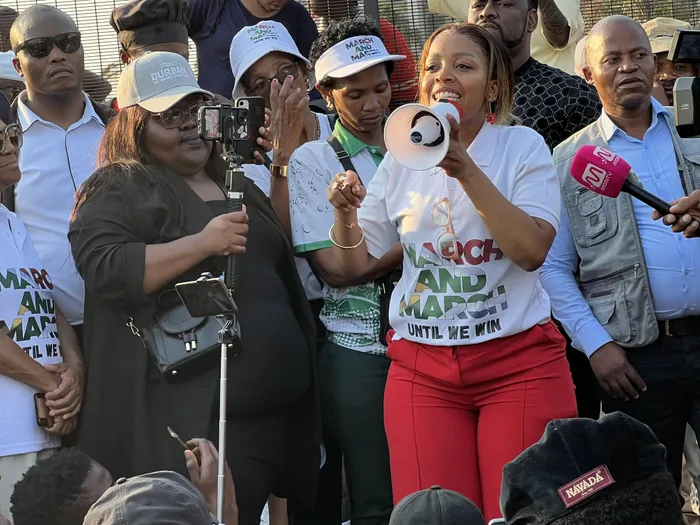
March and March has criticised the ANC for being out of touch with everyday citizens amid projected electoral losses following the local government elections.
This also comes amid threat of imminent arrest against the movement’s leader Jacinta Ngobese-Zuma and her husband.
According to reports, authorities pursued criminal charges against Ngobese-Zuma for inciting public violence during a school protest and fueling tensions surrounding the movement's anti-illegal immigration campaigns. Following these developments, she handed herself over to the Point police station to face the charges.
The movement alleged that the supposed arrests were politically motivated, claiming the government and leadership aimed to intimidate civil society activists, silence their anti-illegal immigration protests, and disrupt their campaign ahead of the local government elections.
However, the National Prosecuting Authority (NPA) and the SAPS rejected these claims as false.
Dube said the government also blocked March and March to engage them on every platform, including the mainstream media.
“There is a very systematic exclusion of March and March, either through the media or through a wall that ‘as a government we will never engage March and March’. We know there is a systematic way of isolating the leader of March March to the extent that some have decided to publish her home address and expose her to any form of attack,” Dube said.
Ngobese-Zuma also posted on her social media platforms that the loss of the ANC’ support raises serious questions about Ramaphosa’s leadership and ability to reconnect with voters.
She also accused Ramaphosa of creating an environment of fear, claiming that those who dare to speak out against him face intimidation and attempts to silence them.
Ngobese-Zuma also warned that the ANC could suffer even greater electoral losses by 2029 if the concerns of ordinary citizens continue to be ignored.
“You can’t lead people using fear. Anyone who dares say anything about him even as a President is instilled with fear, ask me I know. By 2029 the losses will be worse, we can’t have a President that doesn’t listen to people,” she wrote.
Both Ramaphosa’s spokesperson Vincent Magwenya and ANC’s Mahlengi Bhengu-Motsiri did not respond.
Ahead of the local government elections, Ngobese-Zuma and her movement alleged that arrest warrants had been issued against her and co-convener Xolani Zuma, claiming they were politically motivated and intended to intimidate activists.
She also dared Ramaphosa to arrest her, accusing the government of “acting like a dictatorship” and using courts and soldiers instead of dialogue.
Dube said a serious government approach to resolving migration issues and their underlying consequences must include consultation with the leading community-organising stakeholder.
Political analyst Professor Sipho Seepe said the voters decide on multiple elements, adding that migration is one of them as a global issue.
“We must also remember political parties such as ActionSA have long started this campaign when its leader, Herman Mashaba, was the mayor of Johannesburg. The ActionSA already had that posture, and that is why the party was quick to embrace March and March, and if you look at the party’s performance in Gauteng, they have done much better than they thought,” said Seepe.
He added that the results were only not about the migration but the rejection of ANC, which has become arrogant.
Seepe said the MK Party’s visible momentum in KwaZulu-Natal was further boosted by Ngobese-Zuma, who aligned with the party and urged voters to back political groups whose anti-illegal migration stances match her movement's objectives.