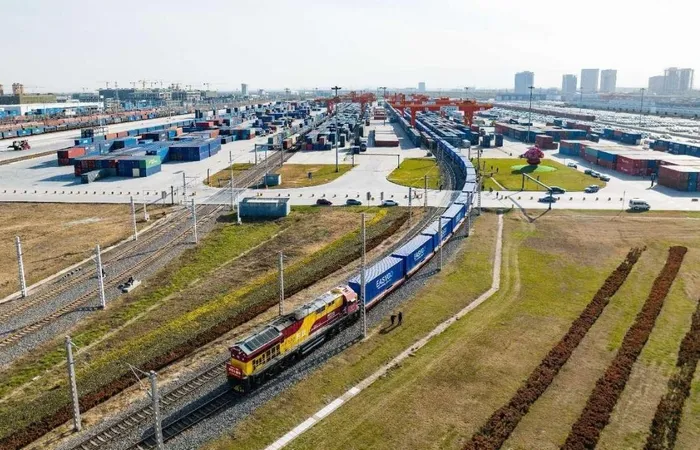
Freight train services originating from Xi'an account for about a quarter (25%) of all China-Europe Railway Express departures nationwide, making it China's busiest departure city.
XI'AN, China — Shaanxi is one of the primary cradles of Chinese agricultural civilisation. It is known for Mount Hua, Dayan Pagoda, biang biang noodles, and the Terracotta Army.
Xi'an, the provincial capital, is also fast becoming a high-speed railway hub and a leading player in the China-Europe Railway Express.
Media from more than 15 countries across Africa touring Xi'an were shown a province betting on rail to turn a landlocked location into a gateway to Central Asia and Europe.
The visit, hosted by People's Daily and the Shaanxi provincial government, took delegates to meet officials and to see businesses and industries the province says are driving its economic growth.
At the centre of the pitch is the Chang'an China-Europe Railway Express, whose first train left Xi'an for Kazakhstan on 28 November 2013. The Xi'an Port operation centre says the service now has 18 international routes reaching 45 countries and regions. It says more than 30,000 trains have run in total, including about 2,000 in the first four months of 2026.
The operator says cargo has shifted from building materials and daily necessities to new-energy vehicles, lithium batteries, solar products and smart appliances. It also says return trains outnumbered outbound ones for the first time in 2025, at 3,451 trains or 57.2% of volume, with Kazakh grain and minerals among the goods coming back.
Nationally, return services overtook outbound ones in 2025, with 10,124 trips versus 9,898, according to China Railway statistics. Xi'an's claimed share is well above the national figure of about 51%, and it has not been independently confirmed.

Zhong Weiguo, professor and former director of the Department of Economics at the Party School of the CPC Shaanxi Provincial Committee, says rail now plays a major part in the local economy.
Xi'an is China's leading hub. It ran 5,063 trains in January to October 2025, up 16.3% year on year, while national China-Europe services grew 3.2% to 20,022 trips over the full year. Its port is designed to handle 5.4 million TEUs and 66 million tons a year, according to People's Daily.
Zhong Weiguo, a professor and former director of the economics department at the Party School of the CPC Shaanxi Provincial Committee, says rail is now a major player in the local economy. He describes Xi'an as a national transport hub replicating the shape of the Chinese character "米" (mǐ, meaning rice), whose strokes extend from the center horizontally, vertically, and diagonally across all eight cardinal points (North, South, East, West, Northeast, Northwest, Southeast, Southwest) high-speed layout radiating in eight directions. "Our goal is to build over 70,000 km of high-speed railways nationwide by 2035," he said.
He reads the Belt and Road as an outlet for China's industrial overcapacity. He acknowledges that direct exports increasingly meet anti-dumping investigations, which is part of why firms are moving production to partner countries such as Vietnam, Malaysia and Thailand.
The tour of the railway operation also highlighted individual firms. Konka, which makes appliances about a kilometre from the rail terminal, says it has exported 286,000 white goods by rail this year, about 47 full trains' worth, with the fastest delivery to Russia taking nine days. A Xi'an power engineering firm says a solar project in Azerbaijan, with a contract value of 2.6 billion yuan, shipped in about 2,038 40-foot containers. An Uzbek-born entrepreneur who runs a Xi'an trading firm says deliveries to Tashkent now take 15 days, nearly a week faster than before.