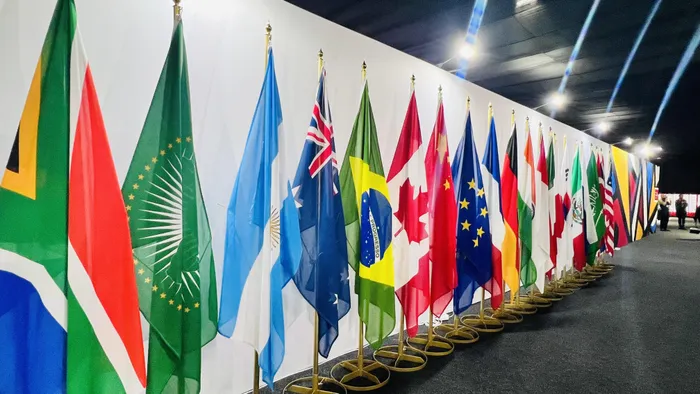
South Africa is expected to participate in the Business 20 (B20) summit in Washington D.C. despite growing diplomatic tensions between the Pretoria and Washington.
Despite growing diplomatic friction between Pretoria and Washington, South Africa’s private sector is retaining a seat at the global table as the US Chamber of Commerce prepares to host the Business 20 (B20) summit in Washington D.C.
The event is expected to take place from November 9 to 11.
This comes after the US recently announced plans to remove South Africa from the African Growth and Opportunity Act (AGOA), ending the country’s duty-free access to US markets starting January 1, 2027.
The US cited barriers to American trade and investment, corruption, and threats to US national security and foreign policy interests.
The US also excluded South Africa from the G20 Leaders Summit in Miami in December.
The B20 is the official G20 dialogue forum that represents the global private sector.
Established in 2010, it acts as a primary bridge between the international business community and the G20 government, gathering industry leaders to formulate concrete policy recommendations on global and trade issues.
South Africa is a permanent member of the B20 because it belongs to the G20 and hosted and chaired the B20 in 2025 during its historic G20 presidency.
According to an international relations expert, Professor Andre Thomashausen, South Africa can use strong US business ties to protect trade benefits and maintain global influence, even if government-to-government relations are strained.
“South Africa might be able to have a voice and be present. American business interests in South Africa continue to be strong, especially in mining, energy generation and distribution and rail transport. These interests constitute a natural support base for South Africa's foreign relations goals. With diplomatic skill, South Africa might be able to gain congressional support for its continued inclusion in the AGOA trade facilitation system,” he said.
Asked what high-level diplomatic mission or special envoy is being dispatched to Washington to engage congress (which determines AGOA frameworks) rather than dealing exclusively with an adversarial executive branch, International Relations and Cooperation spokesperson Phindile Kunene said the questions should be referred to the Department of Trade Industry and Competition.
However, the department’s spokesperson Kaamil Alli said the statement issued following the US announcement had already answered the questions.
In the statement, the department stated that South Africa wants to keep doing business with the US, but strictly on its own domestic terms and without changing its local laws or transformation policies.
While Ambassador Roelf Meyer stated that South Africa has moved past the G20 snub and is already engaging with the UK, which takes over the G20 presidency in 2027, Business Unity South Africa recently told the media that South Africa is using the B20 platform in Washington to maintain commercial and economic ties, given that over 400 US companies operate within South Africa.
During the transition of the B20 presidency from South Africa to the US, the US Chamber of Commerce representatives and B20 US leadership emphasised that the private sector remains committed to bilateral trade and shared economic growth regardless of diplomatic disputes.
Johan Els, a chief economist at PSG Financial Services, said the bigger concern regarding the US decision to remove South Africa from AGOA is the potential impact on business confidence, investment and diplomatic relations between the two countries.
South Africa has historically been the largest beneficiary of AGOA, accounting for roughly 54% of all AGOA-related exports since the programme began in 2000.
Els said while South Africa is the biggest overall participant in AGOA, losing these benefits will have a limited direct impact on the broader South African economy, though specific industries and worker groups will still feel the pressure.
Professor Theo Neethling said it is difficult to predict how the US will treat South Africa under President Donald Trump, because his extensive presidential power is balanced by political pushback in Congress, yet he remains flexible enough to make deals with opponents if it benefits him.
Neethling said Trump has already demonstrated a capacity for pragmatic action when it serves his political interests, adding that an agreement with the Democrats on specific policy issues cannot be ruled out.
“It would therefore be a mistake to underestimate him or to assume that political opposition will inevitably lead to a radical shift in his policy direction,” he said.