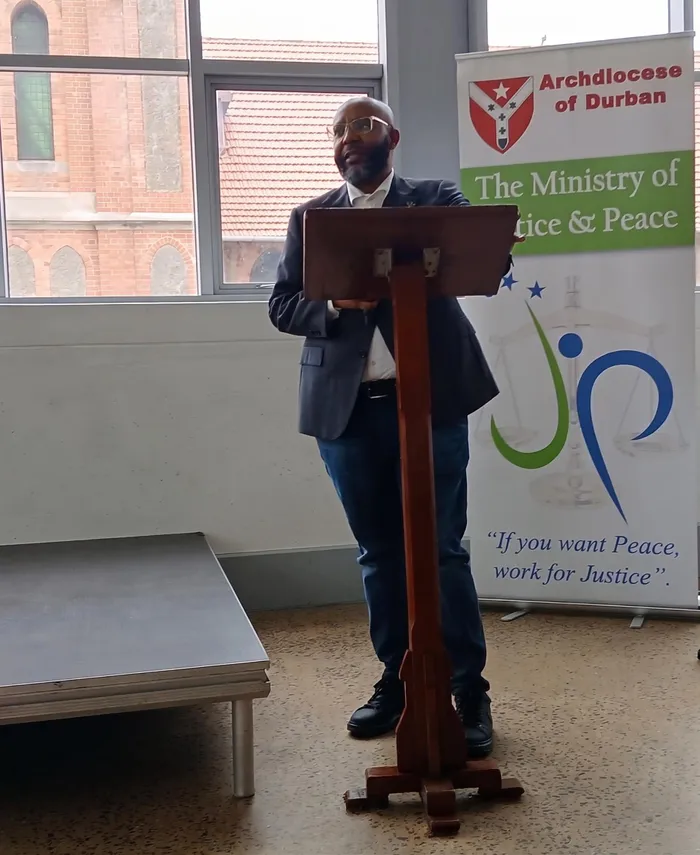
Political economist Nco Dube delivered the Archbishop Hurley-Gabuza Memorial Lecture yesterday at the Denis Hurley Centre in Durban, with St Emmanuel Cathedral in the background.
Political economist and Ukhozi FM resident social commentator Nco Dube has launched a scathing attack on the government over the contentious illegal migration issue, accusing it of hiding behind two opposing groups while evading responsibility for the crisis.
Dube was delivering the Archbishop Denis Hurley-Archbishop Abel Gabuza Memorial Lecture at the Denis Hurley Centre in Durban yesterday, under the theme: “Law & Justice: Victims Deserve Justice Not Victimisation”.
In an address that covered the re-victimisation of gender-based violence (GBV) survivors by society and law enforcement officials, poor service delivery, resource constraints, porous borders and the socio-economic conditions fuelling tensions between South Africans and foreign nationals, Dube urged society to place responsibility where it belongs.
“Government failures pit South Africans against foreign nationals. The scramble for limited resources causes people to blame foreign nationals. It's human nature. But let's be discerning enough to know the root cause.
“Government gets by without any blame,” Dube said, arguing that when anti-illegal migration groups confront foreign nationals, the government escapes scrutiny for its own failures.
He also criticised the Department of Home Affairs for failing to process asylum applications within a reasonable period, with some applicants waiting as long as 10 years for their documentation.
While acknowledging that it was wrong for anti-illegal migration groups to demand immigration papers from foreign nationals and block their access to healthcare services, Dube said their underlying concerns could not simply be dismissed.
“Let's locate the problem where it belongs: government failures,” he said.
He argued that an asylum seeker who had waited a decade for documentation could hardly be expected to resolve their predicament when government inefficiencies and administrative backlogs were at the root of the problem.
Drawing on the legacies of Archbishop Hurley and Archbishop Gabuza, the regular columnist for the Sunday Tribune challenged the church to reclaim its role as a voice for society, particularly on socio-economic issues affecting vulnerable communities.
Archbishop Hurley was a prominent anti-apartheid activist who famously described apartheid as blasphemy. Archbishop Gabuza, who died in 2021 before taking up his appointment as Archbishop of Durban, was a passionate advocate for equality, accountability and social justice.
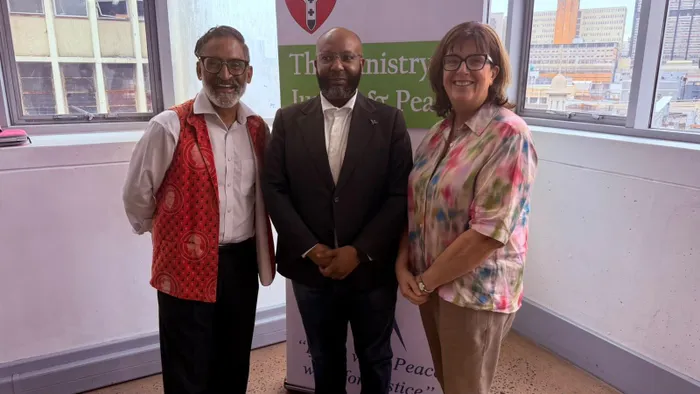
Dr Raymond Perrier, outgoing director of the Denis Hurley Centre; political economist Nco Dube; and Bridget Ward, the centre’s incoming director, at yesterday’s Archbishop Hurley-Gabuza Memorial Lecture in Durban.
Dube highlighted Gabuza's grassroots approach to activism, which included visiting taverns to engage men on issues such as gender-based violence, HIV/Aids and their attitudes towards abuse.
He said the church needed to return to this kind of direct community engagement, rather than remain on the sidelines of pressing social challenges.
The Hurley-Gabuza lecture has attracted prominent speakers over the years, including former deputy president Phumzile Mlambo-Ngcuka, former Cabinet minister Jeff Radebe, the late political analyst Protas Madlala, Catholic Parliamentary Liaison Office director Fr Peter-John Pearson and Catholic writer and scholar Dr Siphiwe Mkhize.
Archbishop Stephen Brislin, then Archbishop of Cape Town, delivered the first relaunched joint Hurley-Gabuza Memorial Lecture, followed by renowned epidemiologist Professor Salim Abdool Karim.