The government is considering extending financial assistance to more retrenched workers and for a longer period, as it reviews the SkillsFuture Jobseeker Support Scheme.
Acting Manpower Minister Jasmin Lau speaks to CNA during an interview. (Image: CNA)
Acting Manpower Minister Jasmin Lau speaks to CNA during an interview. (Image: CNA)





SINGAPORE: From fresh graduates seeking their first jobs to retrenched workers looking for a way back, more employment support could be on the horizon.
In her first interview with local media since taking on the manpower portfolio, Acting Manpower Minister Jasmin Lau said existing support measures must evolve to meet workers’ changing needs.
She said the government is considering extending financial assistance to more retrenched workers and for a longer period, as it reviews the SkillsFuture Jobseeker Support Scheme. Details of possible changes are expected to be announced soon.
It is also exploring a new structured training programme to help young jobseekers gain more work experience.
CNA Games
 Guess Word
Crack the word, one row at a time
 Buzzword
Create words using the given letters
 Mini Sudoku
Tiny puzzle, mighty brain teaser
 Mini Crossword
Small grid, big challenge
 Word Search
Spot as many words as you can
Show More
Show Less
The moves come as Singapore’s labour market faces growing pressure from geopolitical uncertainty and as artificial intelligence increasingly reshapes how companies hire.
MORE SUPPORT FOR RETRENCHED WORKERS
Labour market data for the second quarter of 2026 showed that 54.9 per cent of retrenched residents found new jobs within six months, down from 60.7 per cent in the previous quarter.
Ms Lau said she does not expect labour market conditions to improve significantly in the following quarter.
She added that this is particularly challenging for workers in specialised roles, who may struggle to find comparable positions and increasingly need to move into different industries.
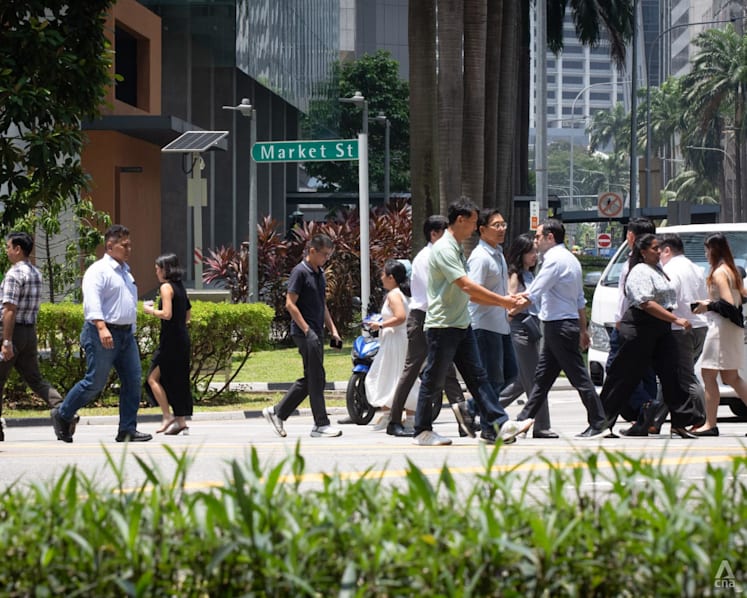
With displaced workers taking longer to secure new employment, Ms Lau said the government is reviewing how to better support them during their job search.
“If they're taking longer to come back in, then the natural answer must be: let's look at how to support them better when they are out,” she said.
However, she cautioned that financial assistance must be carefully calibrated to avoid discouraging people from returning to work.
“We have to be careful. There’re many countries around the world that provide generous support, and there are behaviours that it then induces. People start to feel that maybe it's okay (to) stay out for a while more,” she said.
“So, in Singapore, we still feel very strongly (that) whatever we put in place must incentivise them to search for a good job that they can take up as soon as possible. Nothing beats having a job that they can contribute to.”
The Ministry of Manpower (MOM) is also assessing whether retrenchment benefits should be made mandatory as part of an ongoing tripartite Employment Act review, while seeking to avoid overly restrictive rules for employers.
“For the firms that can pay benefits and don't, that's not acceptable. So there must be consequences, and we are working out what these ought to look like,” Ms Lau said, adding that possible measures could include restricting companies' access to foreign workers, as well as government grants and schemes.
“We're also looking at, for example, retrenchment notifications. How workers can find out a bit earlier because the earlier they receive help, the better the employment outcomes can be.”
LONGER TRAINING STINTS FOR FRESH GRADS
The government is also exploring a longer, more structured training programme to help fresh graduates gain meaningful work experience and ease their transition into the workforce.
The proportion of fresh graduates who secure employment within six months has slipped from about 19 in 20 several years ago to around 18 in 20 today.
While the decline is not particularly steep, Ms Lau acknowledged that young jobseekers face growing pressure over how quickly they secure employment, their starting salaries and the quality of their first jobs.
Existing initiatives such as the Graduate Industry Traineeships (GRIT) provide around three to six months of work experience. But Ms Lau said such stints may be too short to prepare participants for permanent roles.
“GRIT was meant for more of a downturn situation,” she said. "It's very hard to train up a full-time permanent staff with just three months. You have to take them in and give them real responsibilities, and then after about a year or so, know that they can fit quite well."