MANILA, Philippines – A year after Typhoon Tino devastated communities across Cebu, residents are still grappling with flooding, unsafe living conditions, and questions over flood-control efforts.
These concerns took center stage in the Padayon Cebu chat room on Muni in the Rappler app, where survivors shared stories, discussed conditions in affected communities, and highlighted activities that marked the first anniversary of Typhoon Tino on Wednesday, November 4.
Leading up to the anniversary, Cebuanos in the chat room initiated a discussion titled “Isang taon matapos ang Tino, kamusta na ang Cebu?” (How is Cebu a year after Typhoon Tino?). They reflected on the devastation of the disaster, and discussed the challenges that affected communities continue to face a year later.
Cebu-based Mover Jerome Valdez shared the story of Alma Quingco, 46, from Barangay Maslog, Danao City, who was on duty at the University of the Philippines Cebu when Tino struck. When she returned home, floodwaters had made their house inaccessible, and many of their belongings had been swept away.
“Despite the help, the experience left a lasting impact. Alma shared that there are still fears and trauma associated with what happened. Even now, the memory of how quickly the floodwaters rose remains with her,” Valdez shared in the chat room.
The discussion also brought attention to villages in Tambisan, where severe flooding continues even during ordinary rainfall, and families who remain without safe, permanent relocation a year after their homes were destroyed.
Violy Musngi of La Paloma Village, during Rappler’s #MoveCebu roadshow in October, recalled how residents were caught off guard by Typhoon Tino, with floodwaters reaching waist-deep levels in her area and rising above head level in Tambisan.
“We were surprised by the waist-deep flooding, which persisted even after Typhoon Tino. Residents in Tambisan are also suffering from leptospirosis. After Tino, there’s flooding after flooding. Even light rains now cause flooding almost immediately,” Musngi said during the forum.
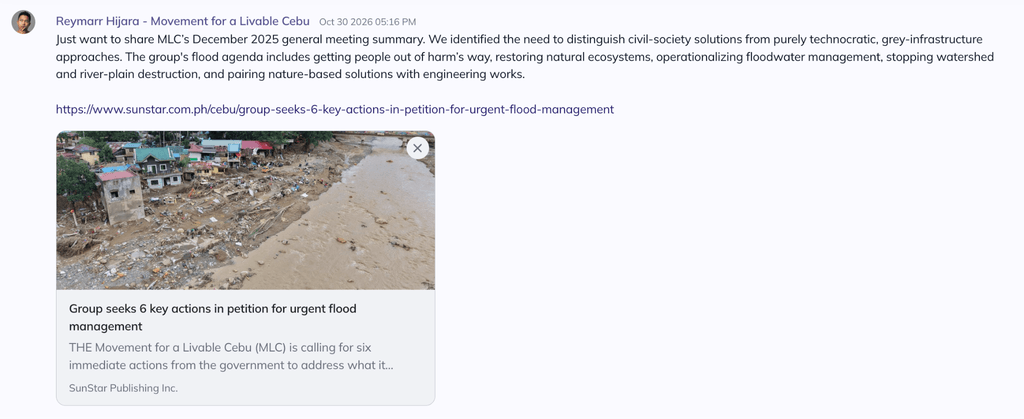
Reymarr Hijara of the Movement for a Livable Cebu (MLC) also joined the online discussion. MLC is a civic group in Cebu, advocating for safer and more sustainable flood management.
In November 2025, they proposed a petition for urgent flood-management measures, including the creation of a Cebu Floodwater Management Office, relocation of families from high-risk areas, protection of watersheds, and a review of flood-control structures. The group also called for no-build zones in areas inundated during Tino.
But even a year later, according to Hijara, implementing the six proposed flood-management actions remained largely unfinished or unverified a year after Tino.
The most concrete development, he said, was MLC’s invitation to join the Provincial Flood Control and Drainage Task Force, created under Executive Order 74 after the November 2025 flooding. However, Hijara stressed that the task force’s formation and MLC’s participation did not amount to implementation of the group’s proposed measures.
“A task force is not yet implementation,” Hijara said in the chat room.
The discussions in Padayon Cebu also highlighted two activities around the November 4 anniversary: a multi-stakeholder dialogue on flood-control accountability and a sustainability walk through downtown Cebu.
Commemoration through a community walkTo examine urban vulnerabilities, University of the Philippines (UP) Cebu’s College of Communication, Art, and Design (CCAD), together with participants from the University of the Philippines Open University and Japan’s Meiji University, held a walk through downtown Cebu.
The guided walk passed through areas including San Nicolas, Pasil, Taboan, Carbon Market, Plaza Independencia, and Colon, examining Cebu’s built environment, public spaces, transportation systems, and cultural heritage.
Dean Crina Tanongon of UP Cebu’s CCAD said Typhoon Tino’s severe flooding served as a point of reflection during the walk, as participants considered how cities can adapt to flooding and extreme heat while preserving their cultural identity.
“We chose a guided walk because remembering is not merely a cognitive exercise. It is sensory and embodied,” Crina said.
According to an announcement by UP Cebu’s CCAD, Tino’s severe flooding served as a point of reflection as participants considered how cities can adapt to flooding and extreme heat while preserving their cultural identity.
The walk also drew comparisons between climate adaptation approaches in the Philippines and Japan, including lessons Cebu could apply to building safer and more livable communities.
Dialogue raises concerns over relocation, flood-control accountabilityAside from a community walk, various groups also organized a dialogue to discuss the pressing concerns among survivors.
The dialogue titled, “Kahinumdom pa mo namo? (Do you still remember us?) A Multi-Stakeholder Dialogue on Flood Control Accountability and the Continuing Concerns on Typhoon Tino Survivors,” was organized by Sugbuanong Pakigbisog Kontra Kurapsyon (SuPaKK) in collaboration with partner organizations.
During the dialogue, John Roy Rigodon of the Sectoral Transparency Alliance on Natural Resource Governance (STANCe) shared findings from visits to communities along major rivers in Cebu, including the Kinalawan River in Toledo City and the Cotcot River in Liloan and Compostela, where he examined the situation of residents living in flood-prone areas a year after Tino.
According to Rigodon, the communities continue to face concerns over their safety when typhoons hit. This includes being at risk to flooding and lack of safe and permanent relocation.
“Will they be safe in the next typhoon?” he asked, pointing to relocation as a major concern among residents.
The dialogue also raised questions about flood-control spending. Organizers cited P17.4 billion in major river flood-control projects from 2016 to 2025, including P11.1 billion for the Butuanon River, and called for transparency and accountability. These figures were also reported in a SunStar Cebu investigation on how Tino’s floods exposed how flood control projects failed in Cebu.
Moreover, Norika Ishikawa of the Cebu Anti-Corruption Coalition and Center for Emergency Aid, Rehabilitation and Development Inc.(CONCERN) questioned how the government would lead rehabilitation efforts for Tino-affected communities amid reported cuts to disaster rehabilitation and housing funds for 2027.
She said recovery must go beyond providing houses, calling for safe and affordable housing with access to livelihoods, utilities, roads, hospitals, and schools.
“Disaster rehabilitation is not an expense. Building back better is a public investment,” Ishikawa said.
Ishikawa said the next steps identified during the dialogue include formulating a relocation agenda with Tino-affected informal settler families and mobilizing for an accountability action on November 30.
“Nakakalungkot ang sharing, nakakagalit ang inaction, but hopeful pa rin (The sharing is saddening, the inaction is infuriating, but there is still hope),” she said.
Typhoon Tino caused widespread devastation in Cebu, affecting nearly 2 million people, displacing over 636,000, and resulting in 96 confirmed deaths with many still missing. It also damaged approximately 262,000 homes (over 24,000 totally destroyed), leaving affected communities struggling to recover a year later.
A year after Tino, affected communities still continue to call for safe relocation, transparent flood-control spending, and rehabilitation that addresses their long-term needs. – Rappler.com