The DA has strengthened its position in the Western Cape, retaining Cape Town with 56.42% of the vote and securing outright majorities in nine municipalities. However, 16 councils remain hung, leaving coalition negotiations ahead.
The Democratic Alliance has strengthened its position in the Western Cape, securing outright majorities in nine municipalities and emerging as the leading party in 21, while 16 councils remain without a clear winner and face coalition negotiations.
The party retained the City of Cape Town with 56.42% of the vote, exceeding its own expectations, while making gains in historically contested areas, including Khayelitsha and Gugulethu.
The results mirror the broad picture of the November 2021 local government elections, with the DA retaining its established strongholds while smaller parties and opposition formations remain important to determining who governs several municipalities.
The nine municipalities where the DA secured outright majorities are Cape Town, Bergrivier, Drakenstein, Hessequa, Mossel Bay, Overstrand, Stellenbosch, Swartland and George.
DA Western Cape leader Tertuis Simmers said the elections marked an important moment for the party, which retained municipalities, reclaimed wards from opposition parties and made inroads into communities where it had traditionally struggled.
The City of Cape Town was the only metropolitan municipality nationally to produce an outright winner, with the DA securing 56.42% of the vote, exceeding the 51% it had anticipated based on its internal polling.
The party also emerged as the leading party in six other metros, while the uMkhonto weSizwe Party (MKP) is expected to be the biggest party in eThekwini.
“This is a resounding endorsement,” said Simmers.
The DA also won a ward from the Patriotic Alliance (PA) in Cape Town and increased its support in townships such as Khayelitsha and Gugulethu.
Simmers said the party secured 50.3% of the vote in George, giving it an outright majority and ending years of coalition government.
In Oudtshoorn, the DA increased its council seats from seven to 10, growing its support from 30% in 2021 to 37.7%.
In Knysna, where no party secured a majority, the DA increased its support from 35.4% to 44.4%, emerging as the biggest party in the council.
The party's support in Ward 98 in Khayelitsha increased from 255 votes in 2021 to 1 919 in the latest election.
ANC acknowledges disappointing Western Cape performance
It is back to the drawing board for the provincial ANC, which has been in decline over the past 20 years.
“We are disappointed at the results,” said provincial ANC spokesperson Sifiso Mtsweni.
“But we accept the outcomes as the will of the people.”
Mtsweni said the party leadership was scheduled to meet to reflect on its performance.
He identified voter turnout as one of the factors affecting the ANC, acknowledging that although the party retained most of its wards in Cape Town, it did so by narrow margins, while the DA won its wards with bigger margins.
He attributed this to higher turnout among DA voters.
“There's no groundswell of support for the DA. We must not put it as if there is a groundswell of support for the DA in black wards. It's only one ward, where they increased substantially and in that ward, we had problems, even with our previous councillor.”
Mtsweni reiterated the party's position that the DA was failing to deliver basic services in poor communities, citing findings by the Public Protector and the courts.
Outside Cape Town, the ANC will engage other parties to determine how best to govern municipalities and prevent the DA from taking control, either outright or through coalition negotiations.
The party hopes to retain governance in Knysna, Oudtshoorn, Saldanha, Swellendam, Cederberg, Matzikama, Central Karoo, Laingsburg and Prince Albert through coalition arrangements.
ANC remains largest party nationally as 127 councils hang
Addressing the official declaration of the election results in Midrand, Electoral Commission chairperson Mosotho Moepya confirmed that the ANC remained the country's largest party nationally, receiving 30.89% of the vote and securing 3 164 council seats.
The DA received 24.60% of the vote and 1 527 seats, followed by the MKP with 9.61% and 701 seats.
The EFF secured 6.25% and 505 seats, while ActionSA received 5.68% and 219 seats.
Other political parties and independent candidates collectively accounted for 22.97% of the vote, securing representation across municipal councils. Spoilt votes accounted for 1.84%.
On municipal outcomes, the ANC achieved outright control in 51 municipalities and emerged as the leading party in 120.
The DA secured outright control in 12 municipalities and was the leading party in 29. The Inkatha Freedom Party (IFP) achieved outright control in five municipalities and led in 19, while the MKP secured outright control in three municipalities and led in 18.
The loudest applause was reserved for Rise Tsantsabane Communities, a local political movement in Postmasburg in the Northern Cape, which secured outright control of Tsantsabane Local Municipality.
Moepya said 72 of the country's 213 municipalities had a party that secured an outright majority of seats, while 127 councils were hung, with no party obtaining more than 50% of the seats.
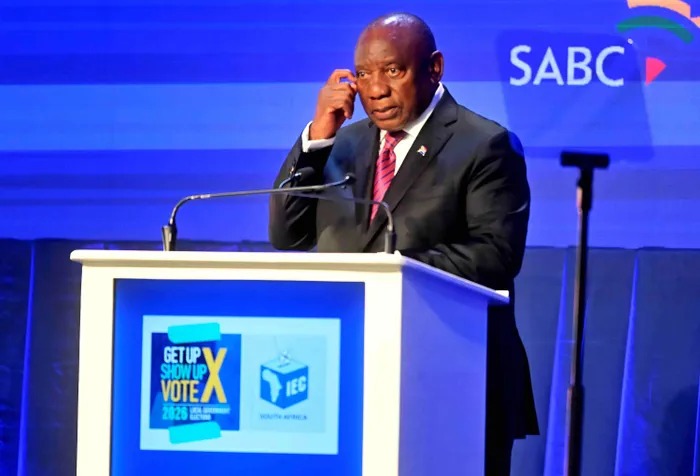
President Cyril Ramaphosa urged newly elected councillors to prioritise residents' interests over political ambitions, saying their election carried the responsibility of improving people's daily lives.
“Your responsibility is not simply to occupy a seat in a council chamber. It is to serve the communities that have placed their trust in you,” he said.
He also cautioned political parties against allowing coalition disagreements to undermine service delivery.
“The stability of our municipalities cannot be sacrificed to narrow political interests. The delivery of essential services cannot be held hostage by political disagreements,” Ramaphosa said.
Director of the School of Public Leadership at Stellenbosch University, Professor Zwelinzima Ndevu, said the results showed the DA had consolidated its power base through a message that mobilised its traditional supporters.
“The message from them was ‘we’ve made some progress, and there are still challenges, but if you don't want to disrupt this progress, help us stop the ANC and the EFF from taking over the city’,” he said.
Ndevu said internal ANC disputes, particularly around candidate selection, could have contributed to disgruntled supporters voting for the opposition.
He also suggested that voters were increasingly prioritising service delivery over political identity, saying a candidate's popularity alone was no longer enough to secure election.
Local governance expert Dr Harlan Cloete said the DA had surprised itself with its performance in Cape Town, crediting its campaign strategy and clear messaging.
He said the party's campaign posters had gone up first and would also be among the first to come down.